Setting Up Utilities in Your Singapore Home

Open one utilities account with SP Group for electricity, water and gas; foreigners with a valid pass aged 18 and above can apply online. A security deposit is added to your first bill, and you can later switch to a retailer or stay on SP's regulated tariff.
On this page9 sections · tap to jump
- 01One account with SP Group first
- 02How to open your account
- 03The security deposit
- 04Turning on electricity, water and gas
- 05Electricity: SP tariff or a retailer (Open Electricity Market)
- 06What you pay for water
- 07Reading meters, bills and paying
- 08Closing the account when you move out
- 09Frequently asked questions
Getting the lights and water on is one of the first jobs after you collect the keys. In Singapore it runs through one body — SP Group — no matter whether you rent or own, and no matter which electricity company you eventually buy from. This guide walks a newcomer through opening the account, the deposit you will pay, turning on supply, choosing an electricity plan and closing the account when you leave. Line it up alongside the other move-in steps in our renting in Singapore guide.
One account with SP Group first
SP Group runs the national meter and billing service, so every home needs an SP utilities account for electricity, water and gas. This is true even if you later buy electricity from a separate retailer: regardless of whether you sign up with a retailer or SP, you still have to open a utilities account with SP first. Think of SP as the meter-and-bill backbone; the retailer, if you choose one, only supplies the electrons.
Who can open one? Only Singaporeans, PRs and foreigners with a valid pass aged 18 and above can apply — so an Employment Pass, S Pass, Dependant’s Pass or similar, plus your proof of tenancy, is enough.
How to open your account
You can apply through the SP app, the Open Utilities Account portal on SP’s website, or at an SP Customer Service Centre. Have ready:
- your NRIC, FIN card, valid pass or passport;
- proof of ownership or tenancy (your stamped tenancy agreement works), which SP may ask for.
Using Singpass/MyInfo during the application auto-fills your details and speeds things up. You will get an SMS confirming receipt, then an email and letter confirming your supply turn-on date.
The security deposit
SP charges a security deposit, and it is simply added to your first utilities bill rather than paid separately up front. The amount depends on your home type and your residency status — foreigners pay more than citizens and PRs.
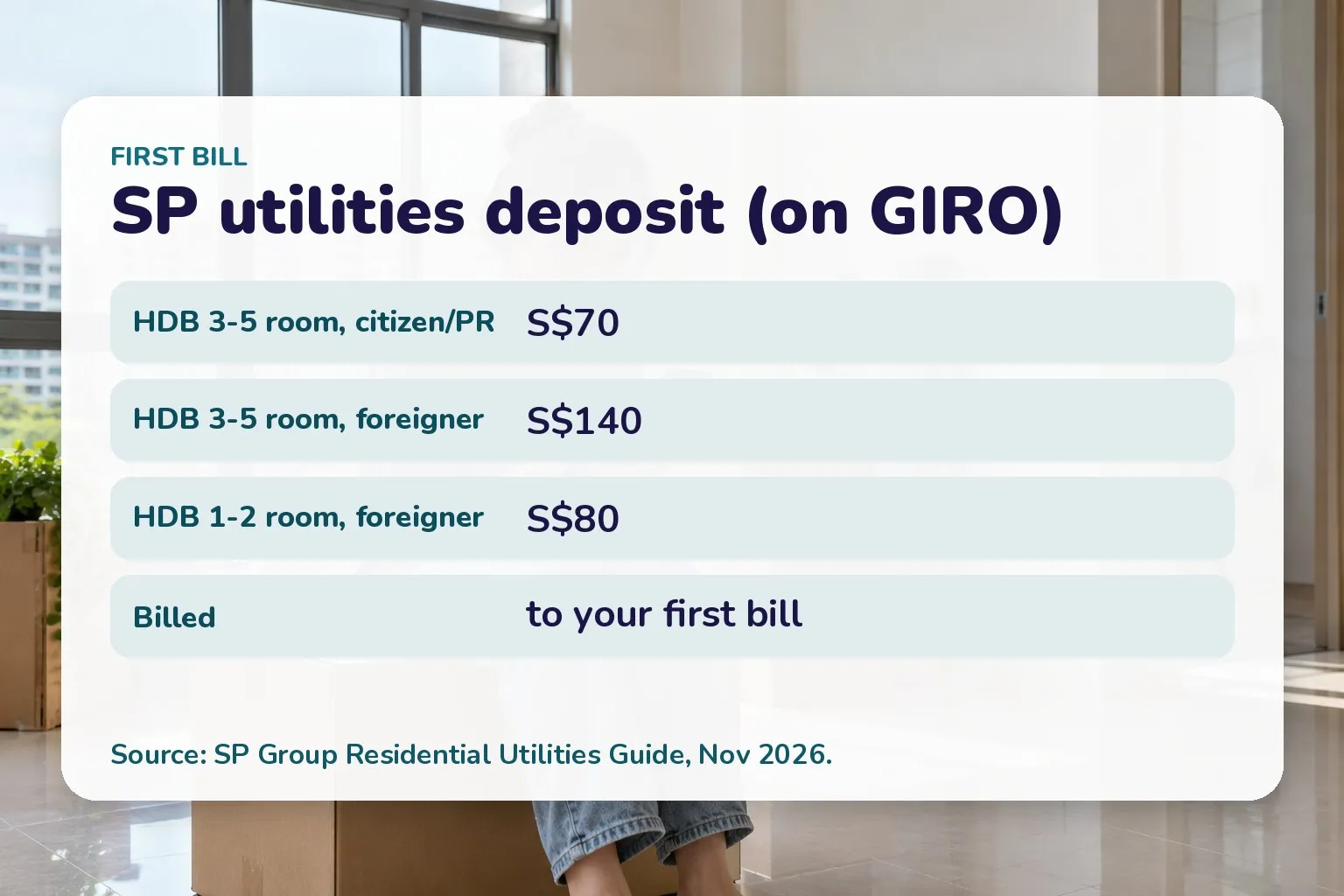
What SP holds as a utilities deposit, billed to your first bill.
For a sense of scale, on GIRO a citizen or PR renting a 3- to 5-room HDB flat pays about S$70, while a foreigner pays about S$140 for the same flat; a 1- or 2-room flat is S$80 for a foreigner, and condominiums and landed homes are higher. Signing up for GIRO lowers the deposit versus non-GIRO (for example S$140 on GIRO rising to S$200 without it for that 3- to 5-room flat). The deposit is refundable when you close the account.
Turning on electricity, water and gas
How supply is switched on depends on the property:
- New HDB BTO flats: no appointment is needed — electricity and water are turned on without a visit.
- Resale HDB flats and other residential properties (including condos and landed homes): an on-site safety inspection is done before electricity and water are turned on, and you or a representative must be present.
- Gas: this is the one piece SP does not switch on itself. Gas activation is managed separately by City Energy. Once your SP account is confirmed, call City Energy on 1800 555 1661 to book a gas turn-on appointment.
Electricity: SP tariff or a retailer (Open Electricity Market)
For electricity you have a genuine choice under the Open Electricity Market (OEM), an Energy Market Authority initiative. You can buy electricity from:
- SP Group at the regulated tariff — the default; no action needed;
- an electricity retailer on a price plan; or
- the wholesale market through SP (for the price-savvy).
Crucially, it is not compulsory to switch to a retailer, and there is no deadline to do so. You can stay on SP’s regulated tariff indefinitely. And whoever you buy from, your supply stays exactly the same, because SP continues to operate the national grid and deliver the electricity.
If you do switch, retailers offer 3 standard price plans — a fixed price, a discount off the regulated tariff, or peak/off-peak rates. The regulated electricity (and town gas) tariff itself is reviewed quarterly to track fuel costs, so a fixed-price plan trades the quarterly ups and downs for certainty. Compare plans on the EMA price-comparison tool before committing, and your chosen retailer works directly with SP to make the switch — you keep the same meter and the same supply.
What you pay for water
Water is billed by SP on the same account and supplied by PUB, the national water agency. The price has three parts — the Water Tariff, the Water Conservation Tax and the Waterborne Tax — all charged per cubic metre of water used.
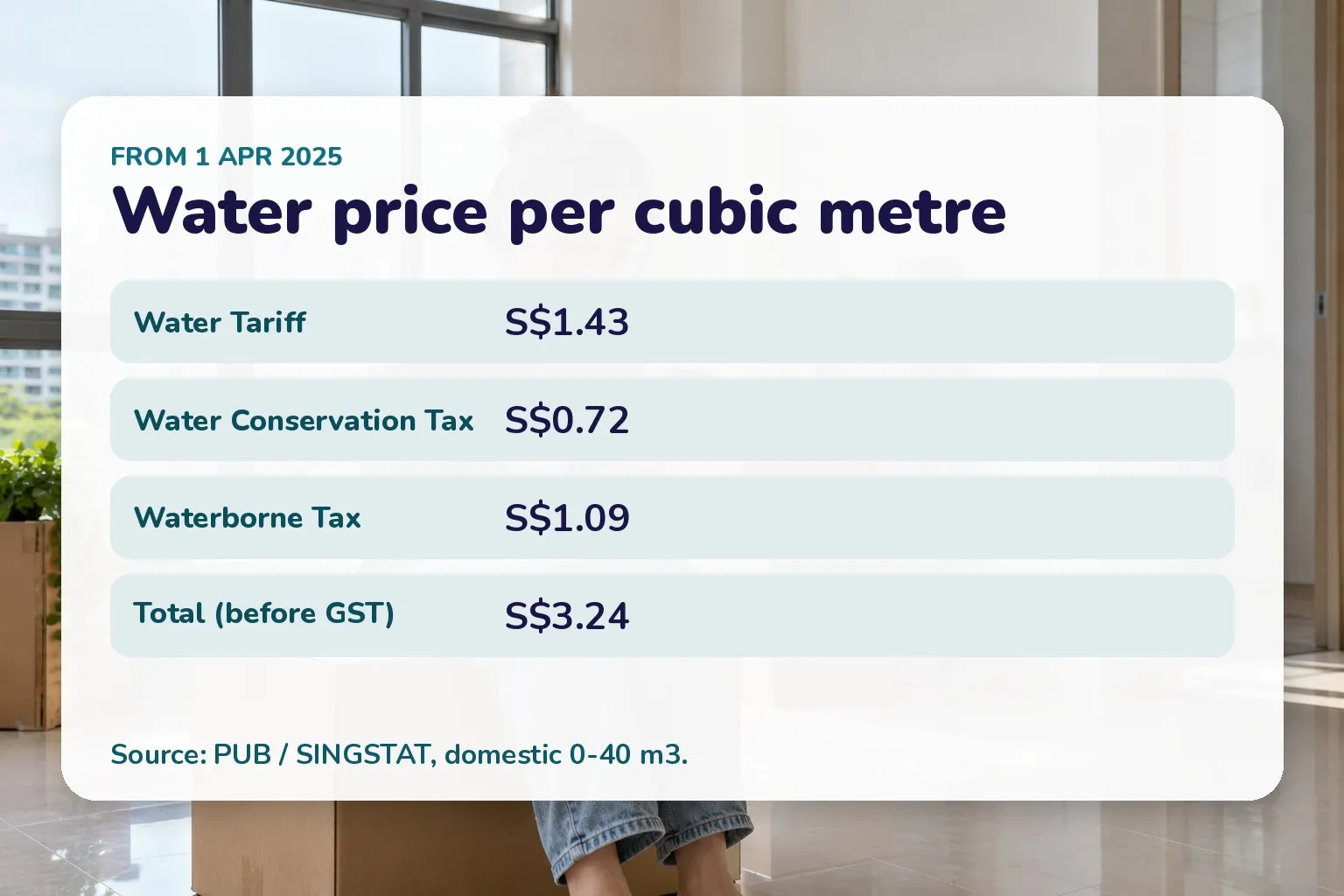
The three parts of the S$3.24/m3 domestic water price (0-40 m3).
For a household using up to 40 cubic metres a month, the potable water price is S$3.24 per cubic metre before GST (from 1 April 2025): a tariff of S$1.43, Water Conservation Tax of S$0.72 and Waterborne Tax of S$1.09. That price rose by 50 cents per cubic metre in two phases — 20 cents from 1 April 2024 and a further 30 cents from 1 April 2025 — so budget a little more than older guides suggest.
Reading meters, bills and paying
SP reads your meters once every two months and estimates usage in the months between, adjusting at the next actual read. You can submit your own reading for a bill based on actual use. Pay by GIRO (the most convenient), the SP app, PayNow, internet banking or AXS.
Closing the account when you move out
When you leave, close the account through the SP app, the portal or a Customer Service Centre. Your security deposit is used to offset the final bill, and any credit balance is refunded to your GIRO account or mailed by cheque within about four to six weeks. If you buy from a retailer, contact them to close the electricity side; a gas termination fee applies via City Energy. One quirk: if a new occupant opens an account for the same address, your account is closed automatically. Settle the final bill cleanly so there is no outstanding charge dragging into a deposit dispute with your landlord.
Frequently asked questions
Do I need to choose an electricity retailer straight away? No. Staying on SP’s regulated tariff needs no action, and there is no deadline to switch. You can move to a retailer later, or never.
Will switching retailer cut off my power during the change? No. SP operates the grid and delivers the electricity regardless of who you buy from, so your supply is uninterrupted when a retailer takes over.
Is the utilities deposit the same as my rental deposit? No — they are separate. The utilities deposit goes to SP and is refunded when you close the account; the rental deposit is held by your landlord under the tenancy agreement.
Can I set everything up before I arrive in Singapore? You can apply online once you have a valid pass and proof of tenancy, but the safety inspection for a resale or private home needs you (or a representative) on site, so plan the turn-on around your move-in.
Related
With the utilities sorted, the usual next steps are opening a bank account and getting a SIM card. If you are still deciding on a home, compare renting an HDB flat versus a condo.
General information only, from SP Group, the Energy Market Authority and PUB, with the date each figure was checked. Utilities tariffs and deposits change; confirm the current figures on the official source for your own home.
Sources
- Utilities Quick Guide (Residential) — SP Group (as of November 2026)
- Residential Utilities Guide (security deposit, turn-on, closing) — SP Group (as of November 2026)
- What is the Open Electricity Market (OEM)? — Energy Market Authority (as of November 2026)
- Higher Electricity & Town Gas Tariffs for July-September 2026 — Energy Market Authority (as of November 2026)
- Water Price to rise from April 2024 (phased potable water price) — PUB, Singapore's National Water Agency (as of November 2026)