Renting HDB vs Condo as an Expat
For most expats a private condo or apartment is the easier rent — a three-month minimum stay versus six months for HDB, and no citizenship quota. An HDB flat wins on budget and space, provided the owner is an eligible citizen and the block's non-citizen quota is still open.
On this page9 sections · tap to jump
Newcomers deciding where to live quickly hit the big fork: rent a private condominium or apartment, or an HDB flat — Singapore’s public housing, where the great majority of residents live. The two are governed by different agencies and different rules, and those rules, not just the rent, often decide which you can actually take. This guide compares them for a renter and names a pick. For the end-to-end process that applies to both, read our renting in Singapore guide.
Both are open to you, with different rules
You can rent either as a foreigner — a private unit or an HDB flat (whole or a room). Private condos and apartments are regulated by the Urban Redevelopment Authority (URA); HDB flats carry the Housing & Development Board’s extra rules on top. The table sums up what differs; the sections below explain each line.
| Feature | Private condo / apartment | HDB whole flat |
|---|---|---|
| Minimum stay | 3 consecutive months | 6 months per application |
| Maximum lease | Set by the tenancy agreement | 2 years (non-Malaysian non-citizen); 3 years (SC/Malaysian) |
| Citizenship quota | None | Non-citizen quota: 8% neighbourhood, 11% block |
| Who may rent it to you | Any owner, following URA rules | Singapore-citizen owner past the 5-year MOP (Standard flats only) |
| Occupancy cap | 6 unrelated persons (8 if 90sqm+ and registered) | 4 to 8 by flat size |
| Facilities | Pool, gym, security usually included | None; paid lifts/estate upkeep via town council |
| Approval to rent | None specific to the let | Prior written HDB approval |
Minimum stay: 3 months vs 6 months
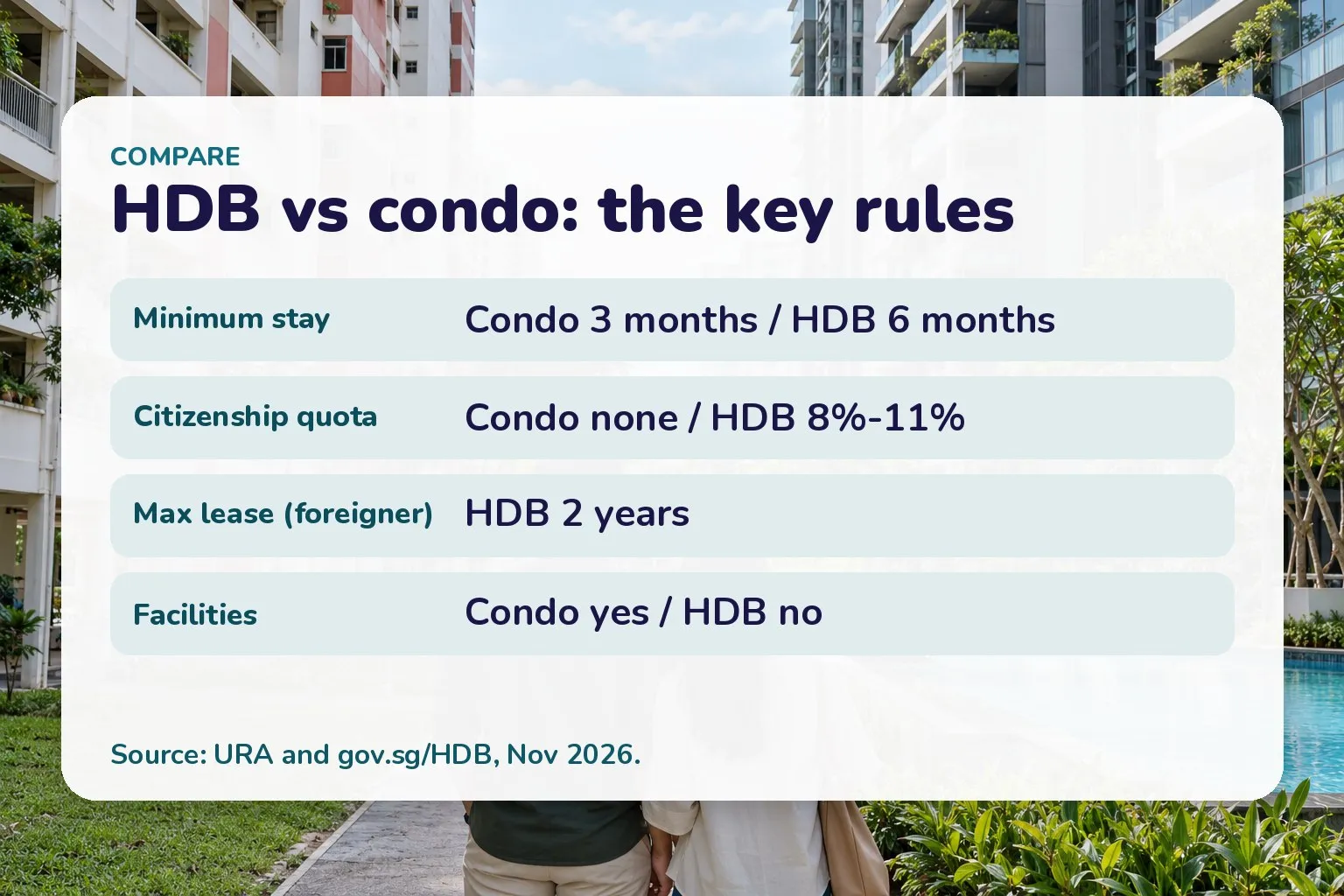
This is the rule that most often settles a short posting. For a private home, all occupants must fulfil a minimum stay of three consecutive months, and renting it out as short-term accommodation (daily or weekly) is not allowed. For an HDB flat, the minimum renting-out period is six months per application, and short-term letting is likewise barred.
The rules that most often decide HDB versus condo.
So if your assignment is, say, four or five months, an HDB flat is off the table and a private unit is your only compliant option. Neither type allows nightly or weekly stays — those are illegal, and a budget “serviced” private rental under three months is a planning offence for the owner.
The HDB non-citizen quota can block you
A quota unique to public housing can stop you renting an HDB flat even when a willing landlord has one. The Non-Citizen (NC) Quota is set at 8% at neighbourhood level and 11% at block level, and it applies to Permanent Residents and foreigners (but not Malaysians). When the quota in a block or neighbourhood is reached, owners there can only rent to Singaporeans and Malaysians — so a non-Malaysian foreigner simply cannot take a whole flat in that area, regardless of budget.
Private condos and apartments have no citizenship quota at all: URA’s rules set a minimum stay and an occupancy cap, but nothing about the tenant’s nationality. If you have your heart set on a specific mature estate where HDB demand is high, the quota is a real risk — and a reason many expats default to private.
Who can legally rent to you
For an HDB whole flat, the owner’s status matters. Only a Singapore citizen may rent out a whole HDB flat; Permanent Residents cannot, however long they have owned it. Only Standard flats qualify — newer Plus and Prime flats cannot be sublet whole — and the owner must have cleared the five-year Minimum Occupation Period. Whole-flat rental also needs prior written HDB approval. A private landlord faces none of these status gates; any owner can let, following URA’s rules.
This is why a good, CEA-registered agent checks the HDB owner’s eligibility and the block’s quota before you commit — and why private lettings tend to close faster.
How long you can stay
An HDB whole-flat lease is capped: up to three years per application if all tenants are Singaporeans or Malaysians, but only two years if any tenant is a non-Malaysian non-citizen — which is most expat households. You renew by re-applying, subject to the quota at that time. A private lease length is set by your tenancy agreement (one or two years is the norm) with no citizenship-based cap, so a longer stay is simpler to lock in.
Occupancy caps
Both types limit how many people may live in the home. A private property under 90sqm caps at six unrelated persons; from 22 January 2024 until 31 December 2028 that is temporarily raised to eight for homes of at least 90sqm, if the owner registers and pays a S$20 fee. Domestic helpers count as part of the family unit, not against the cap. An HDB flat caps at four persons for 1- and 2-room, six for 3-room, and eight for 4-room and larger (the “eight” is a temporary relaxation until 31 December 2026, after which it reverts to six). Sharing with flatmates? Check the cap before you sign.
What the rent includes
Beyond the rules, the packages differ. A condo rent usually bundles in the facilities and building maintenance — pool, gym, security, landscaped grounds — because the development’s maintenance fund is the owner’s cost, not yours. An HDB flat is typically cheaper for the same floor area but comes plain: no pool or gym, and estate upkeep runs through the town council’s charges, which the owner pays. There is no official “typical” rent to quote — levels move every quarter and vary by area — so compare the total value: rent, what is included, location and travel time, not just the headline figure. Your utilities are the same either way; see setting up utilities.
Who should pick which
- Pick a private condo or apartment if your posting is under six months (but at least three), you want facilities and security, you need certainty you can rent in your chosen area, or the local HDB quota is full. It is the overall pick for most expats.
- Pick an HDB flat if you want the most space and the lowest rent for a longer stay, you are relaxed about amenities, and you have found a citizen owner in a block with quota to spare. It is the value runner-up.
- Do not pick a condo purely to save money — on a like-for-like floor area an HDB flat is usually cheaper.
- Do not pick an HDB whole flat if you need a lease shorter than six months, you want it in a quota-full neighbourhood, or you are set on resort-style facilities.
Frequently asked questions
Can I rent just a room instead of a whole flat? Yes. HDB bedrooms in 3-room-or-larger flats can be rented out — PRs and foreigners included — and the non-citizen quota does not apply to rooms, so a room is a good budget route where whole flats are blocked.
Do private condos have a non-citizen quota? No. Private properties have an occupancy cap and a three-month minimum stay, but no citizenship quota.
Is a condo always more expensive than an HDB flat? Usually, for the same area, because the rent reflects the facilities and maintenance. But location and unit size swing it, so compare the total package rather than assume.
Does my work pass need to be valid for a minimum period? Yes — for an HDB rental your pass must have at least six months’ validity at the date of application, and a CEA agent must check and copy it for any foreign tenant.
Related
Start with the full renting in Singapore guide for the step-by-step process, read up on the tenancy agreement and stamp duty, and plan ahead for getting your rental deposit back when the lease ends.
General information only, from URA, HDB, gov.sg and CEA, with the date each rule was checked. We are not a property agency and do not represent landlords or tenants. Confirm the current rules on the official source for your own case.
Sources
- Renting Property (minimum stay, occupancy cap) — Urban Redevelopment Authority (as of November 2026)
- Renting out your HDB flat: A homeowner's guide — gov.sg (as of November 2026)
- Regulations for Renting Out a Flat — Housing & Development Board (as of November 2026)
- Eligibility to Rent Out a Flat (occupancy, pass validity) — Housing & Development Board (as of November 2026)
- Renting or renting out (agent checks on foreign tenants) — Council for Estate Agencies (as of November 2026)