Tenancy Agreement and Stamp Duty in Singapore

A tenancy agreement sets your rent, term, deposit and repair duties. You then pay IRAS lease stamp duty of 0.4% of the total rent, within 14 days of signing in Singapore. Under most agreements the tenant pays it.
On this page9 sections · tap to jump
Signing a lease in Singapore is quick, but two documents decide whether it protects you: the tenancy agreement that sets the terms, and the Stamp Certificate that proves you paid lease stamp duty to the Inland Revenue Authority of Singapore (IRAS). This guide stays on those two — what the agreement should contain, exactly how the duty is worked out, when to pay it and what happens if you are late. For the wider rental process, deposits and the HDB rules, see our newcomer’s guide to renting in Singapore.
What a tenancy agreement covers
A tenancy agreement (TA) is the binding contract between you and the landlord. Before it is signed you usually submit a Letter of Intent (LOI) with a good-faith deposit and your requests (furnishing, repairs, move-in date); that deposit is normally counted toward the security deposit or first month’s rent once the TA is signed.
The TA itself should spell out, at a minimum:
- the monthly rent, the lease term (one or two years is typical) and the security deposit;
- who pays for repairs, often with a minor-repair cap per item that the tenant bears and larger items left to the landlord;
- any diplomatic or break clause, and the minimum stay before it can be used;
- an inventory of furniture and fittings, and the condition at handover.
You do not have to draft this from scratch. The Council for Estate Agencies (CEA) publishes tenancy agreement templates for both HDB and private homes that you can negotiate and adapt. Read every clause before you sign — once stamped, the TA is the document a court will look at.
Lease stamp duty: what it is and who pays
Stamp duty is payable on documents relating to leases of property in Singapore, and the Stamp Certificate IRAS issues is the proof your TA has been duly stamped. The duty is charged on the contractual rent or the market rent, whichever is higher, at the lease duty rates.
The law does not fix who must pay — it is a term of your agreement. In practice the TA makes the tenant liable for the lease stamp duty, so budget for it as an upfront cost alongside the deposit and first month’s rent. Confirm the clause in your own agreement rather than assume.
How lease duty is calculated
The rate depends on the length of the lease:
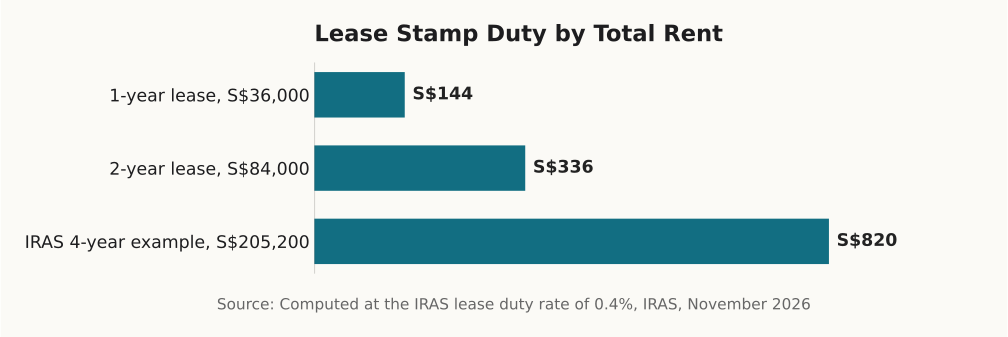
Lease stamp duty rises in step with total rent at the flat 0.4% rate (illustrative).
| Average annual rent (AAR) | Lease duty |
|---|---|
| AAR S$1,000 or less | Exempt |
| Lease of 4 years or less | 0.4% of the total rent for the whole lease |
| Lease over 4 years, or indefinite | 0.4% of 4 times the AAR |
The duty is rounded down to the nearest dollar, subject to a minimum of S$1. Crucially, the “rent” used here is not just the headline figure: the AAR takes the higher of the average annual contractual or market rent and includes advertising and promotion, furniture and fittings, maintenance and service charges written into the lease — but excludes GST.
For a lease longer than four years, you first find the average annual rent, multiply by four and then take 0.4%. In IRAS’s example a five-year lease with a total rent of S$151,200 has an AAR of S$30,240; four times that is S$120,960, and 0.4% gives S$483 after rounding.
Deadlines and how to stamp
You are meant to stamp a document before you sign it. In practice people stamp just after signing, and no penalty is charged if you keep to the deadline:
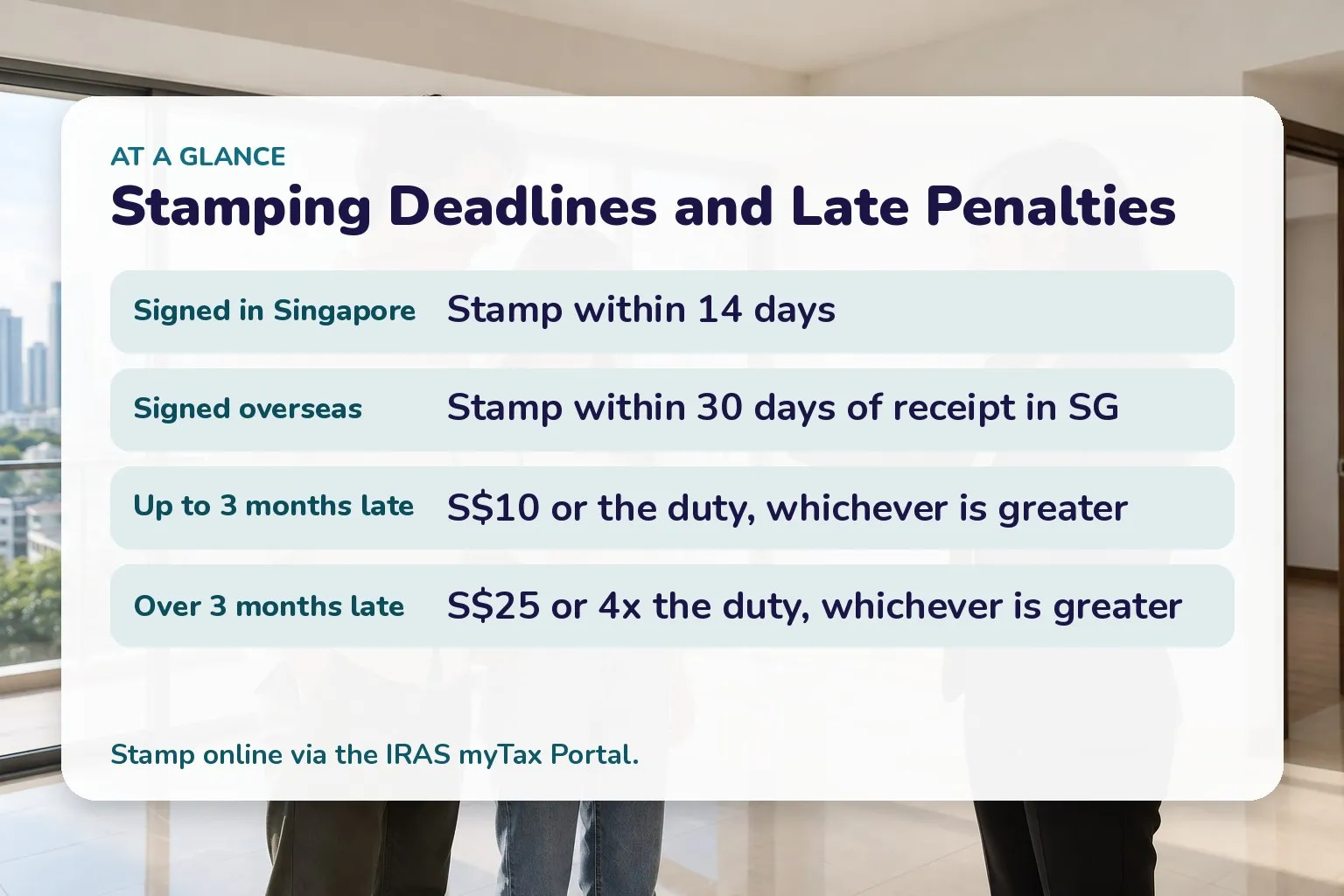
When to stamp, and what late payment costs.
- 14 days after signing if the document is signed in Singapore; or
- 30 days after you receive it in Singapore if it was signed overseas.
Stamping is done online through IRAS’s myTax Portal (Stamp Duty Login), where you pay and download the Stamp Certificate.
If you stamp late
Miss the deadline and the Stamp Duties Act sets the penalty:
- paid within three months of the due date — S$10 or the amount owed, whichever is greater;
- paid more than three months late — S$25 or four times the amount owed, whichever is greater.
On a small lease that can dwarf the duty itself, so stamp promptly.
Renewals, increases and variations
If you later vary the lease, duty depends on the direction of the change. An increase in rent or an extension of the term attracts duty on the increase or the extra period; a decrease in rent or a shortened term does not. Some changes are not dutiable at all — for example changing the permitted use with no extra payment, or simply adding an option to renew.
A lease with a premium (a lump-sum payment) is treated differently: the premium is charged at Buyer’s Stamp Duty rates, and any rent on top is charged at lease duty rates. If you take over someone else’s lease by novation or assignment, or the landlord pays you to surrender it early, duty is charged on the consideration at Buyer’s Stamp Duty rates. These situations are worth a quick check with your conveyancing lawyer.
Why the Stamp Certificate matters
The Stamp Certificate is not just a receipt. An unstamped tenancy agreement cannot be admitted as evidence in a Singapore court, so if you end up in a dispute over your deposit or an early termination, an unstamped TA cannot protect you. Keep the certificate with your copy of the signed agreement.
Frequently asked questions
Is a very cheap room exempt? Yes — if the average annual rent is S$1,000 or less, the lease is exempt from stamp duty.
I signed my lease while still overseas. When must I stamp it? Within 30 days of the document being received in Singapore, rather than the usual 14 days.
Does the rent for stamping include the maintenance fee? Yes. Maintenance, service, furniture and fittings and similar charges in the lease are included; only GST is excluded.
Do I pay stamp duty again when I renew? Only on the increase or the extended period. A straight renewal at a higher rent is stamped on the higher amount for the new term.
Where to go next
With the lease signed and stamped, the usual next steps are to open a bank account and get a SIM card. If you are weighing whether to keep renting or buy, see what it costs a non-resident in buying property as a foreigner.
General information only, from IRAS, CEA and the Stamp Duties Act, with the date each rule was checked. We are not a property agency or a tax adviser. Confirm the current rules on the official source for your own case.
Sources
- Renting a Property (lease duty rates and computation) — Inland Revenue Authority of Singapore (as of November 2026)
- When to Pay Stamp Duty — Inland Revenue Authority of Singapore (as of November 2026)
- Stamp Duties Act 1929, section 74 (late payment penalties) — Attorney-General's Chambers, Singapore (as of November 2026)
- Renting or renting out (CEA tenancy agreement templates) — Council for Estate Agencies (as of November 2026)