Renting in Singapore: A Newcomer's Guide

Renting runs on a tenancy agreement: agree the rent, term and deposit, then pay IRAS lease stamp duty of 0.4% of the total rent, usually within 14 days. Your agent must be CEA-registered, and you must hold a valid pass to rent.
Most newcomers rent before they consider buying. The process is quick by global standards — a lease can be agreed in days — but a few rules and costs catch people out. Here is the end-to-end picture, with the official references.
Before you can rent
To rent in Singapore you must hold a valid immigration or work pass. A property agent is required by the Council for Estate Agencies (CEA) to check and photocopy the passport and pass of foreign tenants and occupiers. For an HDB flat, your pass should have at least six months’ validity at the point of renting.
The steps in order
- Shortlist and view — decide on area, budget, size and lease length (one or two years is typical).
- Letter of Intent (LOI) — you submit an LOI with a good-faith deposit, listing your requests (furnishing, repairs, move-in date). The good-faith deposit is usually counted toward the security deposit or first month’s rent once the lease is signed.
- Tenancy agreement (TA) — the binding contract sets the rent, term, deposit, repair responsibilities and any diplomatic/break clause.
- Stamp the lease — pay IRAS lease stamp duty (below).
- Handover — collect keys, record the unit’s condition, take meter readings.
The money: deposit, commission and stamp duty
Security deposit. There is no law capping a rental deposit — it is a contract term. The settled market convention is one month’s rent per year of lease: one month for a one-year lease, two months for a two-year lease. It is returned, less agreed deductions, usually about two weeks after the lease ends.
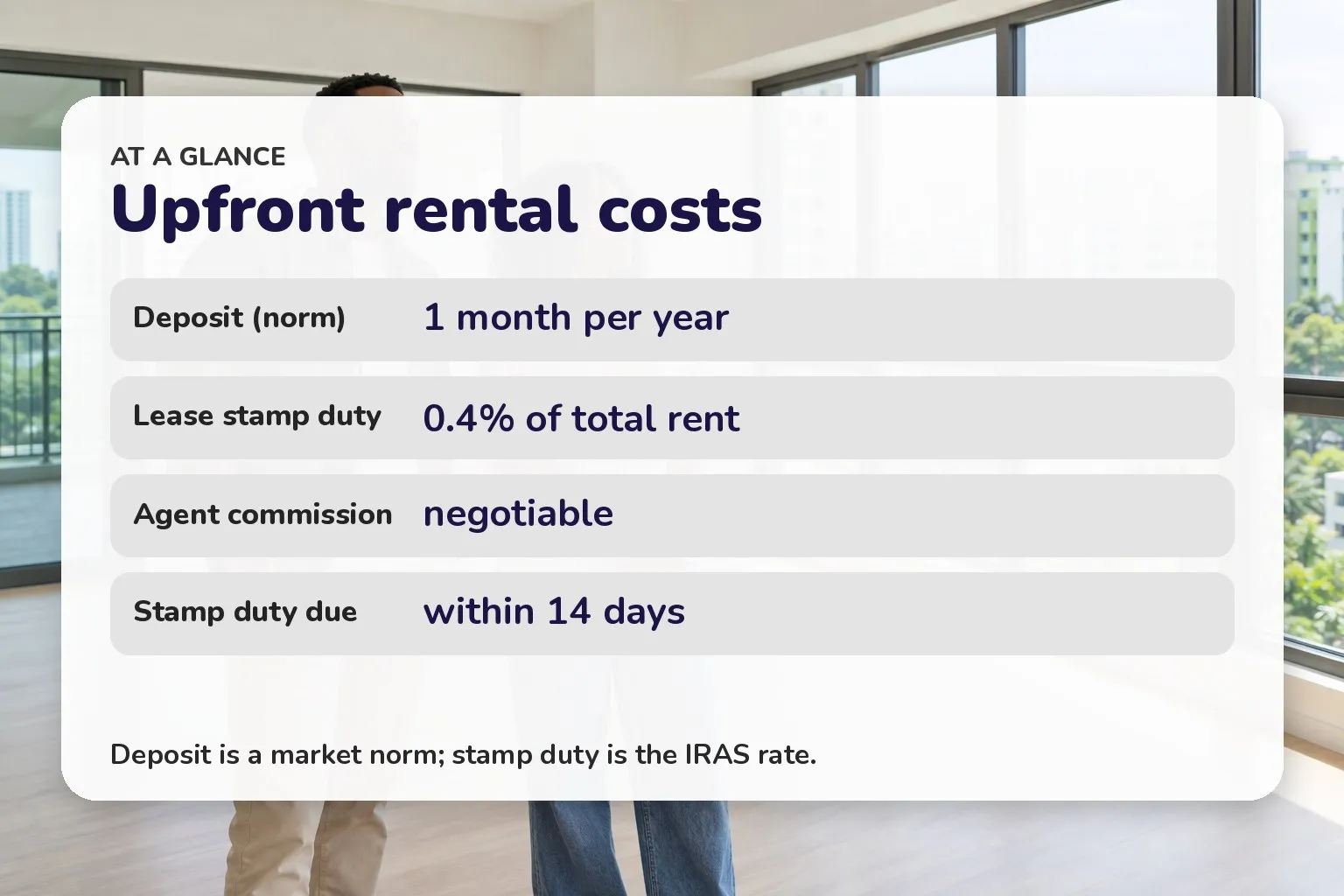
Typical upfront costs when renting in Singapore.
Agent commission. CEA sets no fixed commission rate — it is negotiable. In practice, for leases of a year or more the landlord usually pays the agent (commonly around half to one month’s rent) and the tenant pays none; short leases are different. Always confirm who pays what before signing.
Lease stamp duty. Payable to IRAS at 0.4% of the total rent for leases of up to four years (for longer leases, 0.4% of four times the average annual rent). The TA usually makes the tenant liable, and it is normally due within 14 days of signing.
Protecting yourself
- Document the condition at move-in with dated photos and an inventory — this is your best defence against disputed deductions.
- Read the repair clause: tenants often bear a minor-repair cap per item, with the landlord covering larger items and fair wear and tear.
- Check the break clause: many TAs set a minimum stay before a diplomatic/break clause can be used.
- Confirm the home may legally be rented — for an HDB flat, that it is an approved rental, not an unauthorised sublet.
HDB vs private, and the non-citizen quota
You can rent a private condo or apartment, or an HDB flat (or a room in one). Two things matter for HDB rentals: the owner must be approved by HDB to rent out the whole flat, and whole-flat rentals to non-citizens are subject to a Non-Citizen Quota that caps the share of foreign tenants in each block and neighbourhood to prevent enclaves. If a block has hit its quota, you cannot rent a whole flat there even if the owner is willing. A good agent checks the owner’s eligibility and the quota before you commit, and confirms your pass has at least six months left. Private properties have no such quota.
Where to go next
Once the lease is signed you can open a bank account, get a SIM card and set up transport. If children are moving with you, read how international and local schools differ.
General information only, from CEA and IRAS, with the date each rule was checked. We are not a property agency and do not represent landlords or tenants. Confirm the current rules on the official source for your own case.
Sources
- Renting or renting out (CEA rules for tenants and agents) — Council for Estate Agencies (as of October 2026)
- Renting a Property (lease stamp duty) — Inland Revenue Authority of Singapore (as of October 2026)