Opening a Bank Account in Singapore

Foreigners can open a Singapore bank account with a passport, a valid work or dependant pass and proof of a local address; some banks also ask for proof of income. Eligible SGD deposits are protected by SDIC up to S$100,000 per depositor per bank.
A local bank account makes everyday life in Singapore far easier — salary credits, PayNow transfers, GIRO bills and card payments all run through it. Opening one as a newcomer is straightforward if you bring the right documents. This guide explains how accounts work and what protects your money; it does not recommend a particular bank.
What you can open
Singapore has full banks, wholesale banks and digital banks, all regulated by the Monetary Authority of Singapore (MAS). For a newcomer, the practical choice is usually a savings or current account at a full bank, which gives you a debit card, local transfers (PayNow/FAST) and GIRO for recurring bills.
Documents you will usually need
Requirements vary by bank, but most ask for:
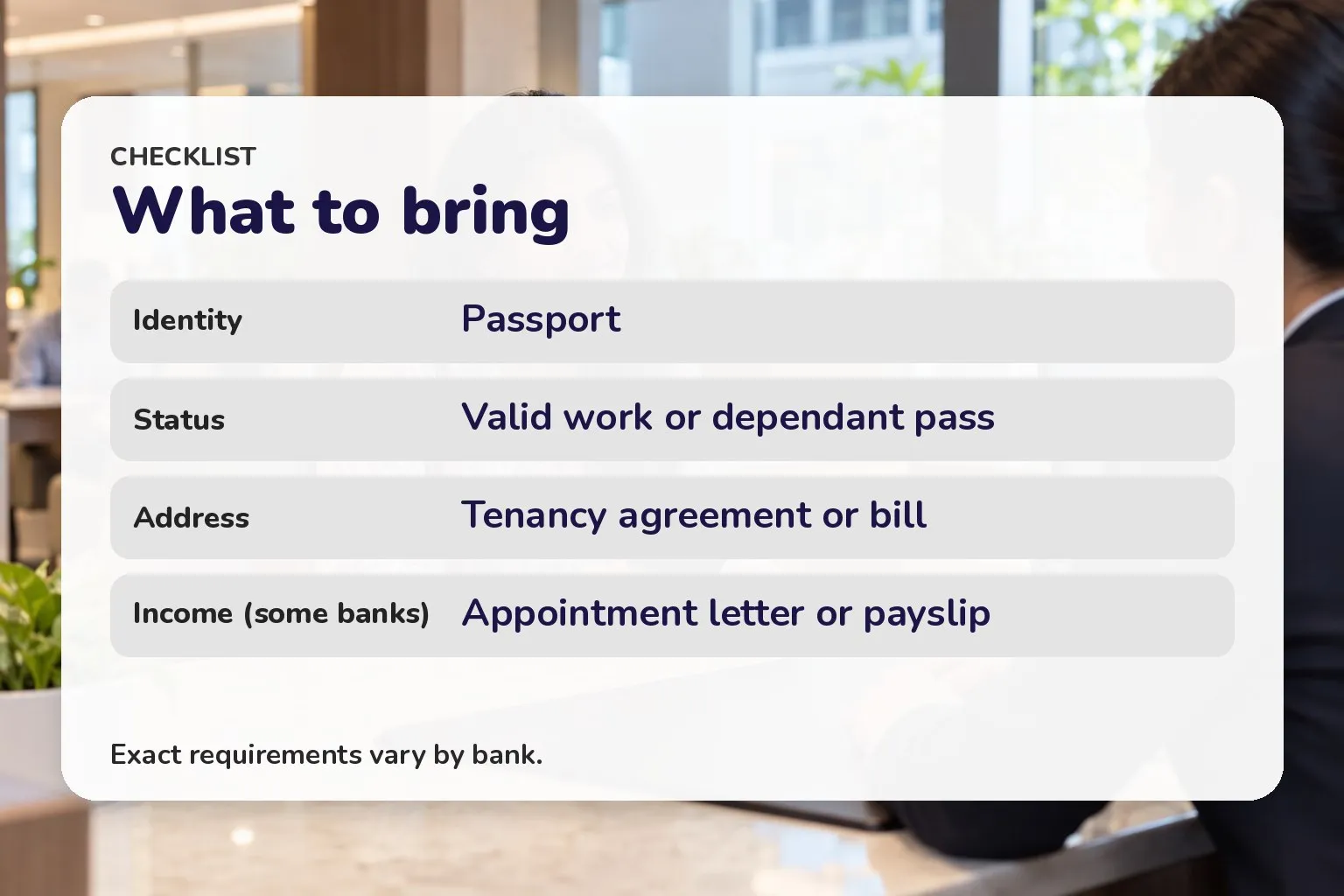
Documents a newcomer usually needs to open an account.
- Your passport;
- A valid work or dependant pass (for example an Employment Pass, S Pass or Dependant’s Pass), or evidence you are PR/eligible;
- Proof of a local residential address — commonly your tenancy agreement or a utility bill; and
- Sometimes proof of employment or income, such as a letter of appointment or recent payslip.
Some banks let you start the application in-app with Singpass once you have it, while others require a first visit in person. A few accept applications before you arrive, with activation on landing.
How your money is protected
Eligible Singapore-dollar deposits in savings, current and fixed deposit accounts at a Scheme member are insured by the Singapore Deposit Insurance Corporation (SDIC) up to S$100,000 per depositor per Scheme member. This is automatic — you do not apply for it.
PayNow and everyday payments
Once your account is open, link it to PayNow — Singapore’s instant transfer service — so people can send you money using your mobile number or registration ID, and you can pay others the same way. For recurring bills (utilities, insurance, your phone plan), set up GIRO so they are debited automatically. Most banks issue a contactless debit card you can tap on public transport and in shops. If you will send money overseas, compare your bank’s remittance fees and exchange rates against licensed money-transfer providers, as costs vary widely.
Common hold-ups and how to avoid them
- No address proof yet — sort your tenancy first, or ask the bank what alternative proof it accepts.
- Pass not yet issued — some banks want the physical card or an in-principle approval; check timing.
- Name mismatches — make sure your passport, pass and application details match exactly.
- Stale details — if your pass is renewed or you move home, update the bank, or cards and transfers can be blocked.
Next steps
With an account open, you can set up GIRO for bills, receive your salary, and get a local number. See getting a SIM card and, if you will be here long enough to be taxed as a resident, how income tax for expats works.
General information only, from MAS and SDIC, with the date each point was checked. We are not a financial adviser and do not recommend specific products (FAA). Confirm current terms with the bank and the official source.
Sources
- Deposit Insurance Scheme FAQs (coverage up to S$100,000) — Singapore Deposit Insurance Corporation (as of October 2026)
- MAS — financial institutions directory (licensed banks) — Monetary Authority of Singapore (as of October 2026)