Getting a SIM Card in Singapore

On arrival you can buy a prepaid SIM with your passport at the airport or any telco shop; registration is required. A passport-registered prepaid SIM is valid for 30 days, and you can hold up to three prepaid SIMs across all telcos.
Getting connected is one of the first things to sort on arrival. Singapore makes it easy — SIMs are sold at the airport and in malls everywhere — but a couple of rules (the 30-day passport limit and registration caps) decide whether you want prepaid or postpaid. Here is how to choose, neutrally.
Prepaid vs postpaid
- Prepaid is the fastest start: buy at the airport or any telco shop, register with your passport, top up as you go. Best for your first weeks.
- Postpaid gives a monthly contract, usually cheaper per GB, but needs a Singapore-issued ID (your FIN/work pass) and often Singpass for online sign-up. Best once your pass is issued.
Registration is mandatory at the point of sale under IMDA rules — bring your passport (or your NRIC/work pass if you already have one).
How many SIMs you can hold
The IMDA sets caps across all telcos combined, not per telco:
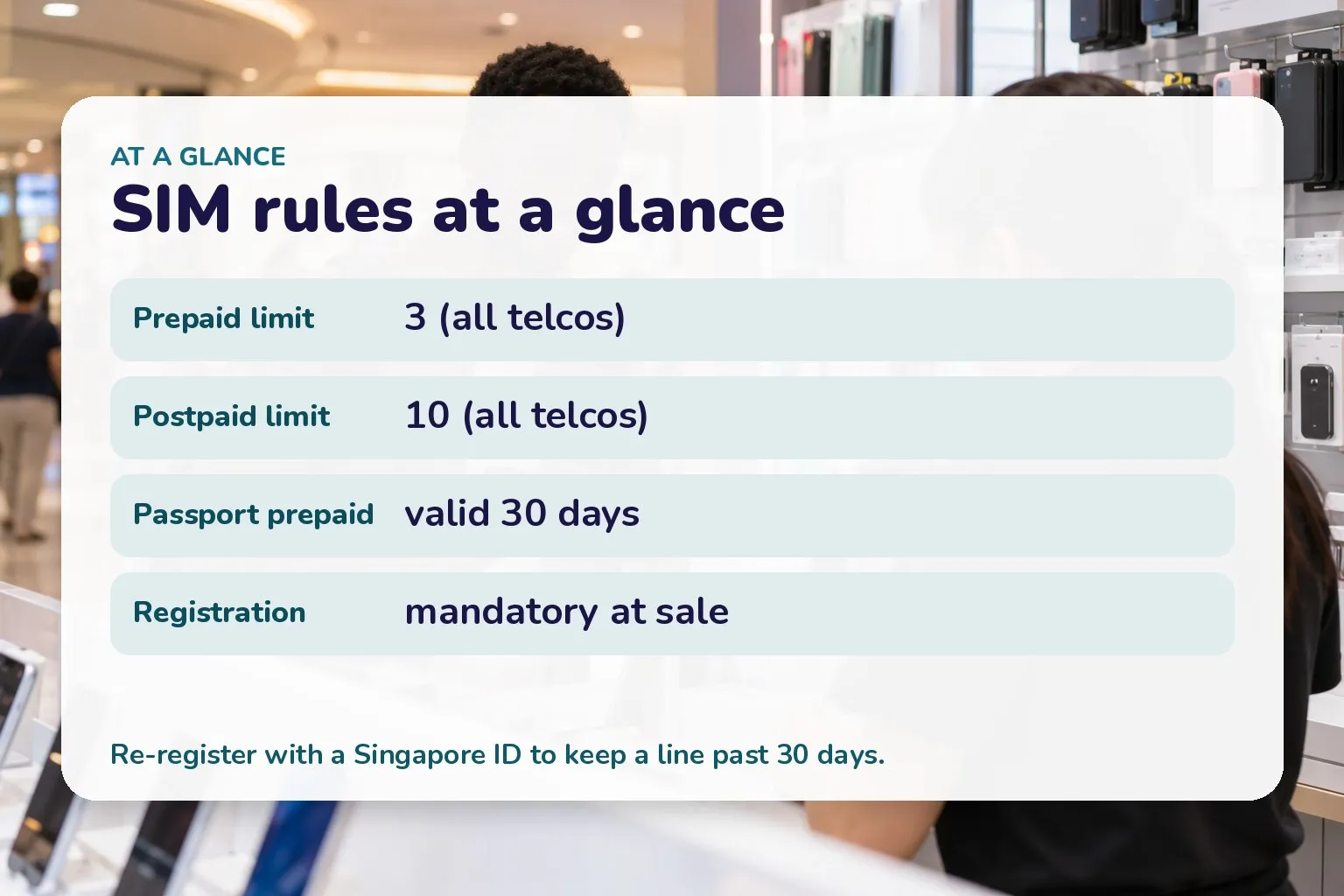
IMDA SIM registration limits for newcomers.
- Prepaid: up to 3 SIM cards per person.
- Postpaid: up to 10 SIM cards per person (tightened to an all-telco limit from 28 February 2026).
The providers
Singapore’s main mobile networks are Singtel, StarHub, M1 and Simba, alongside several MVNOs (smaller brands that run on those networks). All apply the same IMDA registration rules; the retail process differs slightly (in-store vs app). We don’t recommend a specific telco — compare data allowance, validity and price on each provider’s own current terms.
eSIM: data from the moment you land
Most recent phones support an eSIM, which you can activate before you arrive, so you have mobile data at the airport without queueing. A travel/eSIM is a convenient bridge for your first days until you sort a local prepaid or postpaid line.
What to check before you buy
Because we endorse no provider, compare on the things that actually affect you:
- Data allowance, and whether it rolls over or expires each month;
- Validity — prepaid bundles expire; postpaid runs monthly;
- Roaming, if you’ll travel in the region;
- Hotspot/tethering limits, if you work from a laptop; and
- 5G access and coverage where you live and work.
Coverage across Singapore — including on the MRT — is strong on all the main networks, so the choice usually comes down to price and data rather than signal. Keep your passport or pass handy for the mandatory registration at purchase.
Your connectivity checklist
- Before you fly: consider an eSIM for day-one data.
- On arrival: buy a prepaid SIM with your passport (remember the 30-day limit).
- Once your pass is issued: re-register the line with your FIN/work pass, or move to postpaid.
- Watch the caps: 3 prepaid / 10 postpaid across all telcos.
Related
Pair this with the other first-week basics: opening a bank account and getting around on public transport.
General information only, from IMDA and operator terms, with the date each point was checked. We endorse no telco. Confirm current plans, prices and rules on the provider’s and IMDA’s official pages.
Affiliate disclosure: Some links on this page are affiliate links. If you apply or buy through them we may earn a commission at no extra cost to you. This never changes the rates, figures or comparisons shown — those come from official or vendor sources with an "as of" date. We do not recommend specific products.
Sources
- Tightening of limit on number of postpaid SIM cards — Infocomm Media Development Authority (as of October 2026)
- Prepaid SIM registration and 30-day passport validity (operator terms) — M1 (under IMDA regulations) (as of October 2026)