Getting Your Rental Deposit Back in Singapore

Your security deposit is held under the tenancy agreement and returned, less agreed deductions, after you move out and the home passes its final check. If a landlord wrongly withholds it, you can claim up to S$20,000 at the Small Claims Tribunals within two years.
Most of the money you hand over at the start of a Singapore tenancy is the security deposit — usually one month’s rent for every year of the lease. Getting it back is normally straightforward, but it is also the stage where newcomers lose the most money to vague contracts and disputed deductions. This guide explains what a landlord may keep, when the rest should come back, and exactly how to claim it if the deposit is held hostage. For the full rental process and the deposit norm, see our newcomer’s guide to renting in Singapore.
What the deposit is for
The security deposit is money the landlord holds during your tenancy as cover against unpaid rent, unpaid bills and damage beyond normal use. It is not rent, and it is not the landlord’s to keep by default — it is returned at the end of the lease once obligations are settled.
There is no statute that caps a residential deposit or sets a deadline to return it. Both are terms of your tenancy agreement, which is why the contract matters so much. The settled market convention is one month’s rent per year of lease, and a return a week or two after you hand back the keys, but your own agreement is what binds.
What a landlord can and cannot deduct
A landlord may generally deduct from the deposit for things you are responsible for under the lease:
- unpaid rent or utility bills left at the end of the tenancy;
- damage beyond fair wear and tear — a cracked basin or a burnt countertop, not faded paint;
- reinstatement your lease asks for — removing your own fittings, patching mounting holes or a professional clean if the contract says so;
- replacing missing items listed on the move-in inventory.
What a landlord should not do is charge you for ordinary ageing — scuff marks, minor wear to flooring, or appliances that fail through age rather than misuse. “Fair wear and tear” is not defined by a government figure; if it is disputed, the facts decide, which is why your evidence (below) is everything.
When you should get it back
Expect the landlord to inspect the unit after you move out, compare it against the move-in condition, agree any deductions and refund the balance. Under a typical tenancy agreement that happens within a couple of weeks, but the timeline is whatever your contract states. Hand over vacant possession, settle your final utilities bill so no charge is outstanding, and give a forwarding account for the refund.
Protect your deposit before you move in and out
Your deposit is only as safe as your evidence. Two habits protect it:
- Document the condition at move-in. Take dated photos of every room and existing defect, and agree a written inventory with the landlord. Do the same on move-out so the before-and-after is clear.
- Keep the stamped tenancy agreement and its Stamp Certificate. The Stamp Certificate proves your tenancy agreement has been duly stamped; an unstamped agreement is far weaker if you ever need to rely on the contract. Keep both with your inventory and photos.
Remember too that your property agent cannot fix this for you. Under the Council for Estate Agencies rules, a property agent’s role ends after the tenancy agreement is signed and the property is handed over — the deposit return is between you and the landlord, so do not expect the agent to mediate the refund.
If the landlord will not return your deposit
Start with a calm written request: email the landlord an itemised account of the deposit, the deductions you accept, the balance owed and a reasonable deadline. Attach your inventory and photos. Many disputes end here once the paper trail is clear.
If that fails, Singapore gives tenants a cheap, lawyer-free forum: the Small Claims Tribunals (SCT), part of the State Courts.
The Small Claims Tribunals route
The SCT hears a dispute relating to a tenancy for residential premises where the lease does not exceed two years — which covers almost every expat rental. The key rules:
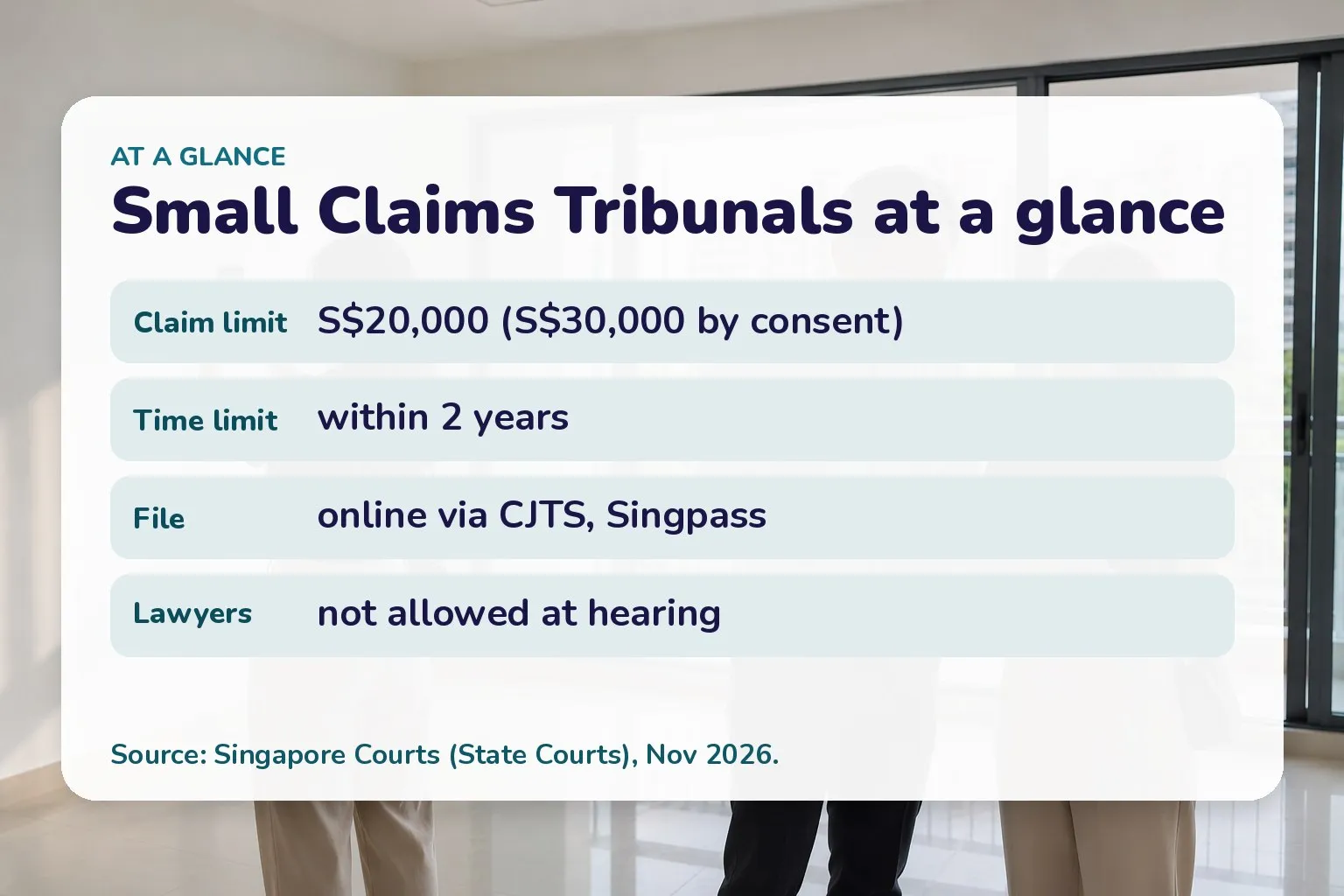
Key limits for a deposit claim at the Small Claims Tribunals.
- Claim limit. You can claim up to S$20,000, or up to S$30,000 if both sides file a Memorandum of Consent. A full deposit dispute sits comfortably inside this.
- Time limit. File within two years of the event that gave rise to the claim. You cannot split one dispute into several to dodge the limit.
- Cost. The filing fee for an individual is S$20 for a claim between S$5,000 and S$10,000, and 1% of the amount for claims above S$10,000; smaller claims cost less. There is no need for a lawyer — in fact, lawyers and agents are not allowed to represent a party at the tribunal hearing.
- How to file. All claims are filed online through the Community Justice and Tribunals System (CJTS). Log in with Singpass; if you are not eligible for Singpass you can apply for a CJTS Pass. Upload your tenancy agreement, the Stamp Duty Certificate, the inventory and your photos.
- Settle first. Before any hearing, parties can negotiate or mediate online through CJTS (e-negotiation and e-mediation). Many claims settle there, and a settlement can be made into a binding Consent Order without going to court.
After filing, you must serve the Notice of Consultation on the landlord within seven working days. The tribunal runs in English, with free interpretation for Malay, Mandarin, Tamil and local Chinese dialects if you ask in advance.
Frequently asked questions
Is there a legal maximum deposit? No. Singapore does not cap a residential deposit; the amount is a term of your tenancy agreement, with one month per year of lease the common market norm.
Can my agent get my deposit back for me? No. The agent’s role ends once the lease is signed and the home handed over, so the refund is strictly between you and the landlord.
What if the deductions are larger than my deposit? The landlord can pursue you for the shortfall, and you can dispute the amount — if it cannot be agreed, either side can bring it to the Small Claims Tribunals within the limits above.
Do I need the Stamp Certificate to claim? Keep it. For a tenancy dispute the tribunal expects the tenancy agreement and its Stamp Duty Certificate among your documents, so an unstamped lease puts you at a disadvantage.
Related
Once your lease ends, you may be opening a new bank account or weighing whether to rent an HDB flat or a condo next time. For the full tenancy and stamping rules, see our guide to the tenancy agreement and stamp duty.
General information only, from the Singapore Courts, CEA and IRAS, with the date each rule was checked. We are not a law firm or a property agency. Confirm the current rules on the official source for your own case.
Sources
- Cases eligible for a small claim — Singapore Courts (State Courts) (as of November 2026)
- A Guide to Small Claims (claim limit, time bar, filing, fees) — Singapore Courts (State Courts) (as of November 2026)
- Community Justice and Tribunals System (CJTS) — Singapore Courts (State Courts) (as of November 2026)
- Renting or renting out (property agent's role) — Council for Estate Agencies (as of November 2026)
- Renting a Property (Stamp Certificate) — Inland Revenue Authority of Singapore (as of November 2026)