How CPF Helps Pay for Healthcare in Singapore

CPF funds healthcare through three schemes: MediSave (your savings account, built from 8–10.5% of pay), MediShield Life (insurance for large hospital bills), and CareShield Life (long-term care). All citizens and PRs are covered.
On this page8 sections · tap to jump
Once you are in the CPF system as a Singapore citizen or permanent resident (PR), a slice of every salary is set aside for healthcare — and it does far more than sit in an account. CPF funds a layered safety net: a personal savings account for medical bills, national insurance for large hospital costs, and a long-term care scheme. Here is how each piece works, what you pay out of pocket, and what newcomers still on a work pass need to know.
Three schemes, one healthcare safety net
The CPF Board describes “three national schemes [that] offer you protection for your healthcare needs”: MediSave, MediShield Life and CareShield Life. They stack together. MediSave is your own savings; MediShield Life is insurance that pays large bills; CareShield Life covers long-term care if you become severely disabled. Behind all three sits MediFund, a government safety net for citizens who still cannot pay.
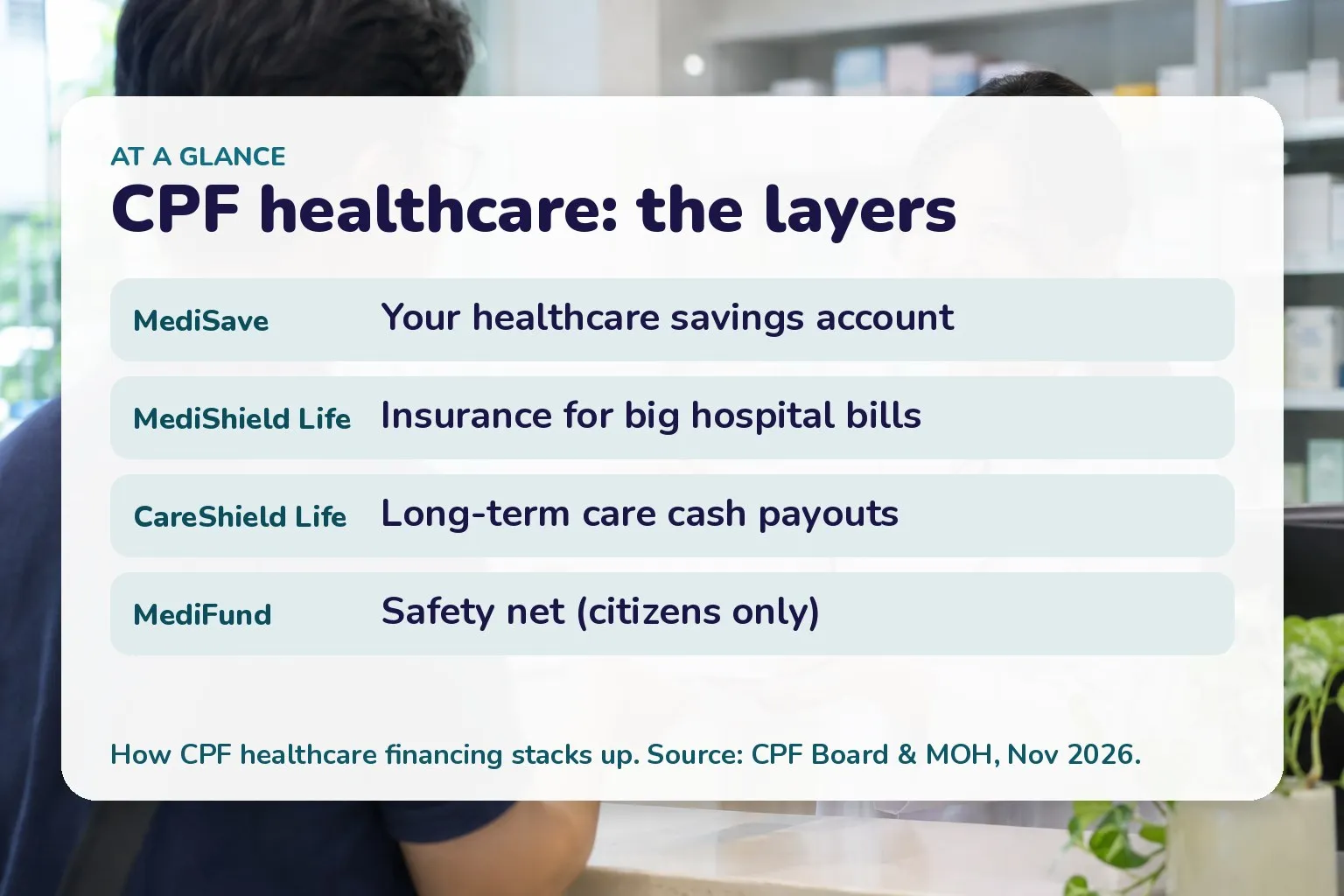
How CPF healthcare financing stacks up.
MediSave: your healthcare savings account
MediSave is the foundation. The CPF Board explains that “when you’re working, you save between 8% and 10.5% of your monthly salary in your MediSave,” with the exact percentage depending on your age group. It “helps you pay for your healthcare expenses over your lifetime, especially when you retire and no longer have a regular income.” The money is part of your CPF, saved in your MediSave Account (MA) alongside your Ordinary and Special Accounts.
There is a cap. Your Basic Healthcare Sum (BHS) is “the estimated amount of savings you need for basic subsidised healthcare expenses in old age [and] the maximum amount you can have in your MediSave.” From 1 January 2026 the BHS for members below 65 was “raised from $75,500 to $79,000.” You do not lose contributions above it — they are “directed to your Special Account or Retirement Account.”
What MediSave can pay for
MediSave is not a free-for-all; each use has a limit, which is why it lasts. The main uses include:
- Hospitalisation and day surgery — you can withdraw “up to $550 per day from your MediSave Account for the first two days of your stay in the hospital, and up to $400 per day thereafter,” plus surgical limits.
- Chronic disease outpatient care — “up to $500 (for non-complex chronic conditions) or $700 (for complex chronic conditions) per year” for the 23 approved conditions under the Chronic Disease Management Programme.
- Insurance premiums — MediSave pays the yearly premiums for MediShield Life, CareShield Life and Integrated Shield Plans.
- Vaccinations, screenings and maternity — selected items under national immunisation and screening schemes, and delivery costs.
MediShield Life: cover for big hospital bills
MediShield Life is the national insurance layer — “a health insurance to help you pay large hospital bills and selected outpatient treatment costs.” Crucially for newcomers, “all Singapore Citizens and Permanent Residents are automatically covered,” regardless of age or pre-existing conditions. You do not apply; cover starts with your status.
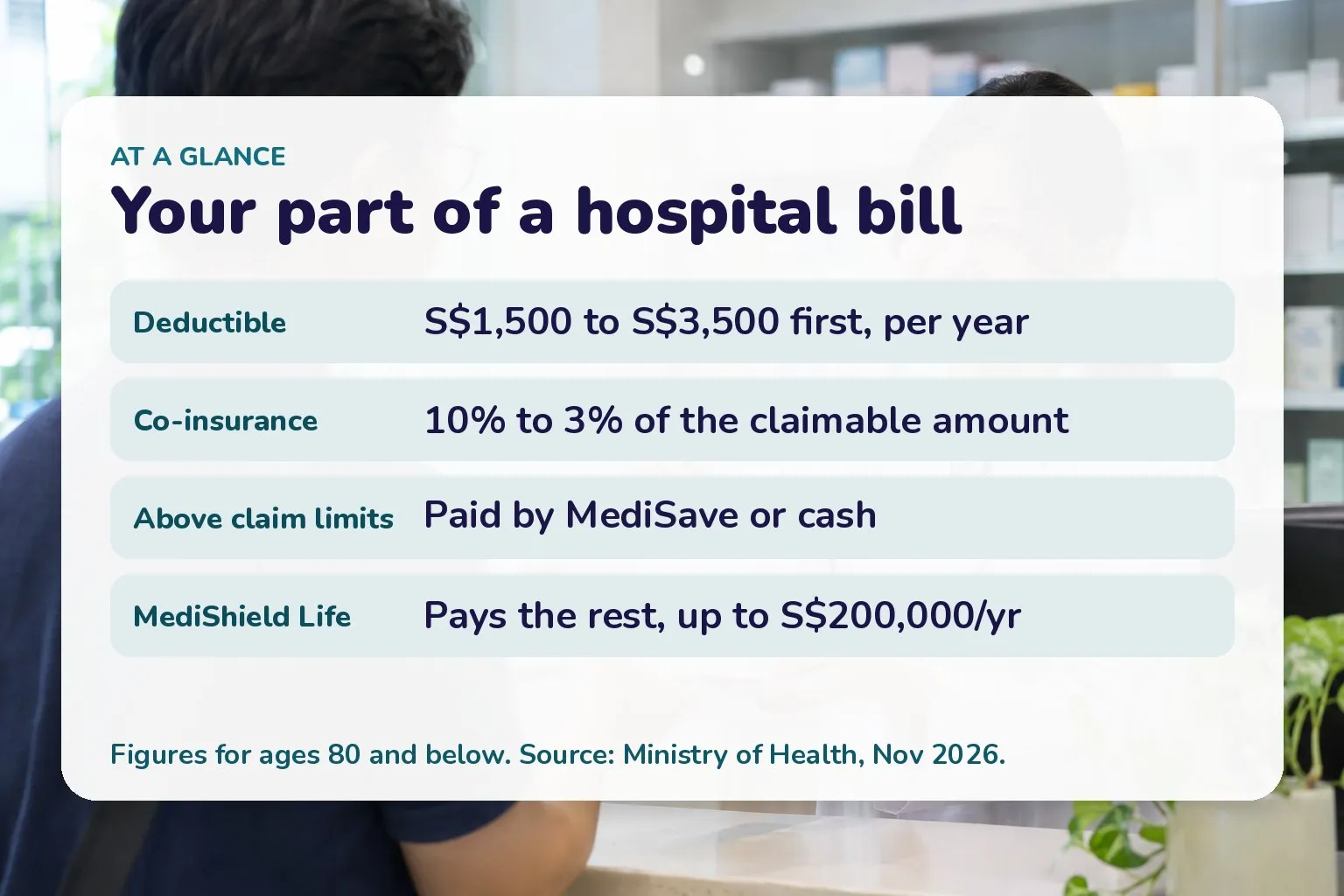
The parts of a bill you pay versus what MediShield Life covers.
It never pays the whole bill, though. The Ministry of Health (MOH) splits a bill into parts: “you are responsible for paying parts A, B and C of your bill from your MediSave account and/or in cash. Your MediShield Life plan will cover part D.” In practice that means three things you pay before and alongside the payout:
- The deductible — a fixed amount you pay first each policy year you are hospitalised. It runs from S$1,500 for day surgery and S$2,000 in a Class C ward up to S$3,500 in Class A (including private hospitals), for those aged 80 and below. You “only have to pay this once in any policy year you are hospitalised.”
- Co-insurance — a percentage of the claimable amount, which “starts at 10% and goes lower as the claimable amount increases” (10% on the first S$5,000, 5% on the next S$5,000, 3% above S$10,000).
- Any bill above the claim limits — the “maximum claim limit per policy year is set at $200,000 with no lifetime limit on claims,” with sub-limits per treatment.
CareShield Life: long-term care insurance
The third scheme looks further ahead. CareShield Life is “a long-term care insurance scheme [that] offers financial support and monthly cash payouts, should you develop severe disability.” A claim is tied to function, not a specific illness: you qualify once an MOH-accredited assessor finds you “unable to carry out 3 of the 6 activities of daily living” — washing, dressing, feeding, toileting, walking or moving around, and transferring — and the payout continues as long as that holds. Payouts are in cash and rise the later in life you first claim; CPF’s illustration for someone born in 1980 is “$689 per month for life” for a successful claim in 2026 at age 46.
For newcomers the enrolment rule is the key point. Those born in 1980 or later are “automatically covered once you turn 30, or from 1 October 2020, whichever is later.” And participation is mandatory for “foreigners who become Singapore Citizens or Permanent Residents from 1 October 2020 onwards,” provided they do not have a disqualifying disability at the time. In other words, if you take up PR now, CareShield Life is not optional. As with MediShield Life, you “can use your MediSave to pay your CareShield Life premiums.”
MediFund: the final safety net
Even after savings, insurance and subsidies, some bills remain. MediFund is “a safety net for Singaporeans who face financial difficulties with their remaining bills after Government subsidies, insurance and MediSave.” It is the one layer that is citizens only: to apply you must “be a Singapore citizen [and] a subsidised patient” treated at a MediFund-approved institution. PRs and foreigners are not eligible, which is one more reason cover and savings matter for non-citizens.
What this means for newcomers
If you are still on an Employment Pass, S Pass or Work Permit, none of this applies to you yet: because CPF is payable only for citizens and PRs, you have no MediSave and no MediShield Life through CPF. Your hospital bills are unsubsidised, so employer or private health cover does the heavy lifting — see our guide to health insurance for expats and how seeing a doctor as a foreigner is charged.
The picture changes the day you become a PR. MediSave starts filling from your pay, MediShield Life cover begins automatically, and CareShield Life enrolment becomes compulsory. For how the contributions themselves ramp up, read CPF for new PRs; for the wider question of who pays CPF and what happens if you leave, see CPF for PRs and foreigners.
Frequently asked questions
How much of my salary goes into MediSave? Between 8% and 10.5% of your monthly salary, depending on your age group. It is part of your CPF, saved in your MediSave Account.
Do foreigners on a work pass have MediSave or MediShield Life? No. Both are funded through CPF, which is payable only for citizens and PRs, so work-pass holders have neither until they become PR. They rely on employer or private insurance.
Does MediShield Life cover my whole hospital bill? No. You first pay a deductible (from S$1,500 to S$3,500 for those aged 80 and below), then a co-insurance share of 10% to 3%, plus anything above the claim limits. MediShield Life covers the rest, up to S$200,000 a policy year.
Is CareShield Life compulsory for new PRs? Yes. Participation is mandatory for foreigners who become citizens or PRs from 1 October 2020 onwards, provided they do not have a disqualifying disability when they gain status.
Can I use MediSave to pay my insurance premiums? Yes. MediSave can fully pay your MediShield Life and CareShield Life premiums, and the premiums of Integrated Shield Plans, up to the applicable limits.
General information for newcomers, not financial or medical advice. CPF and MOH scheme rules, limits and figures change — confirm the current position on the CPF Board and MOH websites for your own circumstances.
Sources
- Healthcare financing — Central Provident Fund Board (as of November 2026)
- Using your MediSave savings — Central Provident Fund Board (as of November 2026)
- MediShield Life — Central Provident Fund Board (as of November 2026)
- How to make a MediShield Life Claim — Ministry of Health (as of November 2026)
- CareShield Life — Central Provident Fund Board (as of November 2026)
- MediFund — Ministry of Health (as of November 2026)
- Basic Healthcare Sum for 2026 — Central Provident Fund Board (as of November 2026)