Health Insurance for Expats in Singapore

Your employer must buy medical insurance of at least S$60,000 a year only if you hold a Work Permit or S Pass. Employment Pass cover is optional, and no work-pass holder is enrolled in MediShield Life, so private cover matters.
On this page8 sections · tap to jump
Health cover in Singapore works very differently depending on which pass you hold. Your employer is legally obliged to insure you for some passes and not others, and the national scheme most residents rely on does not include you at all. This guide explains who your employer has to insure, how much the policy pays, why Employment Pass cover is optional, and what you buy privately to fill the gap — all from the Ministry of Manpower (MOM) and the Ministry of Health (MOH), with no product picks.
Who must be insured by an employer
If you hold a Work Permit or an S Pass, your employer must buy and maintain medical insurance for you before the pass can be issued or renewed. For an S Pass holder, MOM states you must have cover “before you can issue or renew an S Pass”, and the same obligation applies to Work Permit holders. The required minimum is at least S$60,000 per year for each worker, covering inpatient care and day surgery.
Two things protect you here. First, the cost cannot be passed on to you as a matter of course — MOM says plainly that “the insurance cost cannot be passed on to your workers.” Second, the employer has to keep the policy current and, for Work Permit holders, submit the insurer’s name, policy number and dates to MOM before the permit is issued.
What the employer policy must cover
The policy must cover inpatient care and day surgery, including hospital bills for conditions that may not be work-related — not just workplace injuries. The cover has been strengthened in two stages:
- From 1 July 2023 (Stage 1): the annual claim limit rose to at least S$60,000, with a co-payment of 75% by the insurer and 25% by the employer for claim amounts above S$15,000.
- From 1 July 2025 (Stage 2): allowable exclusion clauses were standardised, premiums are set by two age bands (50 and below; above 50), and insurers pay hospitals directly once a claim is admitted.
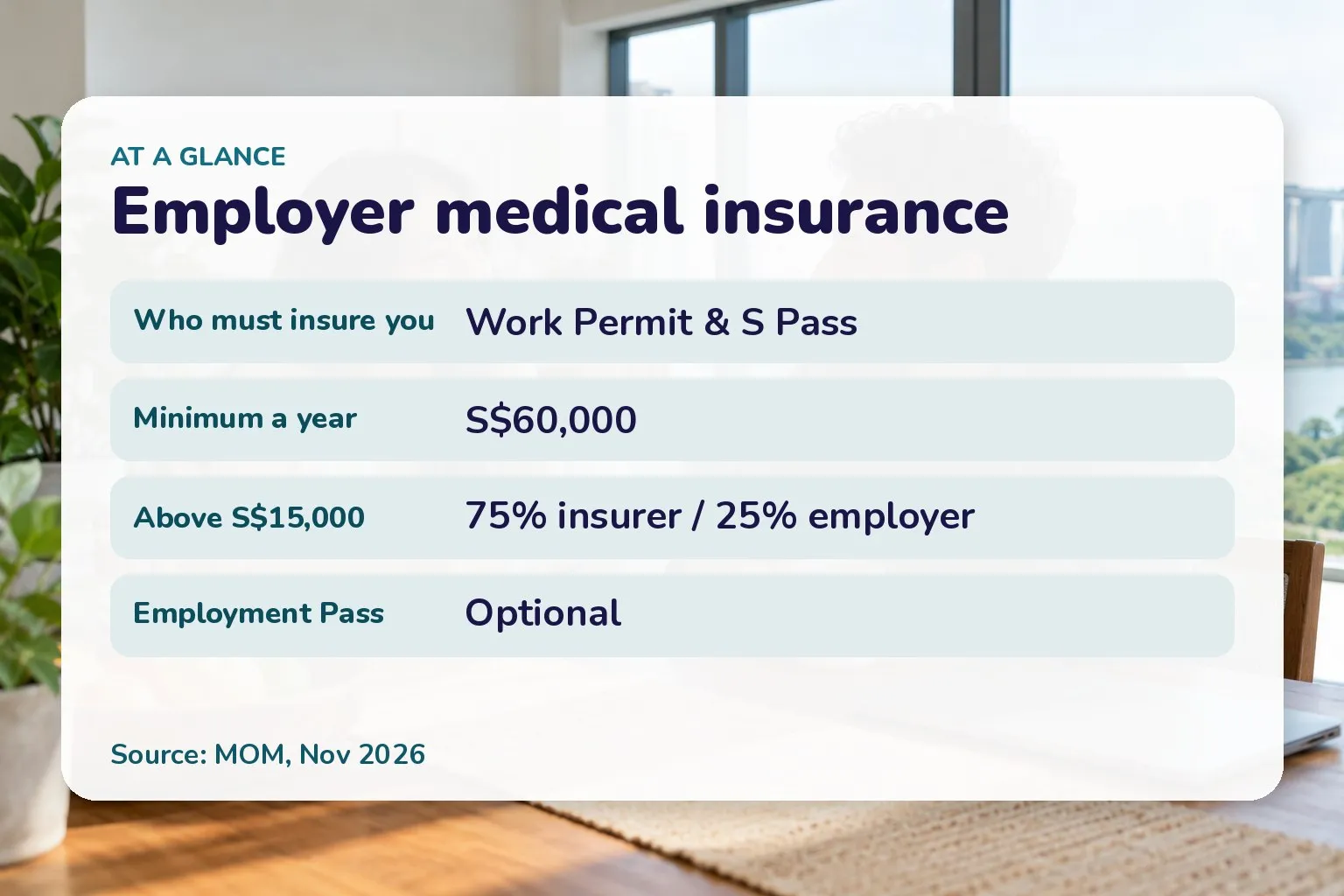
What an employer’s medical insurance must now provide. Source: MOM, Nov 2026.
An employer may ask a Work Permit or S Pass holder to share part of the premium, but only under tight conditions: the amount must not exceed 10% of your fixed monthly salary, the co-payment can run for at most six months in every two years of employment, and it must be written into your contract with your consent.
Employment Pass: cover is optional
Employment Pass holders are treated differently. MOM is explicit: “Providing medical insurance is not a requirement for employing Employment Pass (EP) holders,” and the medical-insurance requirement “applies only to Work Permit and S Pass holders.” EP employers may choose to include cover in the contract, or leave you to arrange your own.
In practice this means an EP holder should check the employment contract carefully. If the company provides a group plan, confirm its limits and whether it continues between roles; if it does not, you are responsible for your own policy from day one.
Why you are outside the national schemes
Singapore residents lean on MediShield Life, the basic national health insurance administered by the CPF Board. But only Singapore citizens and permanent residents are eligible — MOH describes it as protecting “all Singapore Citizens and Permanent Residents”, and lists the eligible group as citizens and PRs. As a Work Permit, S Pass or Employment Pass holder, you are not enrolled, and you do not build a MediSave account to pay premiums from.
MediShield Life benefits are also sized for subsidised treatment in Class B2/C wards of public hospitals, so even for those it covers it is a basic layer. The practical takeaway for you: the national safety net that residents describe does not sit under you, which is exactly why employer or private cover is doing all the work. This is one of the differences people weigh when they read about healthcare costs for expats.
Integrated Shield Plan vs a private plan
Residents who want private-hospital or higher-ward cover add an Integrated Shield Plan (IP) on top of MediShield Life. The key fact for an expat is structural: every Integrated Shield Plan includes a MediShield Life component, made up of “MediShield Life component offered by CPF Board sized for Class B2/C bills in public hospitals; and Additional private insurance component offered by a private insurer.” Because an IP presupposes MediShield Life membership, only citizens and PRs can hold one.
So the choice “IP vs private plan” is not really a choice for a pass holder. Your route is a private or international medical insurance plan bought directly from an insurer. These are not tied to MediShield Life and are underwritten individually, so the exact premium depends on your age, the plan and your health. We name no products and quote no premiums here; compare limits, exclusions, panel hospitals and whether the plan covers treatment outside Singapore before you buy.
Dependants and gaps
Your employer’s policy covers you, not your family. A spouse or child on a Dependant’s Pass is not automatically covered, so arrange separate cover for them. (There is one narrow exception on the employer side: MOM does not require a second policy if a Work Permit holder also holds a Dependant’s Pass and already has a plan meeting the minimum Work Permit cover.)
Two common gaps catch newcomers:
- Between jobs: an employer plan usually ends when employment does. If you switch roles, confirm when the old cover stops and the new one starts.
- Scope gaps: maternity, dental and pre-existing conditions are often excluded. Fill these with your own plan if they matter to you.
If you later become a permanent resident, the picture changes: you are enrolled in MediShield Life, you build a MediSave account, and you can then hold an Integrated Shield Plan. Until then your private or employer cover stands alone — see how CPF and its health accounts work for new PRs.
What this means for you
- Check your pass type: Work Permit or S Pass means your employer must insure you for at least S$60,000 a year; Employment Pass means cover is optional.
- Read your contract and policy: confirm the annual limit, sub-limits, exclusions and any premium share.
- Arrange family and gap cover separately — dependants, maternity, dental, overseas treatment.
- Keep your insurer’s hospital-admission contact handy, and set up a local bank account for any billing and reimbursements.
Frequently asked questions
Does my Employment Pass include health insurance? Not necessarily. For EP holders, providing medical insurance is optional for the employer, so check your contract; the mandatory S$60,000 rule applies only to Work Permit and S Pass holders.
Can I buy an Integrated Shield Plan as an expat? No. An Integrated Shield Plan always includes a MediShield Life component, and MediShield Life covers only citizens and permanent residents. As a pass holder you take out a private or international medical insurance plan instead.
Is my family covered by my employer’s policy? No. The cover is for the pass holder. A spouse and children need their own policy, even if they are on a Dependant’s Pass.
Can my employer deduct the premium from my salary? Only within limits — no more than 10% of your fixed monthly salary, for at most six months in every two years, and only if it is written into your contract with your consent.
General information only, not financial or medical advice, from MOM and MOH with the date each point was checked. Insurance rules and limits change — confirm the current requirements and any policy terms with the official source and your insurer.
Sources
- S Pass medical insurance requirements — Ministry of Manpower (as of November 2026)
- Medical insurance requirements for migrant workers — Ministry of Manpower (as of November 2026)
- Are employers required to buy medical insurance for Employment Pass holders? — Ministry of Manpower (as of November 2026)
- MediShield Life — Ministry of Health (as of November 2026)
- About Integrated Shield Plan — Ministry of Health (as of November 2026)