Healthcare in Singapore for Expats

Expats can use any GP, polyclinic or hospital in Singapore, but as non-residents you pay full, unsubsidised rates and are outside MediShield Life and MediSave. Private health insurance is strongly advisable, and employers must insure Work Permit and S Pass holders.
Singapore’s healthcare is high quality and easy to access — but for newcomers the key point is financial, not clinical: as a non-resident you pay full, unsubsidised rates. Planning your cover matters more than finding a doctor. Here is how the system works for expats, with the official context.
How the system is set up
Healthcare is a mixed public–private system overseen by the Ministry of Health (MOH). Public institutions — polyclinics and public hospitals — provide subsidised care for citizens and permanent residents. Private GPs, specialists and hospitals set market rates and serve everyone.
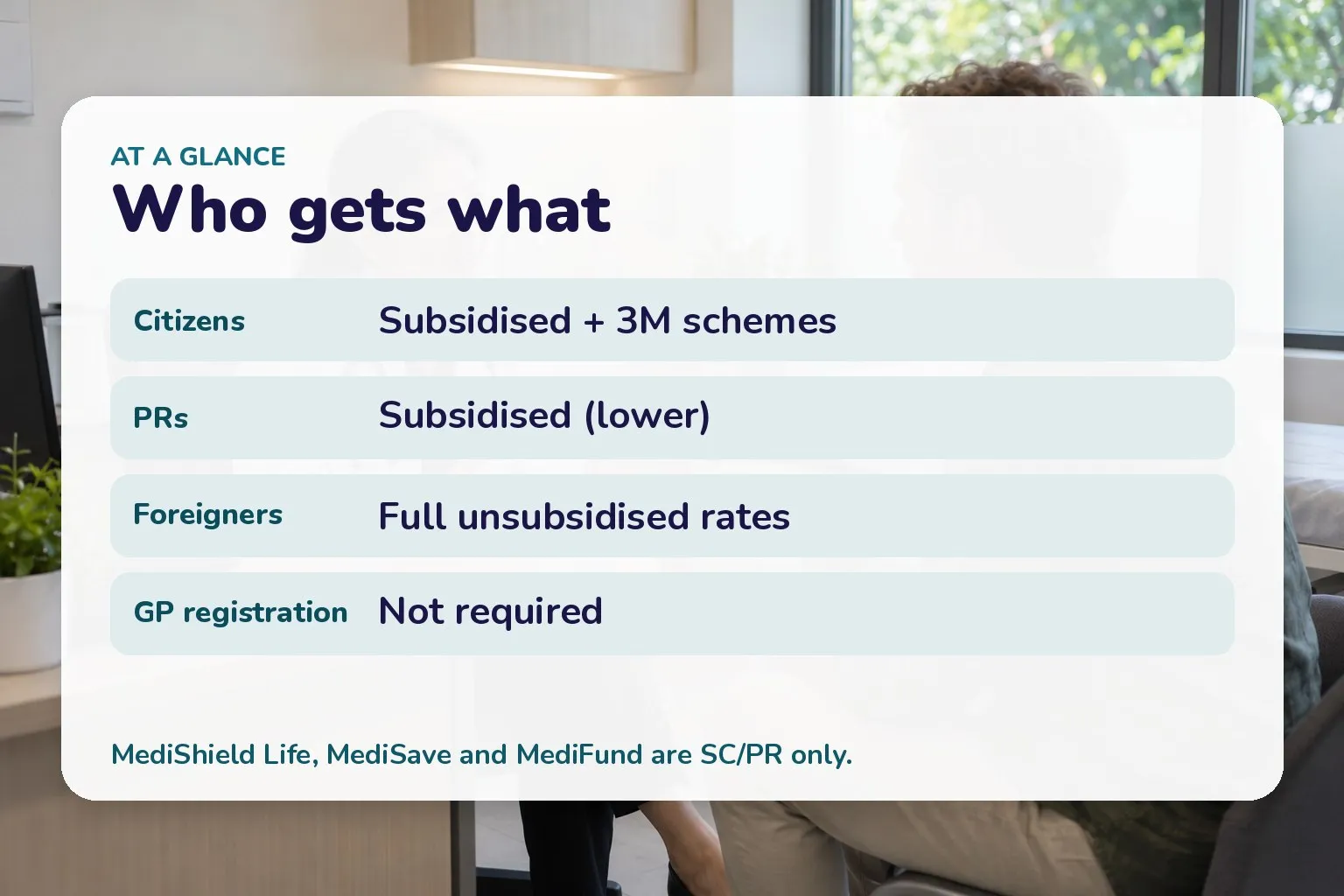
How subsidies differ for citizens, PRs and foreigners.
Singapore’s national financing schemes — MediShield Life (basic insurance), MediSave (CPF health savings) and MediFund (safety net) — are for citizens and PRs only. As a foreigner on a work or dependant pass you are outside all three.
Everyday care: GPs and polyclinics
- GP clinics are the usual first stop for minor illness. There is no registration and no catchment area — walk in or book anywhere. Fees are set by each clinic.
- Polyclinics are public primary-care centres. Foreigners can use them but pay the unsubsidised rate, and waits can be longer than at a GP.
- Many employer insurance plans have panel clinics where treatment is cashless — check which clinics your plan covers.
Hospitals and emergencies
Public hospitals (such as SGH, NUH, TTSH, CGH and KTPH) and private hospitals both treat non-residents at unsubsidised rates. For a true emergency, go to a hospital A&E or call for an ambulance. For minor out-of-hours problems, a 24-hour GP clinic is usually far cheaper and faster than A&E.
Insurance: what to check
- Employer cover: for Work Permit and S Pass holders, employers must provide medical insurance of at least S$60,000 a year. EP and dependant cover varies by employer — read your policy.
- Gaps: cover can lapse between jobs or exclude maternity, dental or pre-existing conditions. Fill gaps with your own plan if needed.
- Family: dependants are not automatically covered by your employer — arrange cover for a spouse and children separately if required.
Becoming a PR changes the picture
If you later become a Permanent Resident, your healthcare position shifts: you gain subsidised rates at public hospitals and polyclinics (lower than a citizen’s, but far below the foreigner rate), you are enrolled in MediShield Life, and you build a MediSave account through CPF that can pay approved medical bills and insurance premiums. Until then, as a pass holder you remain outside these schemes, so your private or employer insurance is doing all the work. This is one of the practical differences people weigh when deciding whether to apply for PR.
Your first-week health checklist
- Confirm what your employer’s insurance covers (limits, panel clinics, family).
- Arrange personal or family cover for any gaps.
- Note a nearby GP and a 24-hour clinic.
- Keep your passport and pass for registration at medical counters.
Related
Line up the basics alongside this: open a bank account for billing and GIRO, and if your family is here, read how schooling works for expat children.
General information only, not medical advice, from MOH and MOM with the date each point was checked. For any health concern, see a qualified doctor, and confirm cover and fees with your insurer and the official source.
Sources
- Hospital bills and fee benchmarks — Ministry of Health (as of October 2026)
- S Pass medical insurance requirements (minimum S$60,000 a year) — Ministry of Manpower (as of October 2026)