CPF for New PRs in Singapore: What Changes

Once you become a Singapore PR, CPF contributions begin. For your first two years you and your employer pay lower graduated rates; from the third year you pay the full citizen rate. The first-year rate starts the day your PR status takes effect.
If you become a Singapore permanent resident (PR), you join the Central Provident Fund (CPF) — the national savings scheme for retirement, housing and healthcare. The surprise for most new PRs is the drop in take-home pay, because a slice of your salary now goes into CPF. The good news: for your first two years the rates are deliberately lower, so the change is phased in. Here is how it works.
When CPF starts
CPF contributions become payable the day you obtain PR status — the date shown on your entry permit (Form 5/5A) issued by the Immigration & Checkpoints Authority (ICA). From that point, both you and your employer must contribute each month on your wages.
The three stages
CPF eases new PRs in over three years. For an employee aged 55 or below earning more than S$750 a month, the combined rates are:
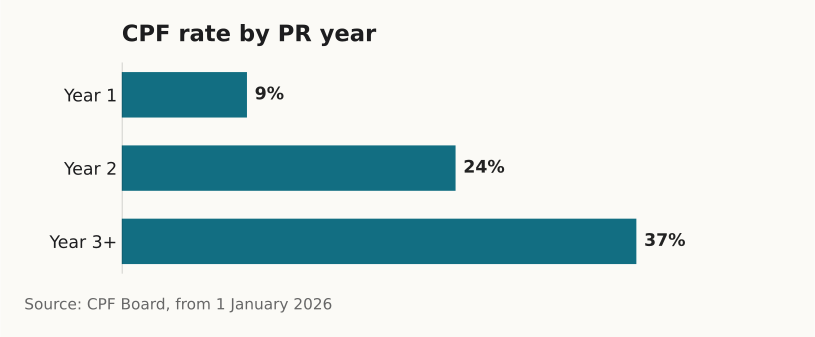
Combined employer and employee CPF rate by year of PR status (age 55 and below). Source: CPF Board, from 1 January 2026.
- First year — graduated: total 9% (employer 4%, employee 5%).
- Second year — graduated: total 24% (employer 9%, employee 15%).
- Third year onward — full: total 37% (employer 17%, employee 20%) — the same as a Singapore citizen.
The lower first- and second-year rates exist specifically to help you adjust to the lower take-home pay. They have not changed since 1 January 2016, so the year-one and year-two figures above are long-standing rather than a recent tweak.
When each rate kicks in
The first-year rate applies from the day your PR status takes effect. The second-year rate begins on the first day of the month after your first anniversary as a PR, and the third-year rate on the first day of the month after your second anniversary — not on 1 January.
What your wages count toward
CPF is charged on your monthly Ordinary Wages up to a ceiling of S$8,000 (from 1 January 2026). Earnings above that are not subject to CPF. Bonuses and other Additional Wages are covered separately, up to their own annual cap. The money is split across three accounts — Ordinary (housing, investment), Special (retirement) and MediSave (healthcare) — with the mix depending on your age.
Where your CPF goes
CPF is not a tax — it is your money, saved in three accounts you can later use. The Ordinary Account can go toward a home, approved investments and insurance; the Special Account is earmarked for retirement; and the MediSave Account pays for approved healthcare and health insurance. The exact split between the accounts shifts with your age, moving more toward retirement and healthcare as you get older. Balances earn interest set by the Government, with a 4% floor on Special and MediSave money that has been extended to the end of 2027.
Paying the full rate sooner
You do not have to stay on the lower rates. A first- or second-year PR and their employer can jointly apply to CPF Board to contribute at higher rates earlier — either full employer with graduated employee, or full rates for both. People who want to build their CPF (and buy a home) faster sometimes choose this.
What this means for you
- Expect your net pay to fall once PR status starts, and plan for the year-three rate, not just year one.
- Check your PR start date on the ICA entry permit — that, not your join date, drives the CPF clock.
- If building CPF quickly matters (for a home, say), ask your employer about the joint application to pay full rates sooner.
New PRs often review their wider finances at the same time: see income tax for newcomers and, if a property is on the horizon, read about applying for PR first, since status changes what you can buy.
General information only, from the CPF Board, with the date each figure was checked. Rates and ceilings change — confirm the current figures on the official CPF website for your own situation.
Sources
- CPF contribution rate tables from 1 January 2026 — Central Provident Fund Board (as of October 2026)
- How much CPF contributions to pay (SPR employees) — Central Provident Fund Board (as of October 2026)
- CPF interest rates from 1 October to 31 December 2026 — Central Provident Fund Board (as of October 2026)
- Saving as a self-employed person — Central Provident Fund Board (as of October 2026)