CPF for Permanent Residents vs Foreigners

Only Singapore citizens and permanent residents contribute to CPF; foreigners on an Employment Pass, S Pass or Work Permit do not. New PRs start on lower graduated rates. If you leave Singapore for good or renounce PR, you can withdraw your CPF in full.
For newcomers, CPF is the question that decides how much of your salary you actually keep. The short version: it depends entirely on your status. On a work pass you pay nothing into CPF; your whole salary is yours. Become a permanent resident (PR) and CPF begins, which is why take-home pay drops at that point and not before. And if you later leave Singapore for good, your CPF does not vanish — you can take it with you. This guide maps who pays, who does not, and what happens to the money when you go. For the exact PR rate tables, see our detailed CPF for new PRs guide.
Who CPF applies to
CPF is a scheme for residents, not for temporary workers. MOM states that “CPF contributions are payable for Singapore citizens (SCs) and Singapore permanent residents (SPRs)”, and the CPF Board says employers are “required to pay CPF contributions for your employees who are Singapore Citizens or Singapore Permanent Residents and who are earning total wages of more than $50 per month.” For foreigners the position is the opposite and explicit: “CPF contributions are not allowed for foreigners” holding an Employment Pass, S Pass, Miscellaneous Work Pass or Work Permit.
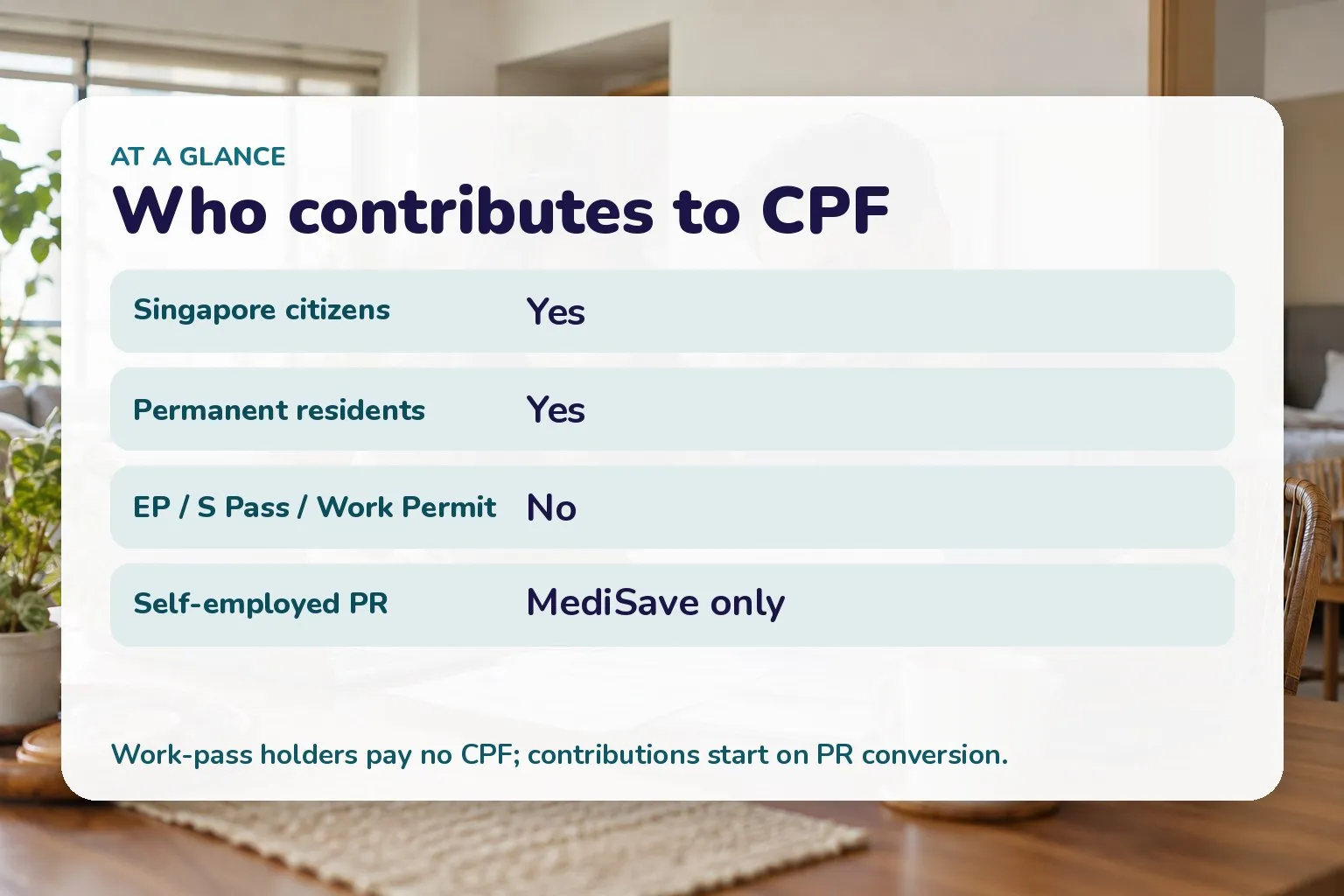
Who contributes to CPF, by residency status. Source: CPF Board and Ministry of Manpower, November 2026.
So the common newcomer surprise — “why did my pay drop when I got PR?” — has a simple answer. On a work pass there was no CPF line at all. CPF “contributions are mandatory for foreigners from the day they attain SPR status in Singapore”, so the deduction appears the day your PR starts. The purpose is spelled out by CPF: the system exists “to cater to the retirement, housing and healthcare needs of all Singapore Citizens (SC) and Permanent Residents (PR).” It is savings for you, not a tax — but it does reduce the cash in each payslip.
Income tax, by contrast, applies to residents and foreigners alike — see income tax for newcomers for how that is worked out separately from CPF.
Becoming a PR: how contributions start
When you convert to PR, CPF does not jump straight to the full rate. New PRs ease in on lower, graduated rates for their first two years, with the full citizen rate applying from the third year; the CPF Board notes that “CPF contribution rates vary based on your employee’s citizenship status, age group, and total wages.” Because the first-year rate is gentlest and then steps up, the real squeeze on take-home pay is not year one but the later jump — a point worth budgeting for. The exact year-by-year percentages, and how the timing is tied to your PR anniversary, are set out in full in our CPF for new PRs guide; this page focuses on the status question and what happens when you leave.
Self-employed PRs: MediSave only
If you are a PR working for yourself rather than an employer, there is no monthly payroll CPF — but you are not entirely outside the system. Through the Self-Employed Scheme you make a mandatory MediSave contribution. You declare your net trade income to IRAS in your tax return, and then, as CPF explains, “you will receive a notice of CPF contributions for self-employed persons from CPF Board informing you of your mandatory MediSave contributions.” That contribution is “due 30 days from the date of issuance of the notice”. So a self-employed PR funds healthcare savings, but not the retirement and housing portions a salaried PR builds.
Getting your CPF out when you leave
Here is the part foreigners most want to know: your CPF is not forfeited if you leave. The key ground is a permanent departure. As Singapore’s official guidance puts it, “You can also withdraw your CPF in full if you are about to leave or have left Singapore and West Malaysia permanently with no intention to either country for employment or residence.” The “and West Malaysia” wording is deliberate — the right to full withdrawal is for people genuinely settling elsewhere, not those relocating just across the Causeway.
Renouncing PR or citizenship: account closure
Withdrawal is tied to giving up status. In Parliament, MOM confirmed that “For those who renounce their citizenship or permanent residency status, their participation in the CPF system and all other CPF schemes will cease, and can thus withdraw their CPF monies in full.” Official guidance adds the timing: for a non-citizen and non-PR, “your Central Provident Fund (CPF) account will be closed in the month following the renunciation of your Singapore Citizenship or Permanent Residency.”
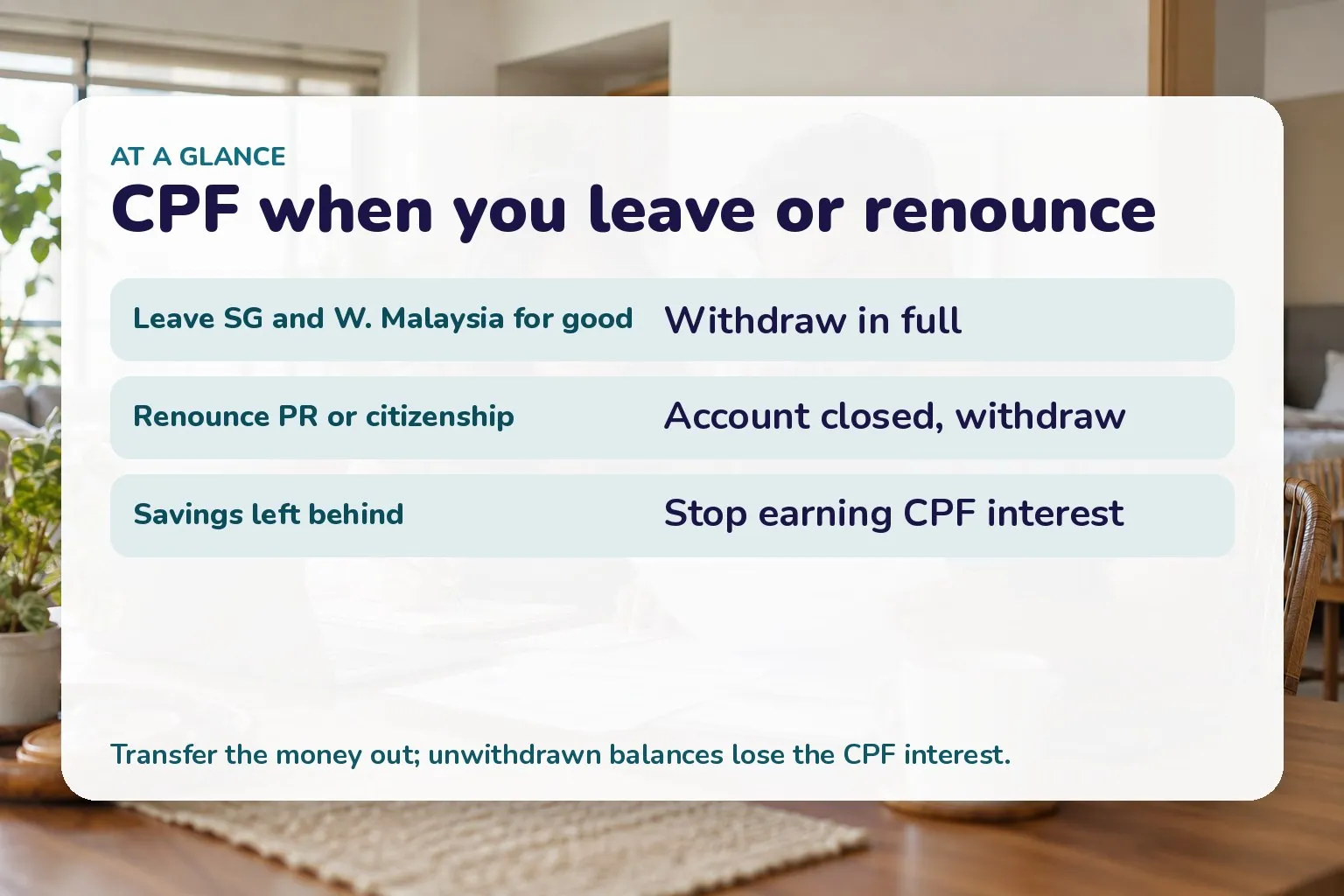
What happens to your CPF when you leave or renounce. Source: MOM and Singapore official guidance, November 2026.
One caution: do not leave the money sitting once you have gone. MOM is explicit that “Any unwithdrawn savings will cease to earn the prevailing CPF interest rates.” Because the interest advantage ends, the sensible move is to complete the transfer to your overseas bank account rather than leaving a balance behind. The withdrawal grounds and the age-55 set-aside apply consistently to citizens and PRs — MOM notes that “to safeguard retirement adequacy, SCs and PRs are required to set aside the Full Retirement Sum (FRS) at age 55”.
Before you leave, it also helps to have the practical admin ready, including a bank account that can receive the funds — see opening a bank account in Singapore. If PR status is still on your horizon, our PR overview explains the bigger picture.
Frequently asked questions
Do foreigners on an Employment Pass pay CPF? No. CPF contributions are not allowed for foreigners on an Employment Pass, S Pass, Miscellaneous Work Pass or Work Permit. Only Singapore citizens and PRs contribute.
Why did my pay drop when I became a PR? Because CPF contributions start from the day you attain PR status. On a work pass there was no CPF deduction at all, so the switch to PR is when take-home pay falls.
Can I withdraw my CPF while still living and working in Singapore as a PR? No — full withdrawal is tied to leaving Singapore and West Malaysia permanently, or renouncing your PR or citizenship. While you are a PR here, CPF continues as normal.
What happens to my CPF if I renounce PR? Your participation in CPF ceases, your account is closed in the month following renunciation, and you can withdraw your savings in full. Anything left behind stops earning the prevailing CPF interest.
Do self-employed PRs pay CPF? Not the full payroll CPF, but they owe a mandatory MediSave contribution once CPF bills them after IRAS assesses their trade income, payable within 30 days of the notice.
General information for newcomers, not financial advice. CPF rates, rules and withdrawal conditions change — confirm the current position on the CPF Board and MOM websites for your own circumstances.
Sources
- Who is entitled to CPF contributions — Ministry of Manpower (as of November 2026)
- How much CPF contributions to pay — Central Provident Fund Board (as of November 2026)
- Who do you need to pay CPF for (PDF) — Central Provident Fund Board (as of November 2026)
- Saving as a self-employed person — Central Provident Fund Board (as of November 2026)
- Oral Answer to PQ on CPF withdrawal for foreigners — Ministry of Manpower (as of November 2026)
- Withdrawal of Central Provident Fund (CPF) Contributions — High Commission of the Republic of Singapore (as of November 2026)