Re-Entry Permit (REP) for PRs Explained

A Re-Entry Permit is what keeps your PR status alive while you are overseas. It is usually valid five years, costs S$10 per year, and you renew it online up to three months before it expires. Travel without a valid one and you risk losing PR.
On this page9 sections · tap to jump
Singapore permanent residence does not travel with you on its own. The document that keeps it alive when you fly out is the Re-Entry Permit (REP), issued by the Immigration & Checkpoints Authority (ICA). Hold a valid one and you come back as a PR; let it lapse while you are abroad and your status is on a strict clock. This guide explains what the REP does, how long it lasts, how to renew it, what it costs, and the 180-day rule that took effect on 1 December 2025.
What the Re-Entry Permit is
When you were granted PR, ICA issued you two things: an Entry Permit, which lets you enter and remain in Singapore, and a Re-Entry Permit, which lets you leave and return as a PR. The Entry Permit governs your stay here; the REP governs your travel. A valid REP lets you re-enter Singapore one or more times during its validity period.
The catch is what happens the moment you step out of the country. ICA is blunt about it: “If you leave Singapore or remain overseas without a valid REP, you will lose your permanent residence status.” In that situation you would be assessed for entry like any foreign visitor. Your blue identity card alone does not get you back in — the REP is the part that proves you are still a PR.
Validity and cost
A REP is granted for a fixed period — up to five years — and the first one you receive, issued when you complete your PR formalities, is a five-year permit costing S$50. After that, the fee is set by a simple rule: S$10 for every year, or part of a year, of the REP that is approved, with a separate fee for each permit issued. A five-year renewal therefore costs S$50; a shorter permit costs less.
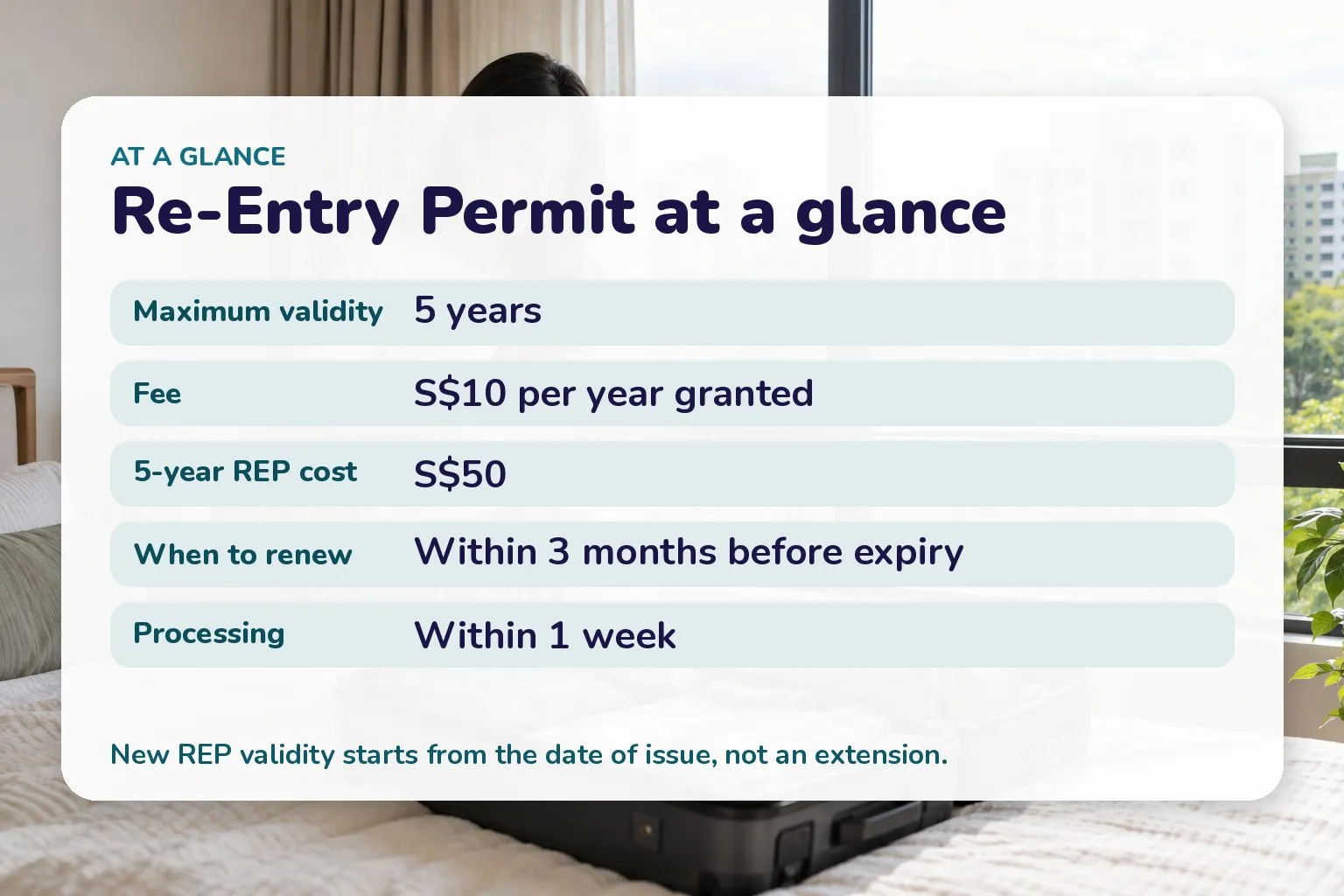
Key REP facts for Singapore PRs.
Two points catch people out. First, a renewed REP is not an extension of the old one — its validity starts from the date of issuance, after you have paid. Second, ICA decides the length it grants; most PRs get five years, but a shorter validity can be issued (for example, a three-month REP for a PR who has to return to Singapore to complete formalities). Treat a short REP as a signal to sort things out quickly.
How to apply or renew, step by step
Renewing is quick and entirely online for most PRs. Do it within the three months before your current REP expires:
- Check your expiry date. Log in to ICA’s website to view your REP validity; you can also print a copy of your REP.
- Check your passport. You must hold a valid travel document with at least three months’ validity. Renew the passport first if it is close to expiring.
- Apply online via ICA’s e-Service with your Singpass. You do not need to submit any documents unless ICA specifically asks for them.
- Wait about a week. The general processing time is within one week, excluding the day you submit; some cases take longer.
- Pay within 14 days of approval. The fee (S$10 per year granted) is due within 14 days of the approval date, or the application is withdrawn. You can pay by Visa/MasterCard, AMEX, internet direct debit from a local bank, or PayNow.
- Save your new REP. Its validity runs from the date of issue once payment clears.
The 180-day rule from 1 December 2025
This is the most important change to PR rules in years, and it cuts both ways: the grace period is now much longer, but the outcome is automatic and there is no reinstatement.
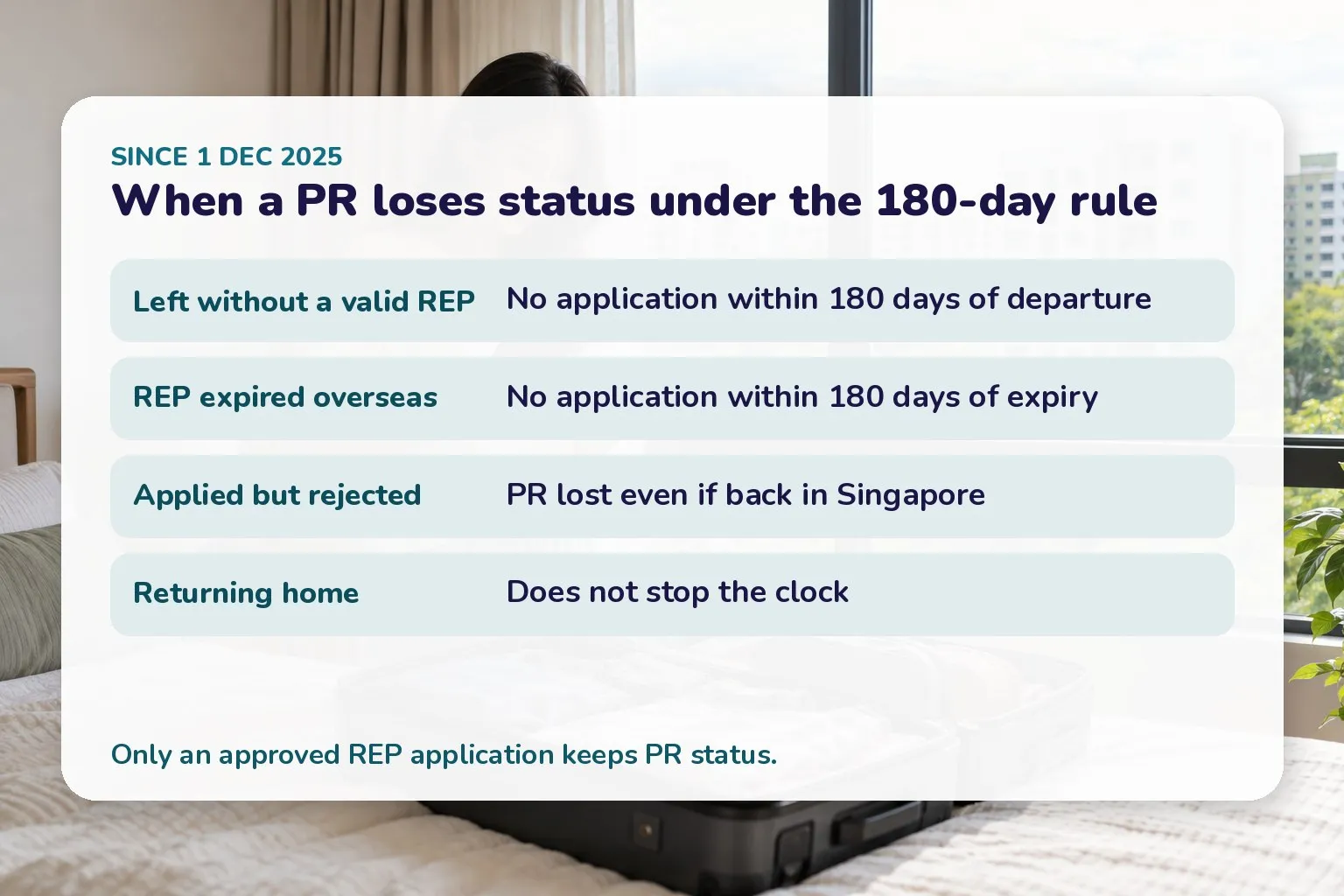
How the 180-day rule ends PR status. Source: ICA, from 1 December 2025.
Under the Immigration Act 1959, from 1 December 2025 you lose your PR status if either of these happens:
- You leave Singapore without a valid REP and do not apply for a REP within 180 days of your departure; or
- Your REP expires while you are overseas and you do not apply for a new REP within 180 days of that expiry.
Crucially, applying is not the same as being granted. ICA states that if you apply within the 180 days and the application is rejected, you lose PR status “even if you subsequently return to and are in Singapore at the point of REP rejection.” To stay a PR you must apply within 180 days and successfully obtain the permit.
How to get back in during that window? ICA may issue a Permanent Resident’s Single-Entry Pass (PRSEP) on arrival so you can re-enter, subject to the usual entry requirements. It covers a single entry only and does not replace the REP — you must still apply within the 180 days. This process replaced the old rule, under which a PR lost status immediately when the REP expired abroad, with only a one-month grace period to apply for reinstatement at ICA’s discretion. Reinstatement is no longer the mechanism; the 180-day application window is.
If your REP expires while you are in Singapore
Here the news is calmer. If you are physically in Singapore when your REP expires, you keep your PR status — the risk only begins when you leave the country. The sensible move is still to renew before you travel. ICA and advisers recommend renewing three months before expiry, or applying for a fresh REP before you exit, rather than discovering a lapsed permit at the airport.
New passport: transfer your REP
If you get a new passport of the same nationality, you must update the passport details on your REP promptly, using ICA’s transfer-of-REP function online. At the checkpoint, ICA will clear you as a PR only if your REP is valid and carries your current passport details. A renewed passport with an un-transferred REP is a common reason PRs are held up on return, so do the transfer before you travel.
Conditions that keep your PR
A valid REP is necessary but not sufficient — PR also comes with conduct conditions. From 1 December 2025, every Entry Permit and Re-Entry Permit carries a condition allowing ICA to cancel it if the holder breaches a permit condition, is found by a court or authority to have broken the law, or is considered to have behaved in an undesirable manner. ICA names examples such as interfering in Singapore’s domestic politics, undermining social harmony, or committing criminal offences including unauthorised drug consumption. A PR found in breach can have their status reviewed and revoked.
FAQ
How much does it cost to renew? S$10 for every year, or part of a year, of validity granted — so S$50 for a five-year REP. Pay within 14 days of approval.
How long does processing take? Usually within one week, excluding the submission day. Some applications take longer.
Can I appeal if I lose PR under the 180-day rule? The official pages set out the loss of status but do not describe an appeal route for it; confirm your own position directly with ICA before relying on one.
What if I only travel to Johor for the day? You still need a valid REP to re-enter as a PR. There is no exemption for short or regional trips.
What this means for your move
- Diarise the expiry date and renew in the three-month window — do not wait until a trip forces it.
- Keep your passport ahead of your REP, and transfer the REP whenever you change passports.
- If a long posting abroad is coming, plan the renewal before you go; the 180-day clock is a far worse place to be than a fresh permit.
If PR is still on your to-do list, start with applying for PR: an overview, understand how PR changes your CPF contributions, and if you are weighing it against staying on a work pass, compare the Employment Pass route.
General information only, from ICA, with the date each figure was checked. We are not an immigration agent; the final decision on any permit rests with ICA. Confirm the current rules on the official ICA website for your own case.
Sources
- Apply for/Renew Re-Entry Permit — Immigration & Checkpoints Authority (as of October 2026)
- Entry Permit and Re-Entry Permit conditions for Singapore Permanent Residents — Immigration & Checkpoints Authority (as of October 2026)
- Becoming a Permanent Resident (fees) — Immigration & Checkpoints Authority (as of October 2026)
- Singapore updates renewal process for Re-Entry Permits (1 December 2025) — EY (summarising ICA) (as of October 2026)