Seeing a Doctor in Singapore as a Foreigner

As a foreigner you can walk into any GP, or use a public polyclinic at the non-resident rate of S$90.36 a consultation. Specialist care at a public hospital needs a referral; for emergencies call 995 or go straight to A&E.
On this page9 sections · tap to jump
Falling ill in your first weeks in Singapore raises a practical question: where do you actually go, and what will it cost you as a non-resident? The medical care is excellent and easy to reach, but foreigners pay full, unsubsidised rates and sit outside the subsidy schemes residents use. This guide maps the three places you can see a doctor — GP, polyclinic and A&E — with the official non-resident fees, when a referral is needed, and the schemes that are not open to you.
Your options at a glance
For everyday illness you have two first stops: a private GP clinic or a public polyclinic. For anything a GP cannot handle you may be referred to a specialist at a public (restructured) hospital. For a true emergency you go to a hospital A&E or call 995 for an ambulance. Which one is right depends on how urgent it is and what you are willing to pay.
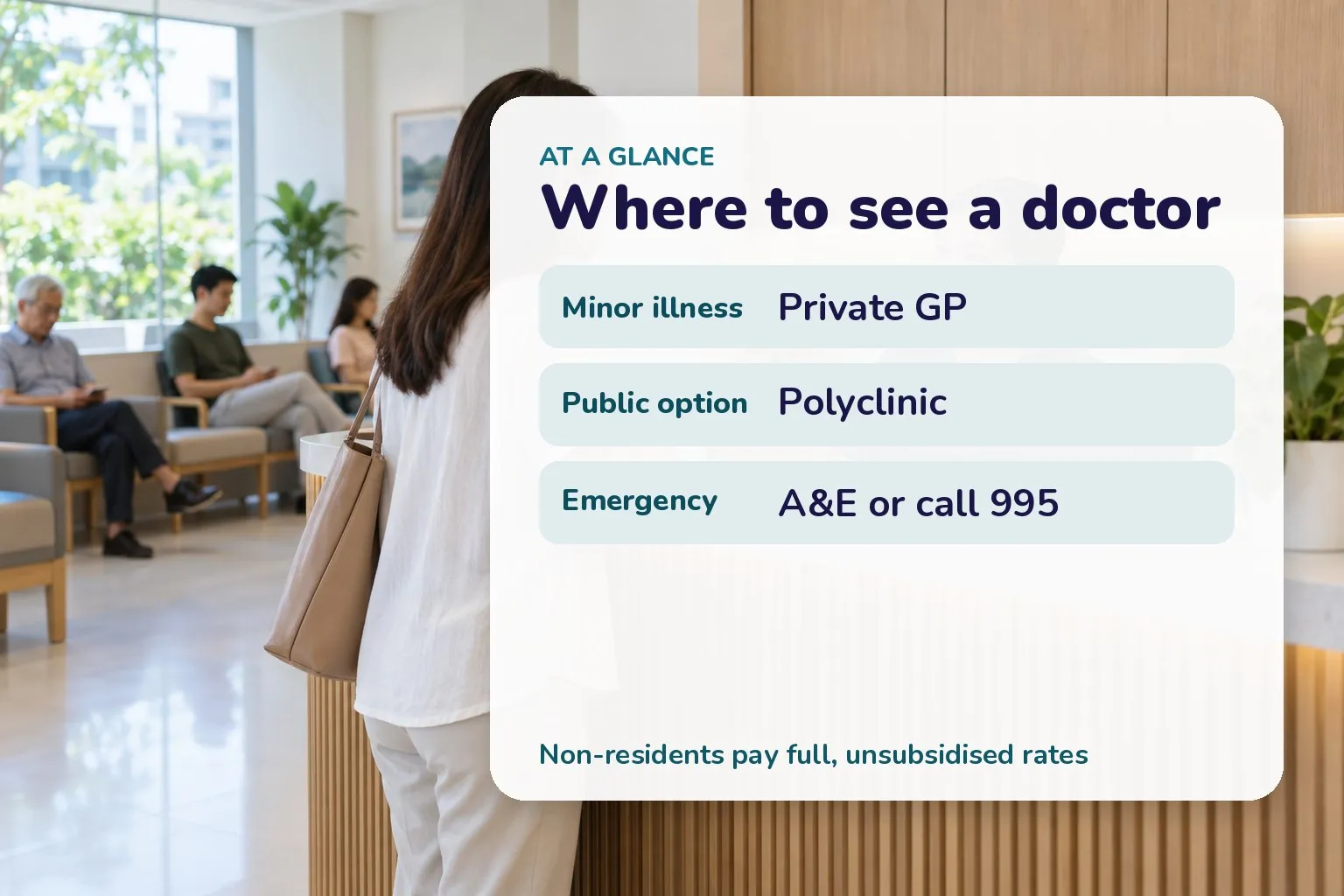
Choosing between a GP, a polyclinic and A&E as a non-resident.
GP clinics: the usual first stop
For minor illness — coughs, fever, infections, a sick note — a private GP clinic is usually the fastest option. There is no registration or catchment area: you can walk into or book almost any clinic. Each clinic sets its own fees, which vary with the time of day, the medicines dispensed and any tests, so treat a quoted figure as a clinic-specific guide rather than a fixed price. Many employer insurance plans also have panel clinics where treatment is cashless, so it is worth checking which GPs your policy covers.
Polyclinics: public but not subsidised for you
Polyclinics are public primary-care centres. You can use one, but as a non-resident you pay the unsubsidised rate. At SingHealth polyclinics a standard consultation costs a non-resident S$90.36, against S$19.60 for a citizen, S$39.70 for a permanent resident and S$9.00 for a citizen child or senior — and that is the consultation alone, before medicines or tests. Non-resident dental examination and diagnosis runs S$60.39 to S$105.95. Prices are inclusive of GST; the Government absorbs GST only for subsidised patients.
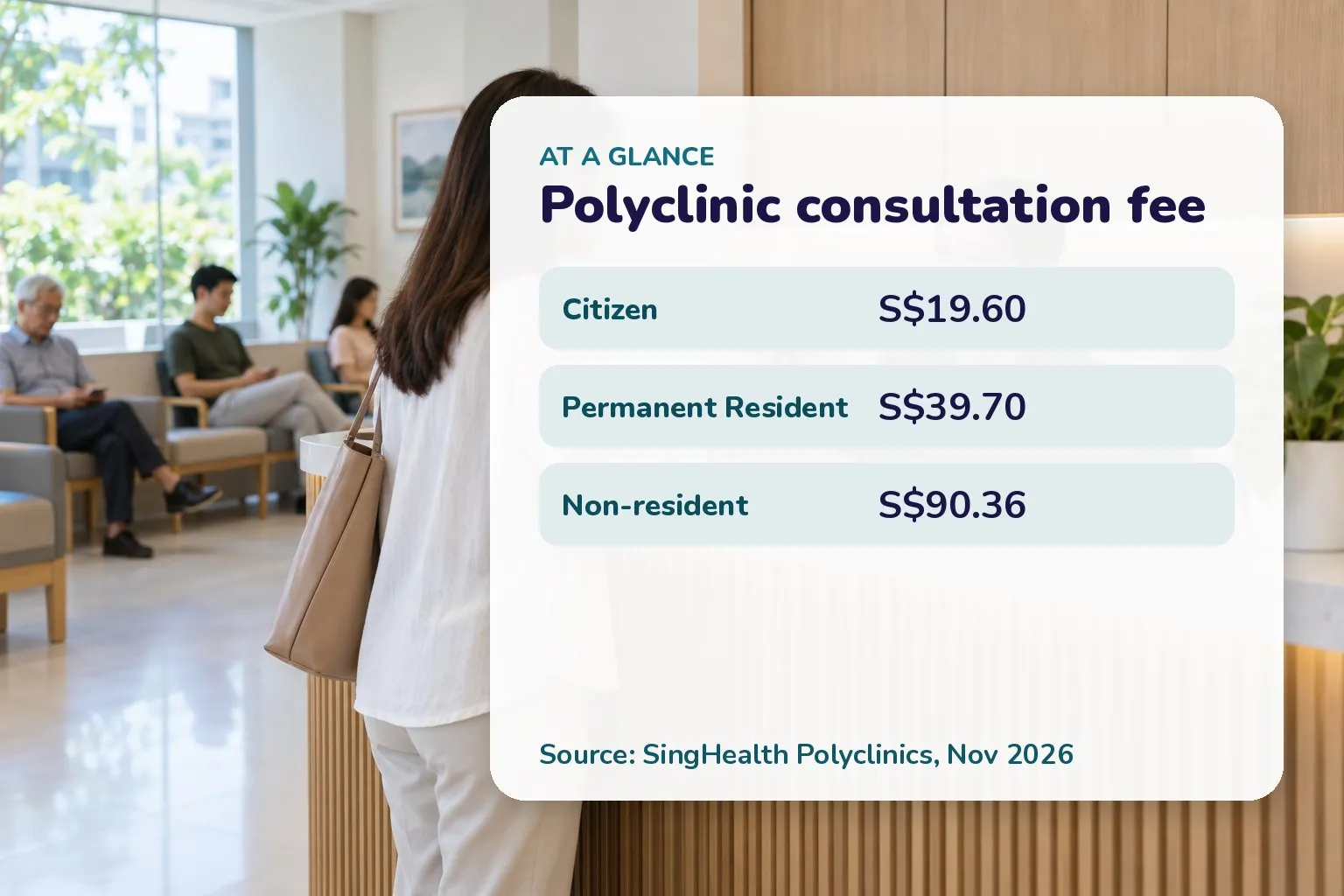
Standard adult consultation. Source: SingHealth Polyclinics, Nov 2026.
Seeing a specialist: the referral step
If you need a specialist at a public hospital, there is a step first: a referral from a polyclinic or GP is needed to be seen at the Specialist Outpatient Clinic. SingHealth explains that patients “require patients to be first assessed by the polyclinics for referrals to the SOC as subsidised patients” — the referral targets specialist resources at those with clinical need. Once referred, the clinic processes it and you “should receive an SMS or notification in HealthHub or Health Buddy app for your specialist appointment”; if no date arrives within seven days, you call the clinic.
The referral, though, does not buy you a subsidy. As a non-resident at Singapore General Hospital, a first specialist consultation ranges from S$221.62 (Associate Consultant/Registrar) to S$288.78 (Senior Consultant), against S$33.40 to S$77.93 for a subsidised citizen. There is also a middle private-patient tier for citizens and PRs who opt out of subsidy — a first consultation of S$170.48 to S$222.14 — but as a foreigner you are billed at the non-resident rate above it. Private specialists can usually be booked directly without a referral, but you pay private rates there too.
Dental and everyday extras
A polyclinic also handles basic dental, again at the non-resident rate: an examination and diagnosis costs S$60.39 to S$105.95, before any treatment such as scaling, a filling or an extraction. For general care, remember that fees stack — the consultation is only the start, and medicines, a medical certificate, injections or tests are billed on top of it.
If you have employer insurance, ask which panel clinics treat you cashless; paying out of pocket and claiming back later is slower and ties up your money. Keeping to a panel GP for routine visits, and reserving the hospital for genuine specialist or emergency needs, is the simplest way to keep your out-of-pocket costs predictable as a non-resident.
Emergencies and A&E
For a life-threatening emergency — chest pain, severe injury, breathing difficulty — call 995 for an ambulance or go straight to a hospital A&E. No referral is needed. MOH states that “all patients who visit the A&E department in a public hospital are charged at a single flat subsidised rate for basic investigations and services, regardless of income”, and that in emergencies patients “are always attended to first and payment is collected after treatment.” No one is denied essential care for being unable to pay.
At Singapore General Hospital the Emergency Department attendance fee is S$172.90, which covers the doctor’s consultation, nursing, basic investigations and treatment, and standard medication up to one week’s supply; specialised scans or procedures cost extra. For non-residents the bill is sent by email or post rather than collected on the day.
CHAS is for citizens, not you
You may read about the Community Health Assist Scheme (CHAS), which gives subsidies at private GP and dental clinics. It will not help you: CHAS “enables Singapore Citizens … to receive subsidies for medical and dental care”, and “all Singapore Citizens are eligible for CHAS.” As a foreigner you are not eligible for a CHAS card. CHAS subsidies also do not apply at polyclinics — they are only for participating private clinics. Your cost control comes from insurance and from choosing the right level of care, not from a subsidy card.
Before you go
- Bring your passport, FIN or work pass to register; SGH asks you to bring your “Identity Card, Work Permit, foreigner pass or passport.”
- Set up Singpass to book appointments and view health records once you have a FIN.
- Keep your insurer’s details and hospital-admission hotline handy — read how health insurance works for expats.
- If your visit is for a work-pass requirement rather than illness, see the work-pass medical examination guide.
Frequently asked questions
Is a polyclinic cheaper than a GP for me? Usually not. A non-resident polyclinic consultation is S$90.36, close to a private GP’s fee, and you pay extra for medicines and tests on top.
Do I need a referral to see a specialist? To be seen at a public-hospital specialist clinic, yes — a GP or polyclinic referral gets you the appointment. Private specialists can often be booked directly. Either way, as a non-resident you pay unsubsidised rates.
What do I do in an emergency? Call 995 for an ambulance or go to the nearest A&E. You are treated first and billed afterwards; no one is turned away for inability to pay.
Can I get a CHAS card to save money? No. CHAS is a subsidy scheme for Singapore citizens only; it is not open to foreigners or available at polyclinics.
General information only, not medical advice, from SingHealth, SGH and MOH with the date each figure was checked. Fees change — confirm the current charge with the clinic or hospital before your visit.
Sources
- Charges and Payment (polyclinic non-resident fees) — SingHealth Polyclinics (as of November 2026)
- What you need to know (referrals to specialist clinics) — SingHealth Polyclinics (as of November 2026)
- Outpatient Charges and Emergency Department Attendance Fee — Singapore General Hospital (as of November 2026)
- Payment for A&E services in public hospitals — Ministry of Health (as of November 2026)
- Community Health Assist Scheme (CHAS) — HealthHub (MOH) (as of November 2026)
- Your Journey at SGH Emergency Department — Singapore General Hospital (as of November 2026)