Bringing Your Pet to Singapore: Dogs and Cats
To bring a dog or cat to Singapore you must microchip it, meet the rabies conditions for your country's risk category, obtain an AVS dog or cat licence and an import licence before arrival, and clear inspection — with post-arrival quarantine for higher-risk countries.
On this page9 sections · tap to jump
- 01Can you bring your pet, and the big picture
- 02Before you start: microchip and age
- 03Rabies risk categories decide your conditions
- 04Breeds and how many pets you can keep
- 05The licences you need
- 06Quarantine on arrival
- 07GST and Singapore Customs
- 08Arrival, inspection and timeline
- 09Frequently asked questions
Moving to Singapore with a dog or cat is entirely doable, but it is a planned, multi-month process — not a last-minute airline booking. Two authorities share the job: the National Parks Board’s Animal & Veterinary Service (AVS) handles health and licensing, while Singapore Customs handles the import declaration and tax. Miss one of their steps and your pet can be held, quarantined longer, or refused. Here is the full picture, in the order you need to tackle it.
Can you bring your pet, and the big picture
Yes — most dogs and cats can be imported, provided you meet AVS’s veterinary conditions and Customs’ requirements. Customs is explicit that both sides matter: all pets must meet the animal health and licensing requirements regulated by NParks AVS, and separately clear the import declaration and any GST with Customs. Think of it as two parallel checklists that both have to be ticked before your pet is released.
The amount of work depends almost entirely on where you are flying from, because that sets your pet’s rabies risk category — so start there.
Before you start: microchip and age
Two baseline rules apply to every dog and cat. First, your animal must be microchipped to International Standards Organisation (ISO) Standard 11784 or 11785 Annex A, and that microchip number must appear on all its vaccination and treatment records. Second, your dog or cat must be at least twelve (12) weeks of age at the time of export.
Do the microchip first. Every later record — rabies vaccination, blood test, health certificate — is tied to that number, and a vaccination given before the chip was implanted may not be accepted.
Rabies risk categories decide your conditions
AVS sorts exporting countries into three schedules by rabies risk, and the veterinary conditions vary by category. This is the single biggest factor in your timeline.
- Schedule I (Australia, New Zealand, Republic of Ireland, United Kingdom): the dog or cat does not require rabies vaccination and a serology test, and does not undergo quarantine if fully compliant.
- Schedule II (much of Europe, the USA, Japan, Canada, Hong Kong and others) and Schedule III (everywhere else): your pet needs a valid rabies vaccination, then a rabies serology blood test taken at least 28 days after vaccination, done at least 90 days and within 12 months before export. The result must show a rabies antibody titre of at least 0.5 IU/ml from an approved laboratory.
Breeds and how many pets you can keep
Before you fall in love with the logistics, confirm your specific animal is even allowed. Singapore bans several dog breeds outright, including Pit Bull types, the Akita, Boerboel, Dogo Argentino, Fila Brasileiro, Neapolitan Mastiff, Tosa and Perro de Presa Canario, plus crosses of these. For cats, first- to fourth-generation Bengal or Savannah crosses are not allowed; a fifth-generation-or-later cross needs documentary proof.
Housing limits matter too. An HDB flat allows up to 2 cats and 1 dog of an HDB-approved small breed (Housing and Development (Animals) Rules 2024); non-HDB premises allow up to 3 cats or dogs combined, of which only one may be a Specified dog. If you are still house-hunting, factor this into your rental search.
The licences you need
Here the order is strict: you must obtain a dog or cat licence before you apply for the import licence. The dog or cat licence is done on AVS’s Pet Animal Licensing System (PALS). For the first three pets, a one-year licence costs S$15 for a sterilised animal and S$90 if unsterilised, with a 10% rebate for GIRO, online or AXS payment; a lifetime one-time licence for a sterilised pet is S$35.
Then apply for the import licence before arrival. It is valid for 90 days from the date of issue, with no extension — so do not apply so early that it lapses before the flight, nor so late that approval is still pending on travel day.
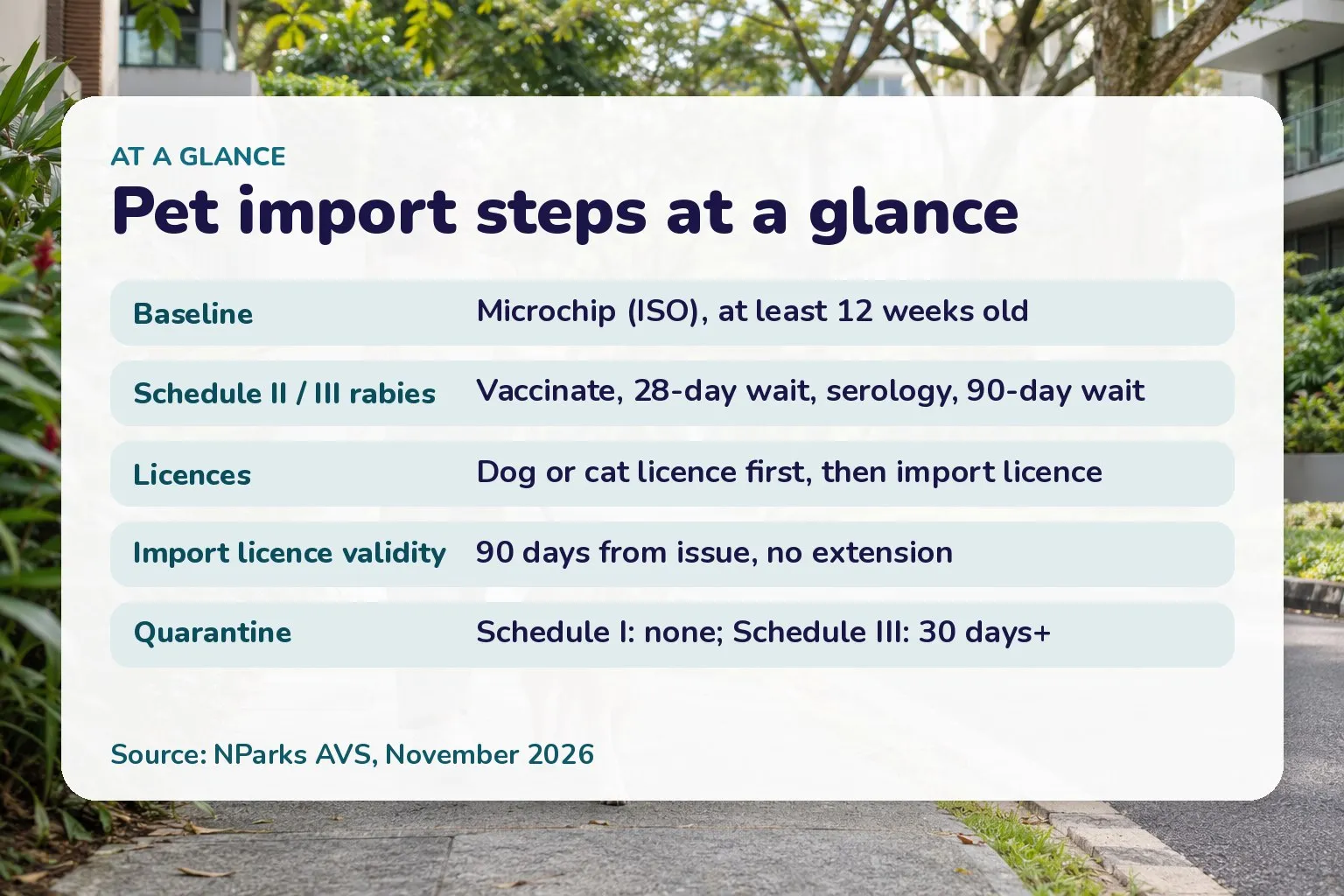
The pet import steps at a glance.
Quarantine on arrival
Whether your pet is quarantined depends again on the schedule. Pets from Schedule I countries do not undergo any quarantine when fully compliant. Pets from Schedule III countries must serve a post-arrival quarantine of at least 30 days and are vaccinated against rabies on arrival. Schedule II pets may avoid post-arrival quarantine if they meet specific conditions (for example, living with you for a set period), otherwise a short home or facility quarantine applies.
Where home quarantine is allowed, AVS uses a smart collar tag charged at S$29 per animal per day or part thereof. Facility quarantine at the Animal Quarantine Centre must be booked in advance through AVS’s Quarantine Management System.
GST and Singapore Customs
The importation of personal pets is subject to Goods and Services Tax (GST). If you are relocating, you may qualify for change-of-residence GST relief, but it is not automatic and is assessed case by case. The conditions include owning the pet for at least 3 months, importing it within 6 months of your first arrival in Singapore, and undertaking not to sell or transfer it within 3 months of import.
If your pet travels separately from you, you must submit a Declaration of Facts to Customs at least 5 working days before arrival. Getting the GST paperwork wrong will not usually bar entry, but it can mean paying tax you could have had relieved.
Arrival, inspection and timeline
Book the border-control inspection at least 5 days before arrival; turning up without an appointment attracts an inspection fee of S$133 per hour or part thereof. Dogs and cats arriving by air are inspected at Changi Animal & Plant Quarantine Station (CAPQ); those arriving by land are inspected at Tuas Checkpoint. Large carriers (over 82cm long, 64cm high, 58cm wide) must be collected in person by the owner or agent on clearance. Separately, between 2 and 7 days before export, your vet does parasite treatments and completes the veterinary health certificate.
A realistic Schedule II/III timeline therefore runs to four months or more: microchip and vaccinate, wait 28 days, blood test, wait 90 days, then line up licences, flights, quarantine and inspection. Schedule I moves are far quicker.
Frequently asked questions
Can I carry my pet in the cabin? Dogs and cats may travel in-cabin or as excess baggage, but you must still provide an IATA-compliant rigid crate for the transfer to the quarantine station; soft bags are not allowed for that transfer.
Do I need both a pet licence and an import licence? Yes. The dog or cat licence on PALS must be obtained first; only then can you apply for the import licence.
How long is the import licence valid? 90 days from the date of issue, with no extension — re-apply if your travel date falls outside that window.
Is my pet definitely quarantined? Not if it comes from a Schedule I country and is fully compliant. Schedule III pets face at least 30 days; Schedule II depends on the conditions you meet.
Settling in with a pet is just one of the first-week tasks — see also converting your driving licence, getting a SIM card and opening a bank account.
General information only, from NParks AVS and Singapore Customs, with the date each rule was checked. Rabies categories, breed lists and fees change; confirm the current conditions for your country on the official AVS pages before you book anything.
Sources
- Importing dogs and cats — National Parks Board — Animal & Veterinary Service (AVS) (as of November 2026)
- Importing a pet (overview) — National Parks Board — Animal & Veterinary Service (AVS) (as of November 2026)
- Dog and cat licence fees — National Parks Board — Animal & Veterinary Service (AVS) (as of November 2026)
- Importing Personal Pets as Part of a Change of Residence — Singapore Customs (as of November 2026)