Understanding Your Payslip: Salary and CPF

A Singapore payslip must show 12 items, including your basic salary, allowances, deductions and net pay. The main deduction for citizens and PRs is the employee's CPF share; foreigners on a work pass have no CPF line.
On this page9 sections · tap to jump
- 01Does your employer have to give you a payslip?
- 02What a Singapore payslip must show
- 03From gross to net: how the figures fit
- 04The CPF line: what leaves your pay
- 05Ordinary Wages and Additional Wages
- 06What your employer may and may not deduct
- 07Foreigners on a work pass: no CPF line
- 08If your payslip is missing or wrong
- 09Frequently asked questions
Your first Singapore payslip can be a surprise — not because the pay is wrong, but because the layout, the jargon and the CPF line are unfamiliar. The good news is that what a payslip must show is set by law, so once you know the parts, every payslip reads the same way. This guide walks through each item, explains gross versus net pay, and unpacks the CPF deduction that trips up most newcomers.
Does your employer have to give you a payslip?
Yes, if you are covered by the Employment Act — which is most employees. The Ministry of Manpower (MOM) states that “from 1 April 2016, all employers must issue itemised pay slips to employees covered by the Employment Act.” It is not optional, and it is not only for locals.
The timing is fixed too. The payslip must be given “together with payment to employee” or, “if unable to give together, to be given within three working days of payment.” If you are leaving a job, MOM is specific: in the case of termination or dismissal, the employer “must give pay slip together with outstanding salary.” The format is flexible — “soft or hard copy (including handwritten)” all count — but the content is not.
What a Singapore payslip must show
MOM sets out exactly what an itemised payslip has to contain. Not every line applies to everyone — if you earn no overtime, the overtime items can be left off — but the structure is standard:
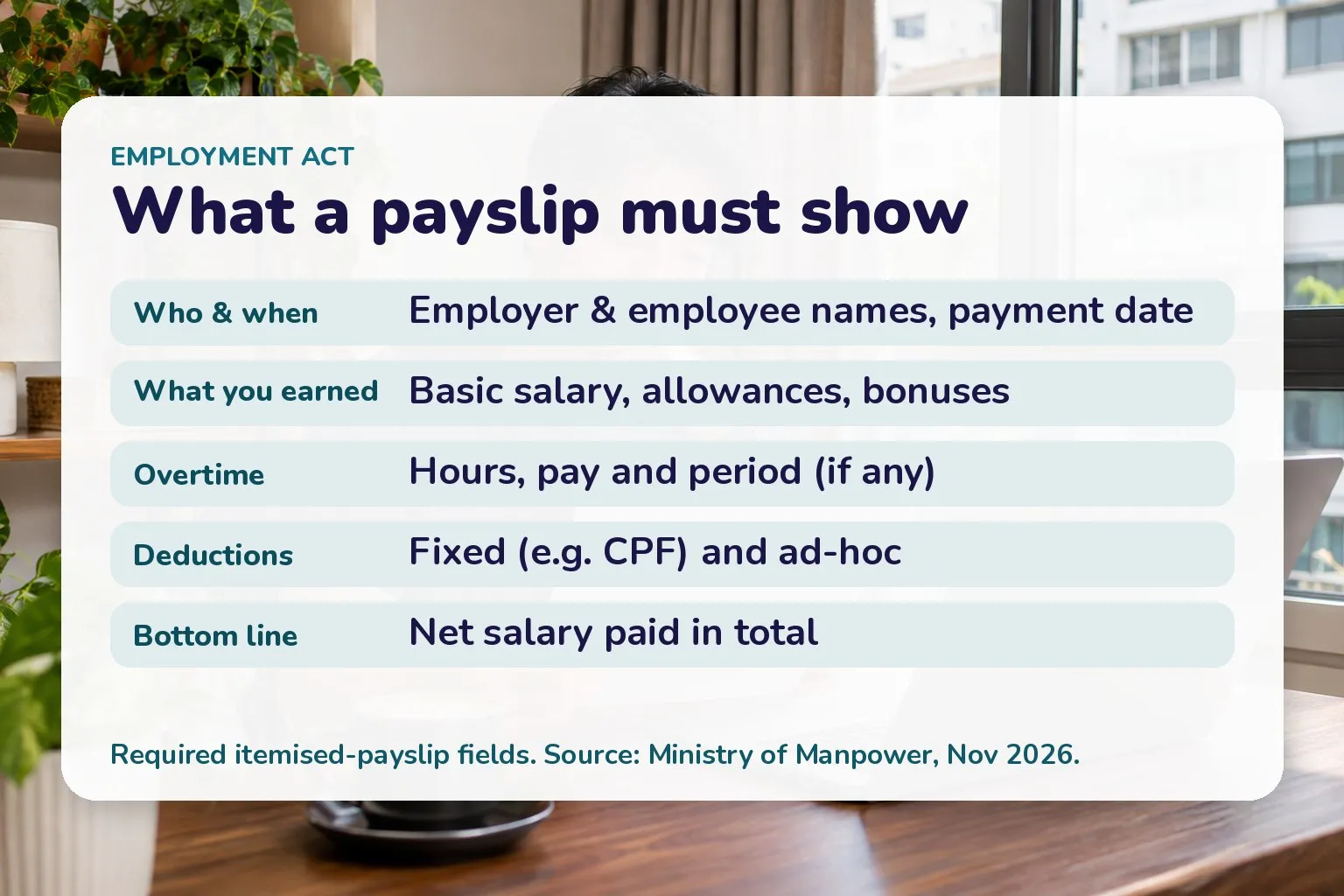
The items an itemised payslip must include.
- Full name of the employer.
- Full name of the employee.
- Date of payment (or dates, if several payments are consolidated).
- Basic salary (for hourly, daily or piece-rated staff, the rate and hours or pieces).
- Start and end date of the salary period.
- Allowances for the period — fixed ones such as transport, and ad-hoc ones such as a one-off uniform allowance.
- Any other additional payment, such as bonuses, rest day pay and public holiday pay.
- Deductions, both fixed (MOM’s own example is “employee’s CPF contribution”) and ad-hoc (such as no-pay leave). 9–11. Overtime hours, overtime pay and the overtime period (if different from the salary period).
- Net salary paid in total.
Read from the top, a payslip is simply: what you earned, minus what was deducted, equals what you were paid.
From gross to net: how the figures fit
Two numbers cause most of the confusion. Gross pay is everything you earned for the period — basic salary plus allowances, overtime and any bonus. Net pay (item 12) is what actually lands in your bank account, after deductions. The gap between them is the deductions in item 8, and for most employees the biggest single line there is CPF.
The CPF line: what leaves your pay
Here is the line newcomers ask about most. The Central Provident Fund (CPF) is Singapore’s national savings scheme, and for employees it is split into two shares: a share your employer pays on top of your salary, and a share deducted from your pay. Only the employee share appears as a deduction in item 8 — the employer share never reduces your net figure.
CPF applies to a specific group. The CPF Board tells employers they are “required to pay CPF contributions for your employees who are Singapore Citizens or Singapore Permanent Residents and who are earning total wages of more than $50 per month.” So if you are a citizen or permanent resident (PR), expect a CPF deduction; if you are a foreigner on a work pass, you will not have one (see below).
For an employee aged 55 or below, the current full rates from 1 January 2026 are 17% from the employer and 20% from the employee, a combined 37%. The 20% is the slice you see deducted. Two wrinkles are worth knowing: there is “no employee’s share of CPF contributions” if you earn above $50 but not more than $500 a month, and the employee share has its cents dropped when rounded. New PRs do not start at 20% — they ease in over their first two years on lower graduated rates, which our guide to CPF for new PRs sets out year by year.
Ordinary Wages and Additional Wages
CPF is not charged on unlimited salary. The CPF Act defines wages as “remuneration in money, including any bonus that is due or granted to a person in respect of his employment,” and then splits them into two types that each have a ceiling.
- Ordinary Wages (OW) are wages for that month, payable by the 14th of the following month — typically your monthly salary. CPF on OW is capped at the Ordinary Wage ceiling of S$8,000 a month in 2026; salary above that attracts no CPF. The CPF Board’s own example: “if an employee’s Ordinary Wages are $9,000 and the OW ceiling is $8,000,” CPF is charged only on the first $8,000.
- Additional Wages (AW) are irregular payments such as a bonus. These have a separate annual ceiling.
“Total Wages is the sum of Ordinary Wages and Additional Wages,” and CPF is computed on the total for the month, subject to those ceilings. Not everything you receive is wages, though: basic pay, overtime, commission, allowances and bonuses count, but genuine reimbursements, termination benefits and benefits-in-kind (such as a commemorative watch) do not — so they carry no CPF.
What your employer may and may not deduct
Beyond CPF, an employer cannot deduct from your salary for just any reason. The Employment Act limits the grounds — CPF contributions, absence from work, recovery of advances or overpaid salary, and a few others — and caps the amounts. For damage or loss of company property, for example, MOM says the employer may “not deduct more than 25% of your 1 month’s salary” and it “must be made as a one-time lump sum payment,” only after an inquiry.
There is also an overall ceiling. MOM states plainly that an employer “cannot deduct more than 50% of your total salary payable in any one salary period.” A few items, such as deductions for absence and loan recoveries, sit outside that 50% cap, and on your final payment when you leave, the total authorised deduction may exceed 50%.
Foreigners on a work pass: no CPF line
If you are on an Employment Pass, S Pass or Work Permit, you should see no CPF deduction at all — CPF is payable only for Singapore citizens and PRs. Your full salary, minus income tax arrangements and any allowable deductions, is yours. This is why take-home pay typically drops only when you convert to PR, not before. Our page on CPF for PRs and foreigners explains who pays and what happens to the savings if you later leave.
Income tax, by contrast, is handled separately from your payslip — most employees settle it once a year rather than through monthly deductions. See income tax for newcomers for how that works, and filing your first tax return when your first filing season arrives.
If your payslip is missing or wrong
If you are not getting payslips, or a figure looks wrong, raise it with your employer first — many errors are simple period or allowance mistakes. Employers must keep payslip records: for current employees, the “latest two years,” and for ex-employees, the “last two years, to be kept for one year after the employee leaves employment,” so the paper trail exists to check against.
If it is not resolved, MOM handles salary-related claims, and the records-keeping rules mean your employer should be able to produce the history. Keep your own copies each month — they are also useful evidence for rentals, loan applications and your tax filing.
Frequently asked questions
Is my employer required to give me a payslip in Singapore? Yes, if you are covered by the Employment Act. Itemised payslips have been mandatory since 1 April 2016, given with payment or within three working days of it.
Why is 37% mentioned when only 20% comes out of my pay? 37% is the combined employer-plus-employee CPF rate for a worker aged 55 or below. The 20% employee share is deducted from your pay; the 17% employer share is paid on top and credited to your CPF, never deducted from your take-home.
Do foreigners on an Employment Pass have CPF deducted? No. CPF is payable only for citizens and permanent residents, so a work-pass holder’s payslip has no CPF line.
Is there a limit on CPF deducted from a high salary? Yes. CPF on monthly salary is capped at the S$8,000 Ordinary Wage ceiling in 2026, so salary above that attracts no further CPF. Bonuses have a separate annual ceiling.
How much can my employer legally deduct? Generally no more than 50% of your salary for a period, and only for grounds allowed under the Employment Act. Some items, such as deductions for absence, sit outside that cap.
General information for newcomers, not legal or financial advice. CPF rates and ceilings and employment rules change — confirm the current figures with MOM and the CPF Board for your own situation.
Sources
- Itemised pay slips — Ministry of Manpower (as of November 2026)
- Allowable salary deductions — Ministry of Manpower (as of November 2026)
- How much CPF contributions to pay — Central Provident Fund Board (as of November 2026)
- What constitutes wages for CPF contributions — Central Provident Fund Board (as of November 2026)