Filing Your First Income Tax Return in Singapore

To file income tax in Singapore, e-File on myTax Portal with Singpass between 1 March and 18 April. You must file if your total income tops S$22,000, but many employees are on the No-Filing Service and only verify a pre-filled return.
Your first Singapore tax filing lands in the year after you start earning here, and it is simpler than most newcomers fear — but the timing, the login and the “do I even need to file?” question all trip people up. Here is how to file income tax in Singapore step by step for the Year of Assessment (YA) 2026, which covers income earned from 1 January to 31 December 2025.
Do you need to file?
Not everyone does. IRAS requires you to file an Income Tax Return if your total income for the year was more than S$22,000, or you had self-employment net profit above S$6,000, or you are a non-resident who earned income in Singapore (in which case you file regardless of the amount). Around February and March, IRAS sends a filing notification by SMS, email or letter; if you receive one telling you to file, you must.
Many employees, though, never fill in a return at all:
- No-Filing Service (NFS): you receive a pre-filled return and simply verify it. You can still file changes to income or reliefs by 18 April — but no filing extension is given under NFS.
- Direct Notice of Assessment (D-NOA): no action is needed; your tax bill is finalised from the records IRAS holds, and you receive it from mid-March.
The tax-season calendar
The window is fixed each year. Filing opens on 1 March and the e-Filing deadline is 18 April. After you file, your Notice of Assessment — the tax bill — generally arrives from end April to end September, and only then is tax due. For D-NOA cases the bill comes earlier, in March.
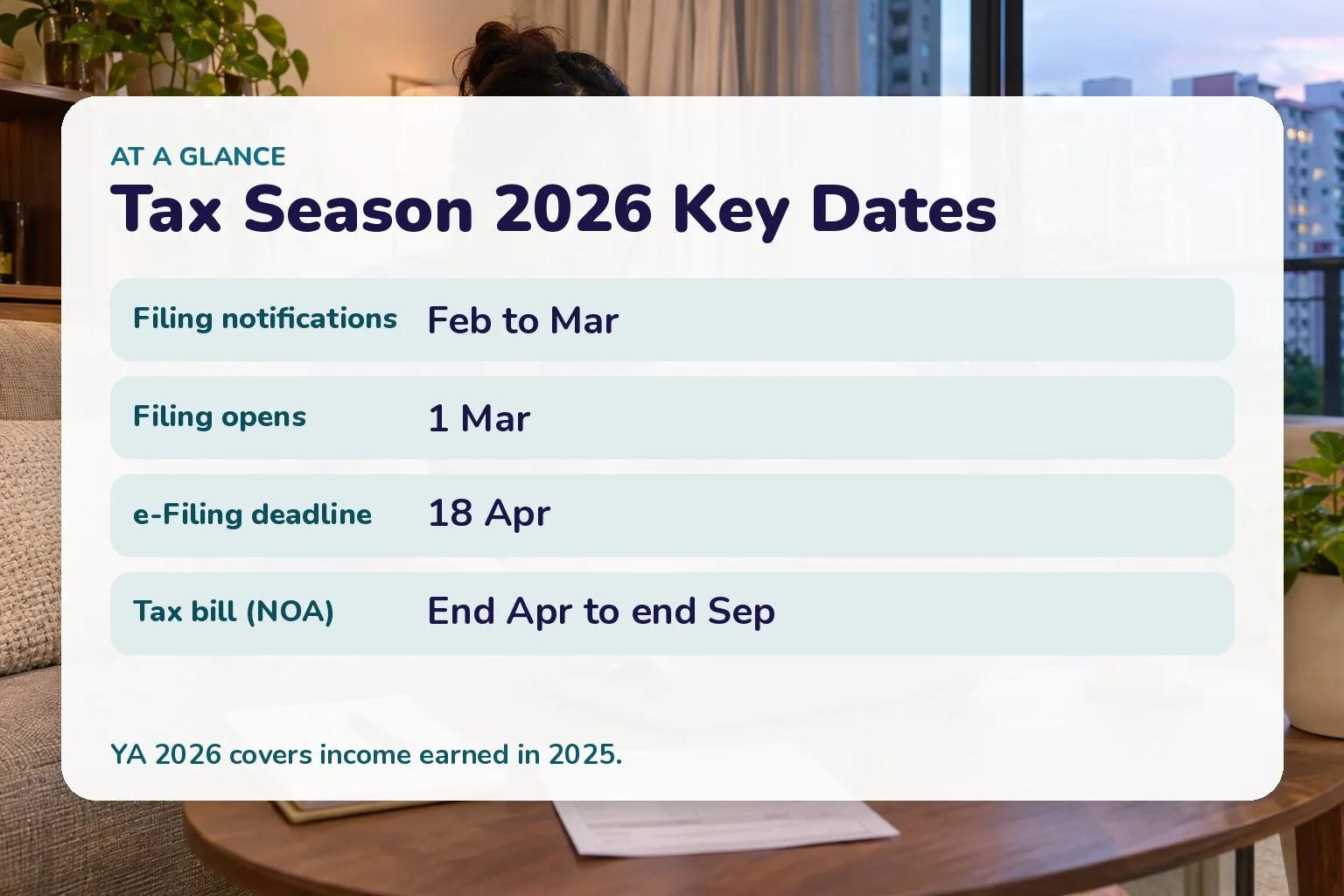
Key dates for Tax Season 2026. Source: IRAS, November 2026.
What you need before you start
Gather these before logging in — IRAS says the online form itself takes only about 5–10 minutes:
- Singpass, or a Singpass Foreign user Account (SFA) if you are not eligible for Singpass. Note that a 2-step verification is required, and the one-time PIN mailer can take 3 to 10 working days to arrive, so register well ahead of the deadline.
- Form IR8A from your employer — but only if your employer is not in the Auto-Inclusion Scheme. Under the Auto-Inclusion Scheme (AIS), your employer sends your income straight to IRAS by 1 March and it is pre-filled for you; a non-AIS employer must hand you the Form IR8A by 1 March instead.
- Particulars of any dependants (child, parent) for new relief claims — see which reliefs you can claim in our guide to income tax reliefs for newcomers.
- Details of other income, such as rent from a property.
How to e-File, step by step
- Log in to myTax Portal with your Singpass or SFA, then choose “Individuals” > “File Income Tax Return.”
- Check the pre-filled information. IRAS pre-fills employment income (from AIS employers), approved reliefs from last year, and rental income from e-stamped tenancy records. Verify it is accurate — if an employer’s figure is wrong, ask them to resubmit.
- Declare income that is not pre-filled, such as rental income, using “Add New.” If your AIS employer’s income is not showing, tick the box confirming your employer will transmit it.
- Update your reliefs — remove any you no longer qualify for, adjust shared claims, and add new ones. You will be asked to confirm, for example, that a dependant earned no more than S$8,000 in the year.
- Review the Consolidated Statement, tick the declaration, and Submit. Save or print the acknowledgement page that appears.
After you file: your tax bill
You may re-file only once, and only by 18 April; the new submission overrides the old one. Once your tax bill (Notice of Assessment) arrives, the window to correct it changes: use the Amend Tax Bill service within 30 days of the bill’s date for any wrong income or relief figure. You have a legal duty to flag inaccuracies, and there are penalties for staying silent.
Keep your paperwork. IRAS asks you to retain records — Form IR8A, payslips, CPF statements — for five years; for YA 2026 that means until 31 December 2030. You do not submit them unless IRAS requests them.
Paying your tax
Tax is paid after the bill, not at filing. IRAS steers you to GIRO or PayNow as the main digital methods; GIRO also lets you spread payment over interest-free instalments. IRAS does not take credit cards directly — you can only use a card via AXS, which caps a payment at S$20,000. If you overpay, any credit is refunded within 30 days of a revised bill.
If you miss the deadline
Late or non-filing is an offence, not a formality. IRAS can:
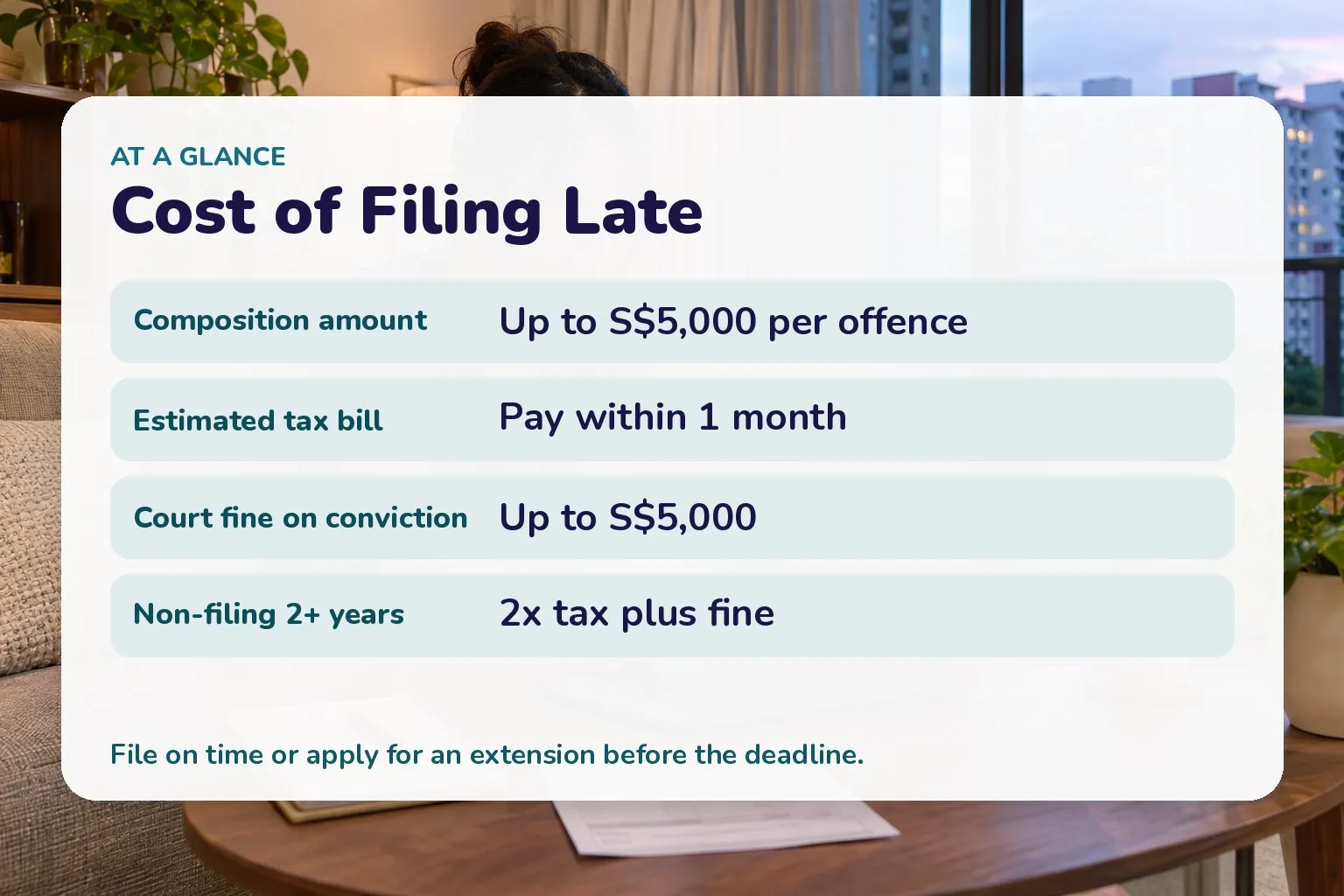
Consequences of late or non-filing. Source: IRAS, November 2026.
- Issue an estimated Notice of Assessment based on past income (often assuming an increase), which you must pay within one month even while you sort out the actual figures;
- Offer to compound the offence for a composition amount of up to S$5,000 per offence; or
- Issue a summons to court, where a conviction can mean a fine of up to S$5,000 per offence.
Fail to file for two years or more and the penalties escalate sharply: on conviction, a penalty of twice the tax assessed plus a fine of up to S$5,000, and possible imprisonment of up to six months. If you simply need more time, apply online through the “Apply for Extension of Time to File” service, which gives an instant decision — but not once a summons has been issued.
Frequently asked questions
I just arrived and have no NRIC — how do I log in? Apply for a Singpass Foreign user Account (SFA), which lets you access myTax Portal. Allow several working days for the one-time PIN mailer.
My employer already sent IRAS my income. Do I still file? Only if IRAS asks you to. If you are on the No-Filing Service you just verify the pre-filled return; if you received a notification to file, you must file even though the income is pre-filled.
When do I actually pay? After your Notice of Assessment arrives (generally end April to end September). Payment is not due at the point of filing.
Can I fix a mistake after submitting? Yes — re-file once before 18 April, or after the bill use Amend Tax Bill within 30 days of the bill date.
What if I earned under S$22,000? You generally need not file unless IRAS notifies you to, or you are a non-resident with Singapore income. If in doubt, check IRAS’s filing checker.
Related
For the rates and residency rules behind the numbers you will enter, read income tax for newcomers, and before you file, see which income tax reliefs you can claim so you do not miss a deduction. New PRs should also check CPF for new PRs, since CPF statements are part of your records.
General information only, from IRAS, with the date each figure was checked. We are not a tax adviser. Confirm current dates and rules on the official IRAS pages, and seek professional advice for your own case.
Sources
- Basic guide for new individual taxpayers — Inland Revenue Authority of Singapore (as of November 2026)
- Individuals required to file tax — Inland Revenue Authority of Singapore (as of November 2026)
- Tax Season 2026 - All you need to know — Inland Revenue Authority of Singapore (as of November 2026)
- e-Filing your Income Tax Return — Inland Revenue Authority of Singapore (as of November 2026)
- Late filing or non-filing of Individual Income Tax Returns — Inland Revenue Authority of Singapore (as of November 2026)
- Tax payment modes — Inland Revenue Authority of Singapore (as of November 2026)