Income Tax Reliefs Newcomers Can Claim

As a Singapore tax resident you can cut your bill with personal income tax reliefs, capped at S$80,000 a year. But many family reliefs need a Singapore-Citizen child, so newcomers lean most on Earned Income, SRS and Life Insurance Relief.
On this page8 sections · tap to jump
Singapore’s headline tax rates are low, but your actual bill depends just as much on the reliefs you can subtract first. The catch for newcomers is that income tax relief in Singapore is built mostly for citizens and their families — several of the biggest reliefs quietly require a Singapore-Citizen child or CPF contributions you do not make on a work pass. This guide sorts the reliefs you can genuinely claim from the ones that look available but are not, all for the Year of Assessment (YA) 2026 (income earned in 2025).
Who can claim reliefs — and the S$80,000 cap
The first gate is residency. Reliefs are for tax residents only, and the Inland Revenue Authority of Singapore (IRAS) spells out that this includes “non-Singapore Citizens who are in Singapore for more than 183 days in a year.” A non-resident gets no personal reliefs at all, so whether you clear the 183-day residency test decides whether any of this applies to you.
The second gate is the ceiling. A personal income tax relief cap of S$80,000 applies to the total of all reliefs claimed each YA — a limit in place since YA 2018. For most newcomers the cap is academic; you would need a very large stack of family and retirement-scheme reliefs to reach it. But it is a hard limit, not a target.
Reliefs most newcomers can use
A short list of reliefs is open to you as a foreign tax resident, regardless of your family’s nationality.
Earned Income Relief is automatic if you have taxable income from employment, a pension, or a trade. The amount rises with age: S$1,000 if you are below 55, S$6,000 at 55–59, and S$8,000 from 60 (restricted to your earned income if that is lower). You do not claim it — IRAS applies it.
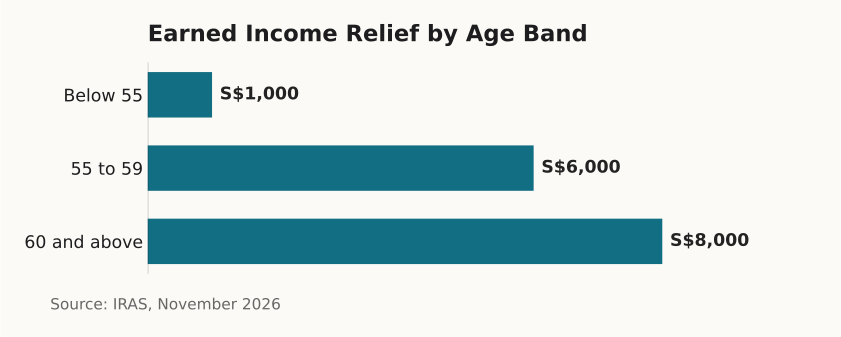
Maximum Earned Income Relief by age as at 31 Dec 2025. Source: IRAS, November 2026.
SRS Relief is where newcomers actually have an edge. The Supplementary Retirement Scheme is a voluntary savings scheme, and foreigners can contribute up to S$35,700 a year — more than double the S$15,300 ceiling for citizens and PRs. Every dollar contributed by 31 December is a dollar of relief in the next YA (within the S$80,000 cap), provided you are a tax resident that year. You need to be at least 18, and you may hold only one SRS account.
Life Insurance Relief is one most foreigners overlook precisely because of a rule that works in their favour. You can claim it only if your total compulsory CPF contribution was under S$5,000 — and since foreigners on work passes pay no CPF, that whole band is usually open. The relief is the lower of (S$5,000 minus your CPF) or 7% of the sum insured, capped at the premiums you actually paid, and the insurer must have a Singapore office or branch. From YA 2026 it also covers premiums a wife pays on her husband’s policy.
Parent Relief reaches further than people expect. If your own parents live with you in Singapore, are 55 or older, and earned no more than S$8,000 in the year, you can claim S$9,000 per parent (S$5,500 if they live in a separate Singapore household and you spend at least S$2,000 supporting them), for up to two dependants. A foreign parent counts as “living in Singapore” if they stayed here at least eight months in the year — relevant if a parent on a Long-Term Visit Pass spends most of the year with you.
Family reliefs: the Singapore-Citizen catch
This is where many newcomers lose reliefs they assumed they would get.
Qualifying Child Relief (QCR) is the exception that does work for foreign families: it is S$4,000 per child and does not require the child to be a citizen. The child must be unmarried, under 16 (or a full-time student), and have earned no more than S$8,000 in the year — a threshold raised from S$4,000 from YA 2025.
But the three big parenthood reliefs all hinge on citizenship:
- Working Mother’s Child Relief (WMCR) needs a Singapore-Citizen child and is only for mothers — “single or male taxpayers are not eligible.” For a child born or adopted from 1 January 2024 it is a fixed S$8,000 for the first child, S$10,000 for the second, and S$12,000 for the third and beyond.
- Parenthood Tax Rebate (PTR) is a one-off rebate of up to S$20,000 per child, again only where the child is a Singapore Citizen at birth or within 12 months — S$5,000 for a first child, S$10,000 for a second, S$20,000 for a third or later. Unused amounts carry forward.
- Grandparent Caregiver Relief gives a working mother S$3,000 when a grandparent cares for her Singapore-Citizen child aged 12 or below.
Reliefs that do not apply to work-pass holders
Two common reliefs are simply off-limits until your status changes.
CPF Relief tracks your compulsory CPF contributions — and foreigners make none. The CPF Board states plainly that “CPF contributions are not allowed for foreigners,” and that they become “mandatory for foreigners from the day they attain SPR status.” So there is no CPF Relief on a work pass; it appears only once you become a PR and start contributing (see CPF for new PRs).
NSman Relief (S$1,500 to S$5,000 for the serviceman, S$750 each for a wife or parent) recognises National Service and so does not reach foreigners either.
Reliefs that have lapsed
Do not plan around reliefs that have been withdrawn. Course Fees Relief has lapsed with effect from YA 2026, and the Foreign Domestic Worker Levy Relief lapsed from YA 2025. Older guides and forum posts still mention both; IRAS lists them as lapsed.
What changes when you become a PR
Permanent residence reshuffles your reliefs rather than simply adding to them. You begin paying CPF, so CPF Relief switches on automatically. At the same time your SRS ceiling drops from the foreigner’s S$35,700 to the citizen/PR S$15,300, so a newcomer planning a large SRS top-up may want to do it in the years before PR. Parenthood reliefs still turn on whether your child is a Singapore Citizen, which is a separate application to ICA. If PR is on your horizon, read our overview of applying for PR alongside this page.
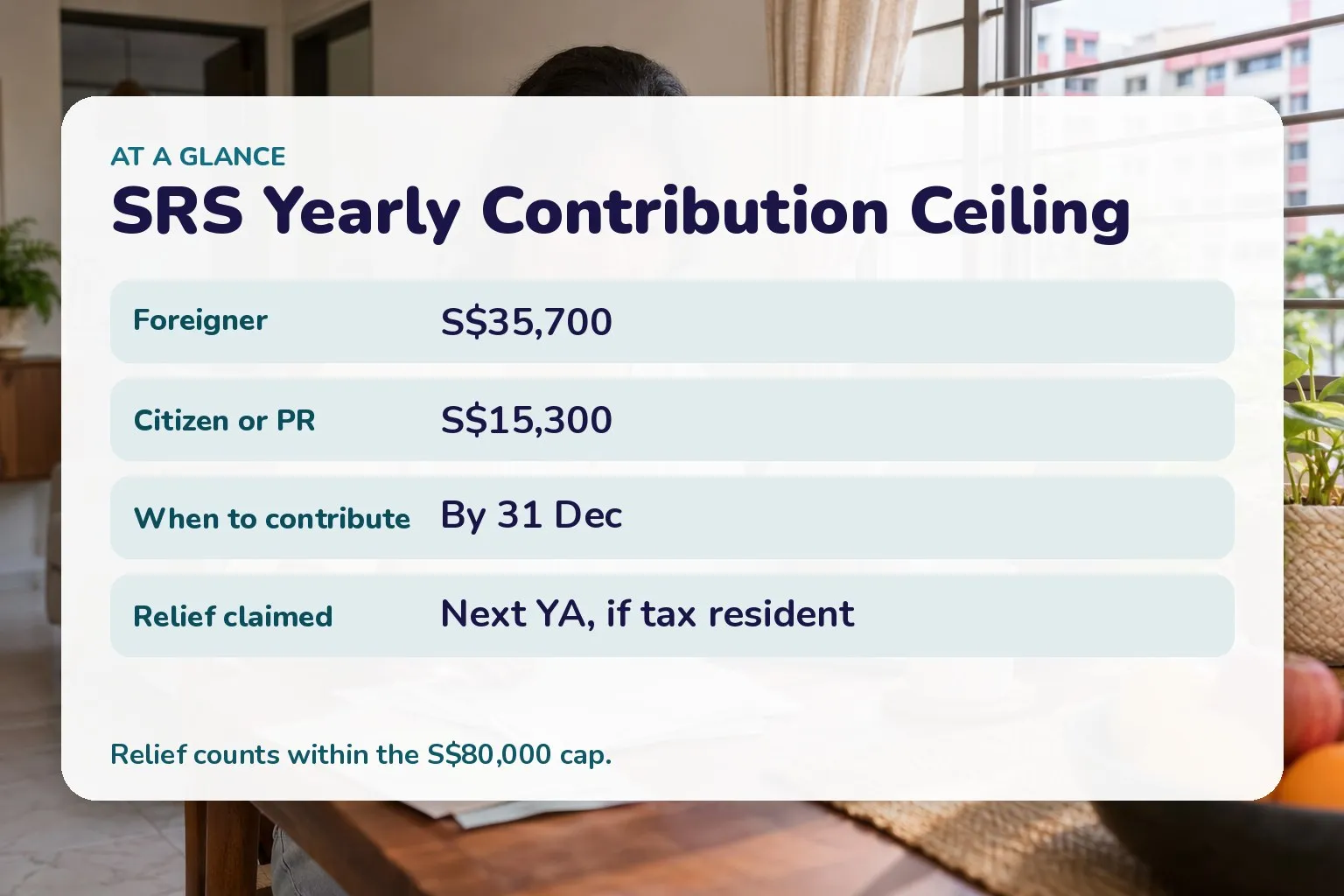
SRS contribution room by residency status. Source: IRAS, November 2026.
How to claim
Most reliefs are handled for you. Earned Income Relief, CPF Relief, NSman Relief and SRS Relief are applied automatically from records IRAS already holds; SRS, for instance, “will be allowed automatically based on the information provided by the SRS operator.” Reliefs that depend on your family circumstances — QCR, Parent Relief, Life Insurance Relief — are claimed when you e-File, under “Deductions, Tax Reliefs and Rebates,” and once granted they are pre-filled the next year. Our step-by-step guide to filing your first tax return walks through where each one sits.
Frequently asked questions
Can I claim any relief if I am a non-resident? No. IRAS allows personal reliefs only to tax residents (including non-citizens here more than 183 days). A non-resident gets none.
My child is not a Singapore Citizen — what can I still claim? Qualifying Child Relief of S$4,000, if the child is unmarried, under 16 or a full-time student, and earned S$8,000 or less. WMCR, PTR and GCR all require a citizen child.
Is SRS worth it just for the tax relief? It reduces this year’s tax and the foreigner contribution room is large, but the money is locked for retirement and early withdrawals are penalised. Treat it as retirement saving with a tax benefit, not a refund.
Do I need to keep proof of my relief claims? Yes — keep supporting documents for five years in case IRAS asks; you submit them only on request.
Related
Start with how income tax treats newcomers to see the rates these reliefs reduce, then our walkthrough of filing your first tax return for where to enter each claim. If PR is next, see what CPF for new PRs adds to the picture.
General information only, drawn from IRAS and the CPF Board, with the date each figure was checked. We are not a tax adviser. Confirm the current rules and amounts on the official IRAS pages, and seek professional advice for your own case.
Sources
- Tax reliefs (list and the personal income tax relief cap) — Inland Revenue Authority of Singapore (as of November 2026)
- Earned Income Relief — Inland Revenue Authority of Singapore (as of November 2026)
- SRS contributions and tax relief — Inland Revenue Authority of Singapore (as of November 2026)
- Life Insurance Relief — Inland Revenue Authority of Singapore (as of November 2026)
- Qualifying Child Relief (QCR)/Child Relief (Disability) — Inland Revenue Authority of Singapore (as of November 2026)
- Working Mother's Child Relief (WMCR) — Inland Revenue Authority of Singapore (as of November 2026)
- Parenthood Tax Rebate (PTR) — Inland Revenue Authority of Singapore (as of November 2026)
- Parent Relief/Parent Relief (Disability) — Inland Revenue Authority of Singapore (as of November 2026)
- Grandparent Caregiver Relief — Inland Revenue Authority of Singapore (as of November 2026)
- Who do you need to pay CPF for (foreign employees) — Central Provident Fund Board (as of November 2026)