GST in Singapore: What Consumers Pay

GST is Singapore's 9% consumption tax on most goods and services. You pay it as the final consumer, already built into displayed prices, so the shelf or menu price is what you pay — unless a service charge applies on top.
On this page10 sections · tap to jump
- 01What GST is, in one line
- 02How the rate reached 9%
- 03The price you see already includes GST
- 04Restaurants, hotels and the “++”
- 05What is not taxed at 9%
- 06GST on online and imported shopping
- 07Goods you carry in when you arrive
- 08Can you claim GST back?
- 09Checking a business is really GST-registered
- 10Frequently asked questions
If you have just arrived, GST is the tax you will meet first — on your groceries, your phone plan, your coffee. It is Singapore’s version of VAT, and the Inland Revenue Authority of Singapore (IRAS) sets how it works. The good news for a newcomer is that it is mostly invisible: the price you see is the price you pay. This guide explains the rate, where GST hides, the restaurant “++” that trips up new residents, and why, as someone here on a pass, you usually cannot claim it back.
What GST is, in one line
GST is a broad-based consumption tax charged on the supply of goods and services in Singapore and on the import of goods. It is borne by the final consumer — you — while GST-registered businesses merely collect it and pass it to IRAS. Unlike income tax for expats, which depends on how much you earn and how long you stay, GST is flat and you pay it every time you spend, whatever your pass or nationality. Singapore leans on taxes like this partly so it can keep income-tax rates low.
How the rate reached 9%
The current GST rate is 9%, and it has risen in steps. GST began at 3% in April 1994, went to 4% in 2003, 5% in 2004, and 7% from 2007 — where it stayed for over a decade. It then moved to 8% in 2023 and to 9% on 1 January 2024. That two-stage increase is why older price lists, receipts and online guides may still quote 8% or 7%; anything a business charges you today should be at 9%.
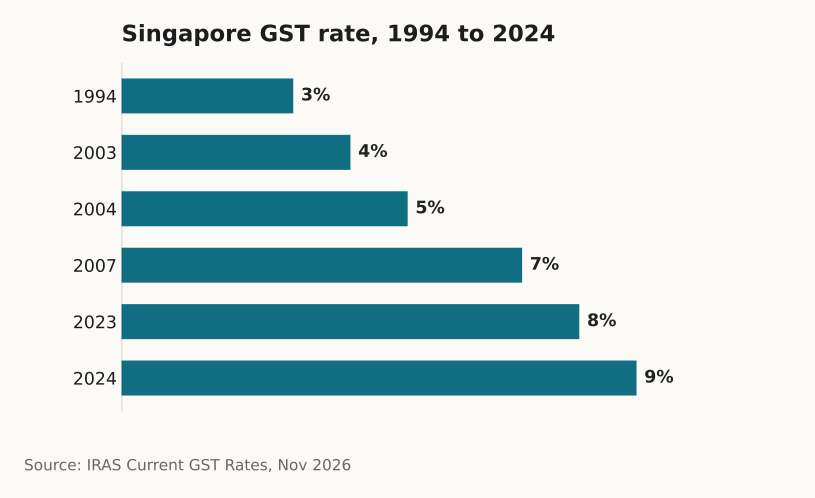
Singapore’s headline GST rate at each change. — Source: IRAS Current GST Rates, Nov 2026.
The price you see already includes GST
Here is the rule that makes daily life simple: prices displayed to the public must be the final, GST-inclusive price. IRAS states that GST-registered businesses “are not allowed to display, quote, advertise or publish prices without GST”. So a S$5.90 shelf tag at the supermarket is S$5.90 at the till — the 9% is already inside it, not added after. If a business shows both a with-GST and a without-GST price, the GST-inclusive figure must be at least as prominent, and shops that break the display rule can be fined.
Restaurants, hotels and the “++”
The big exception to “what you see is what you pay” is the service charge, and it is the number-one surprise on a newcomer’s first restaurant bill. Hotels and food-and-beverage places that levy a service charge are allowed to display prices before GST and service charge — the familiar “++” — as long as they show a clear statement that prices are subject to both. Crucially, GST is charged on the final value including the service charge, so the two stack.
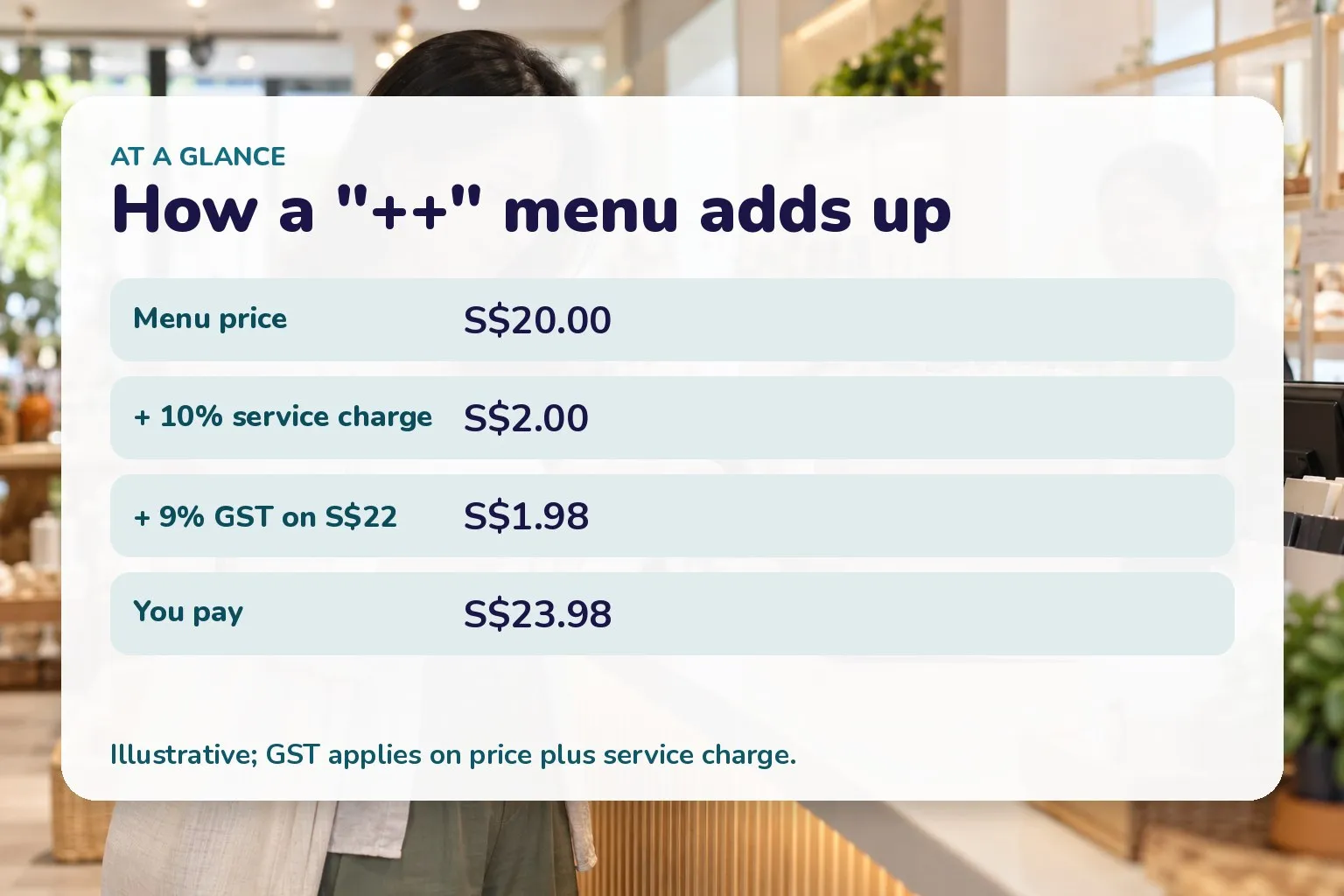
How a “++” menu price builds up.
What is not taxed at 9%
Most of what you buy is “standard-rated” at 9%, but two narrower categories carry no GST at the point of sale. Zero-rated supplies are taxed at 0% — chiefly exports of goods and international services, such as an air ticket out of Singapore. Exempt supplies fall outside GST entirely: many financial services (IRAS gives the issue of a debt security as an example), investment-grade precious metals, and digital payment tokens (exempt since 1 January 2020). For everyday spending the practical takeaway is simple — groceries, dining, transport, electronics, haircuts and your phone plan are all taxed at 9%; there is no special lower rate for essentials.
GST on online and imported shopping
Online bargains from overseas are no longer automatically GST-free. The rules depend on how the goods arrive and who sells them:
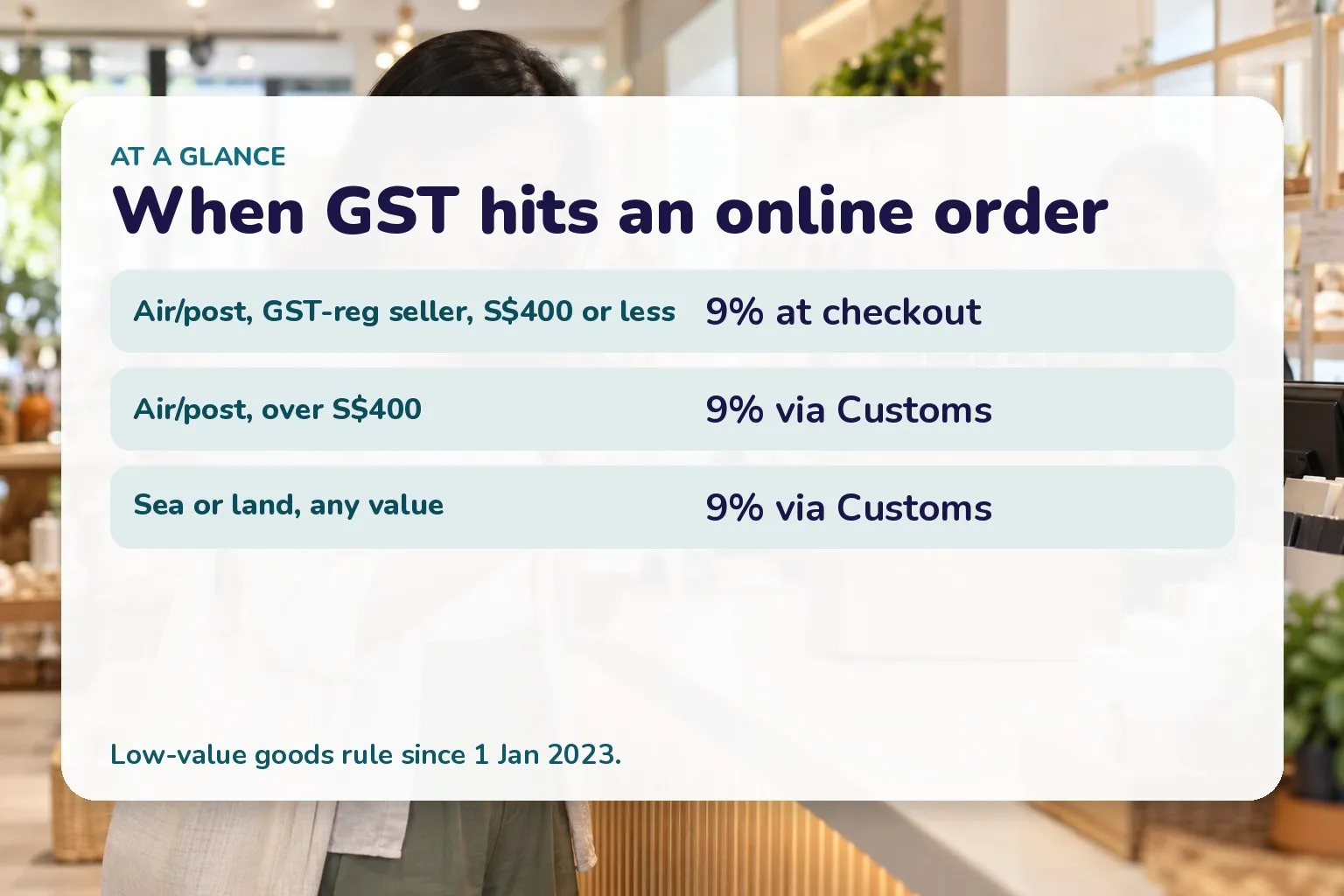
Where the 9% is collected on an overseas purchase.
- By air or post, from a GST-registered overseas seller, value S$400 or less: 9% GST is charged at checkout, paid to the seller. This “low-value goods” rule has applied since 1 January 2023.
- By air or post, value over S$400: no GST at checkout, but import GST is payable to Singapore Customs on the whole value, collected by your courier or SingPost on delivery.
- By sea or land, any value: import GST is payable to Singapore Customs regardless of value.
Import GST is 9%, calculated on the cost-plus-insurance-plus-freight (CIF) value together with any duties and incidental charges — so a big-ticket parcel can cost noticeably more than its sticker price once it lands.
Goods you carry in when you arrive
When you fly in with newly bought goods, there is a GST import relief for bona fide travellers: up to S$500 of goods if you were away two days or more, or up to S$100 if away less than two days, with GST payable on anything above that limit. The relief never covers liquor, tobacco, or goods for business or for other people.
Can you claim GST back?
For most newcomers, no. The Tourist Refund Scheme lets tourists reclaim the GST paid on goods they take home, but only if they are 16 or older, not a Singapore citizen or PR, and not a “Specified Person” — a category that expressly includes holders of any MOM work pass, a Dependant’s Pass, a Long-Term Visit Pass or a Student’s Pass. In other words, the pass that lets you live here is exactly what disqualifies you from the refund. Tourists who do qualify must spend at least S$100 (GST included) at a participating retailer, show their passport at purchase, and leave with the goods within two months; services and anything consumed here never qualify, and the refund comes after a handling fee.
Because you cannot claw GST back, treat it as a fixed part of your cost of living and build the 9% into your budgets for rent-adjacent setup, a new bank account’s linked spending and a local SIM or mobile plan. Note that GST is separate from the stamp duty you pay when you sign a lease — see the tenancy agreement and stamp duty guide for that.
Checking a business is really GST-registered
If a receipt shows GST but you are unsure the seller should be charging it, IRAS lets anyone look up a business’s GST registration through its online GST Registered Business Search. A legitimately registered business shows GST-inclusive prices and can give you a receipt or tax invoice; a business that is not registered must not add GST at all. This is a quick way to spot an improperly added charge before you pay.
Frequently asked questions
Is there GST on rent? This guide covers GST on goods and services; residential leases are handled differently and carry their own stamp duty rather than a GST line on your rent. See the tenancy agreement and stamp duty guide.
Do I pay GST if the shop isn’t GST-registered? No. Only GST-registered businesses may charge GST. A business under the S$1 million turnover threshold need not register, and if it has not, it cannot add GST.
Why is my restaurant bill about 19% more than the menu? Because a service charge (commonly 10%) is added first, then 9% GST is applied on top of that larger amount. A “++” on the menu signals this.
Did GST used to be lower? Yes — it was 7% until the end of 2022, 8% through 2023, and 9% from 1 January 2024. Old receipts and guides may still show the earlier rates.
Can I get the airport tourist refund on my way home for a holiday? Not while you hold a Singapore pass. The refund is for tourists who are not citizens, PRs or pass holders, so most residents are excluded.
Related
Keep setting up the money side: open a Singapore bank account, understand income tax for expats if you will be here long enough to be taxed as a resident, and compare the cost of a local SIM or mobile plan — a price that already includes the 9%.
General information only, from IRAS, with the date each rule was checked. We are not a tax adviser. Confirm the current rules on the official IRAS page for your own situation.
Sources
- GST: What it is and how it works — Inland Revenue Authority of Singapore (as of November 2026)
- Current GST Rates — Inland Revenue Authority of Singapore (as of November 2026)
- Buying from a GST-registered business (price display) — Inland Revenue Authority of Singapore (as of November 2026)
- GST on Imported Low-Value Goods — Inland Revenue Authority of Singapore (as of November 2026)
- Importing of goods (import GST relief) — Inland Revenue Authority of Singapore (as of November 2026)
- Travellers bringing goods into Singapore — Inland Revenue Authority of Singapore (as of November 2026)
- Tourist Refund Scheme — Inland Revenue Authority of Singapore (as of November 2026)