Work Permit in Singapore: An Overview

The Work Permit lets employers hire semi-skilled migrant workers from approved countries in construction, manufacturing, marine shipyard, process or services. There is no salary floor, but the employer pays a monthly levy, is capped by a quota and buys a S$5,000 security bond.
On this page9 sections · tap to jump
The Work Permit (WP) is Singapore’s work pass for semi-skilled migrant workers — the people who build, make, service and maintain much of the country. It sits below the S Pass and Employment Pass, and it works very differently from them: there is no salary floor, but a web of employer obligations — approved source countries, a monthly levy, an industry quota, a security bond and medical insurance — decides whether a job can actually be filled. This overview sets out who the Work Permit is for and the rules around it, with the Ministry of Manpower’s (MOM) current figures.
What the Work Permit is
The Work Permit covers semi-skilled or unskilled foreign employees working in one of five sectors: construction, manufacturing, marine shipyard, process or services. It is not a pass you choose or apply for yourself — only an employer or an appointed employment agent can apply, and the worker cannot be in Singapore while the application is processed. Unlike the S Pass and Employment Pass, a Work Permit comes with no family privileges at all: there are no Dependant’s Passes or Long-Term Visit Passes for a Work Permit holder’s relatives.
No salary floor (and the one exception)
The Work Permit has no minimum qualifying salary. Eligibility is built on sector, source country and age rather than pay, which is the single biggest difference from the S Pass and EP. The age rule is that a worker must be at least 18 and below 62 when the employer applies for a new permit, and a holder can keep working until 64, pegged to Singapore’s retirement age.
The one exception to “no salary floor” is the Non-Traditional Sources (NTS) Occupation List route (below): workers hired under it must earn a fixed monthly salary of at least S$2,000.
Sectors and source countries
A firm can only hire from approved source countries, and the list depends on the sector.
- Services and manufacturing: Malaysia; the People’s Republic of China (PRC); and the North Asian Sources (NAS) — Hong Kong (HKSAR passport), Macau, South Korea and Taiwan. These sectors can also hire from Non-Traditional Sources, but only for jobs on the NTS Occupation List.
- Construction, marine shipyard and process: all of the above plus the Non-Traditional Sources (NTS) more broadly — Bangladesh, Bhutan, Cambodia, India, Laos, Myanmar, the Philippines, Sri Lanka and Thailand.
The NTS Occupation List lets services and manufacturing firms hire NTS workers for a restricted set of roles, subject to a sub-quota of 8% of the firm’s workforce and that S$2,000 minimum salary.
Levy and quota (the employer’s side)
Two employer limits sit behind every Work Permit: a quota (how many foreign workers the firm may employ) and a monthly levy (a per-head charge).
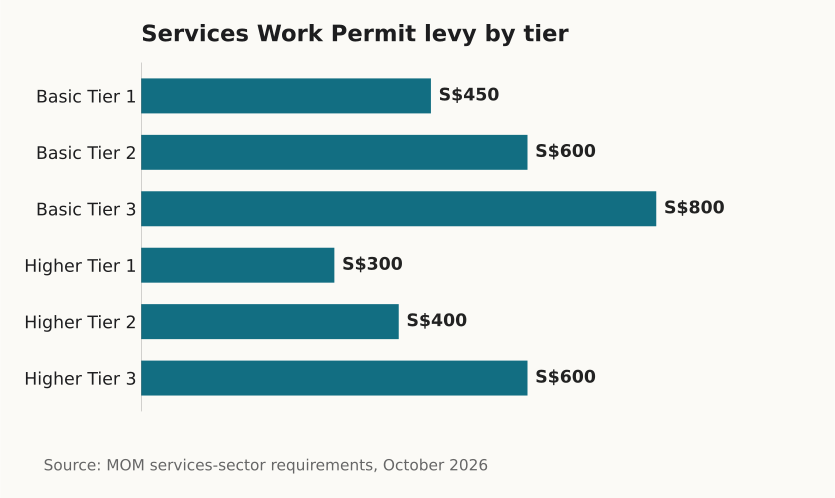
Services-sector monthly foreign worker levy: basic-skilled vs higher-skilled, by quota tier.
The quota is the sector’s Dependency Ratio Ceiling (DRC) — the share of the workforce that can be foreign: 35% in services, 60% in manufacturing, 75% in marine shipyard, and 83.3% in construction and process. MOM works the quota out from the firm’s local employees, so a company near its ceiling has no room for another hire.
The levy is tiered — the closer a firm is to its quota, the more it pays per worker, and higher-skilled workers attract a lower levy than basic-skilled ones. In the services sector, for example, the basic-skilled monthly levy runs from S$450 in the first tier to S$800 in the top tier, while the higher-skilled rate runs from S$300 to S$600.
Other sectors set their own levy rates, so an employer should check the page for its own sector. The point for a jobseeker is simple: the levy is a real monthly cost to the employer, and the quota is a hard limit.
Security bond, insurance and the Primary Care Plan
On top of the levy, the employer must put money and cover in place before the worker arrives:
- Security bond: a S$5,000 banker’s or insurer’s guarantee for each non-Malaysian Work Permit holder. It is forfeited if, for example, the employer fails to pay salary on time, does not send the worker home when the permit ends, or the worker goes missing. The cost cannot be charged to the worker.
- Medical insurance: at least S$60,000 a year per worker, covering inpatient care and day surgery. Since 1 July 2023, claims above S$15,000 are co-shared 75% by the insurer and 25% by the employer. The premium cannot be passed to the worker, though a limited salary co-payment for medical bills is allowed within strict caps.
- Primary Care Plan (PCP): required for workers who live in dormitories housing 7 or more workers, or who work in the construction, marine shipyard or process (CMP) sectors. The employer must declare the PCP purchase before the permit is issued.
How the application works
Only the employer or an appointed employment agent can apply, through MOM’s Work Permit Online service.
- Get the worker’s written consent and submit the application, paying the S$35 application fee. Most applications get an outcome within one week.
- Receive the in-principle approval (IPA). Check that the IPA particulars exactly match the worker’s passport — any error (such as a misspelt name) must be fixed, or the worker will be refused entry.
- Before arrival, buy the security bond (for non-Malaysian workers), the medical insurance and, where required, the Primary Care Plan; CMP arrivals have added onboarding steps.
- On arrival, send the worker for a medical examination by a Singapore-registered doctor within two weeks, register the residential and workplace addresses, and get the permit issued.
- Register fingerprints and photo if required; the Work Permit card then arrives within about five working days.
A permit runs for up to two years, but is shortened to one month before the passport expires and two months before the security bond expires, whichever comes first. It is renewable before it expires.
The conditions a holder must follow
A Work Permit is tightly conditioned. A holder must:
- Work only for the named employer, in the occupation and sector stated on the permit;
- Not run or take part in any other business;
- Reside at the address registered by the employer, and tell the employer before moving;
- Carry or show the digital work pass (in the SGWorkPass app) or the card when a public officer asks;
- Not marry a Singapore citizen or PR, in Singapore or abroad, without MOM’s approval — this holds even after the permit has ended; and
- Not become pregnant or give birth in Singapore during the permit’s validity, unless already married to a citizen or PR with MOM’s approval.
These conditions are part of the Conditions of Work Pass and apply throughout employment.
When employment ends
When a job finishes, is terminated or the worker resigns, the employer must cancel the Work Permit within one week of the last day of notice and bears the cost of repatriation, including an air ticket with a check-in luggage allowance. A worker should not start a new job until a fresh permit (or other valid pass) is issued for the new employer — working on a cancelled permit is an offence.
FAQ
Is there really no minimum salary? Yes — a standard Work Permit has no qualifying salary. The only pay rule is the S$2,000 floor for NTS Occupation List hires in services and manufacturing.
Can a Work Permit holder bring their spouse or children? No. The Work Permit offers no family passes of any kind.
Can I change employer on my existing permit? No. The permit is tied to one employer; a new employer must apply for a fresh permit, subject to that firm’s quota and the rules at the time.
Can a Work Permit be upgraded to an S Pass? Yes, with a fresh application if the salary and role meet the S Pass criteria — MOM recognises prior pass experience in some levy calculations.
Who pays the levy and bond? The employer. The levy, the S$5,000 security bond and the insurance premium cannot be deducted from the worker’s salary.
General information only, from MOM, with the date each figure was checked. We are not an immigration agent; the final decision on any pass rests with MOM. Confirm the current rules on the official MOM page for your own case.
Sources
- Key facts on Work Permit for migrant worker — Ministry of Manpower (as of October 2026)
- Services sector: Work Permit requirements — Ministry of Manpower (as of October 2026)
- Non-Traditional Sources (NTS) Occupation List — Ministry of Manpower (as of October 2026)
- Security bond requirements for migrant worker — Ministry of Manpower (as of October 2026)
- Medical insurance requirements for migrant workers — Ministry of Manpower (as of October 2026)
- Work Permit conditions — Ministry of Manpower (as of October 2026)
- Apply for a Work Permit — Ministry of Manpower (as of October 2026)
- Factsheet on foreign workforce policy announcements at COS 2025 — Ministry of Manpower (as of October 2026)