EP vs S Pass vs Work Permit Compared

The Employment Pass fits foreign professionals (from S$5,600/month plus COMPASS, no levy or quota). The S Pass fits mid-skilled staff (from S$3,300, with a S$650 levy and a quota). The Work Permit fits semi-skilled workers in set sectors, with no salary floor but no family passes.
Singapore has three main work passes, and newcomers often assume they can pick one. You cannot: the Ministry of Manpower (MOM) sorts them by skill and pay, so your salary and role decide which pass an employer can apply for. The Employment Pass (EP) is for professionals, the S Pass for mid-skilled staff, and the Work Permit for semi-skilled workers in set sectors. Here is how they differ on the things that actually matter — the salary bar, COMPASS, levy and quota, family rights and duration — with MOM’s current figures.
The three passes in one line
The jump from Work Permit to S Pass to EP is a jump in skill level, salary and employer freedom. As you move up, the salary bar rises — but the employer’s levy and quota burden falls away, disappearing entirely at the EP.
| Employment Pass | S Pass | Work Permit | |
|---|---|---|---|
| For | Professionals, managers, executives | Mid-skilled staff (APTs) | Semi-skilled workers in set sectors |
| Salary floor | From S$5,600 (S$6,200 financial services), rising with age | From S$3,300 (higher in financial services), rising with age | No minimum |
| Points test | COMPASS (40 points) | None | None |
| Levy | None | S$650/month | Yes (varies by sector and skill) |
| Quota | None | Yes | Yes |
| Family passes | Yes | Yes (higher salary needed) | Not available |
| Duration | Up to 2 years, 3 on renewal (5 for some tech roles) | Up to 2 years, 3 on renewal | Up to 2 years |
| Who applies | Employer or agent | Employer or agent | Employer or agent |
Salary: the first fork
Salary is what separates the three, and it is your fixed monthly salary — basic pay plus fixed monthly allowances, not bonuses or variable pay.
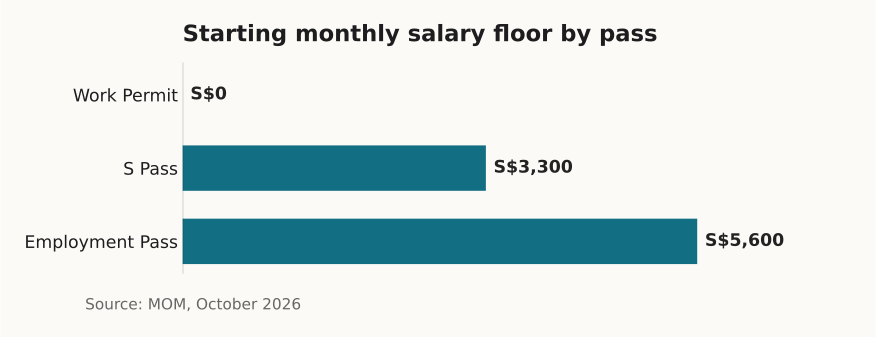
Entry-level fixed monthly salary floor (non-financial sector). Work Permit has no minimum.
- EP: from S$5,600 a month (S$6,200 in financial services), rising with age to S$10,700 (S$11,800 in financial services) at 45 and above.
- S Pass: from S$3,300 a month, rising with age to about S$4,800 in the mid-40s, with higher figures in financial services.
- Work Permit: no minimum qualifying salary at all — eligibility is about sector, source country and age (at least 18 and below 62 when applying) rather than pay.
COMPASS, quota and levy: the employer’s side
This is where the passes feel most different in practice.
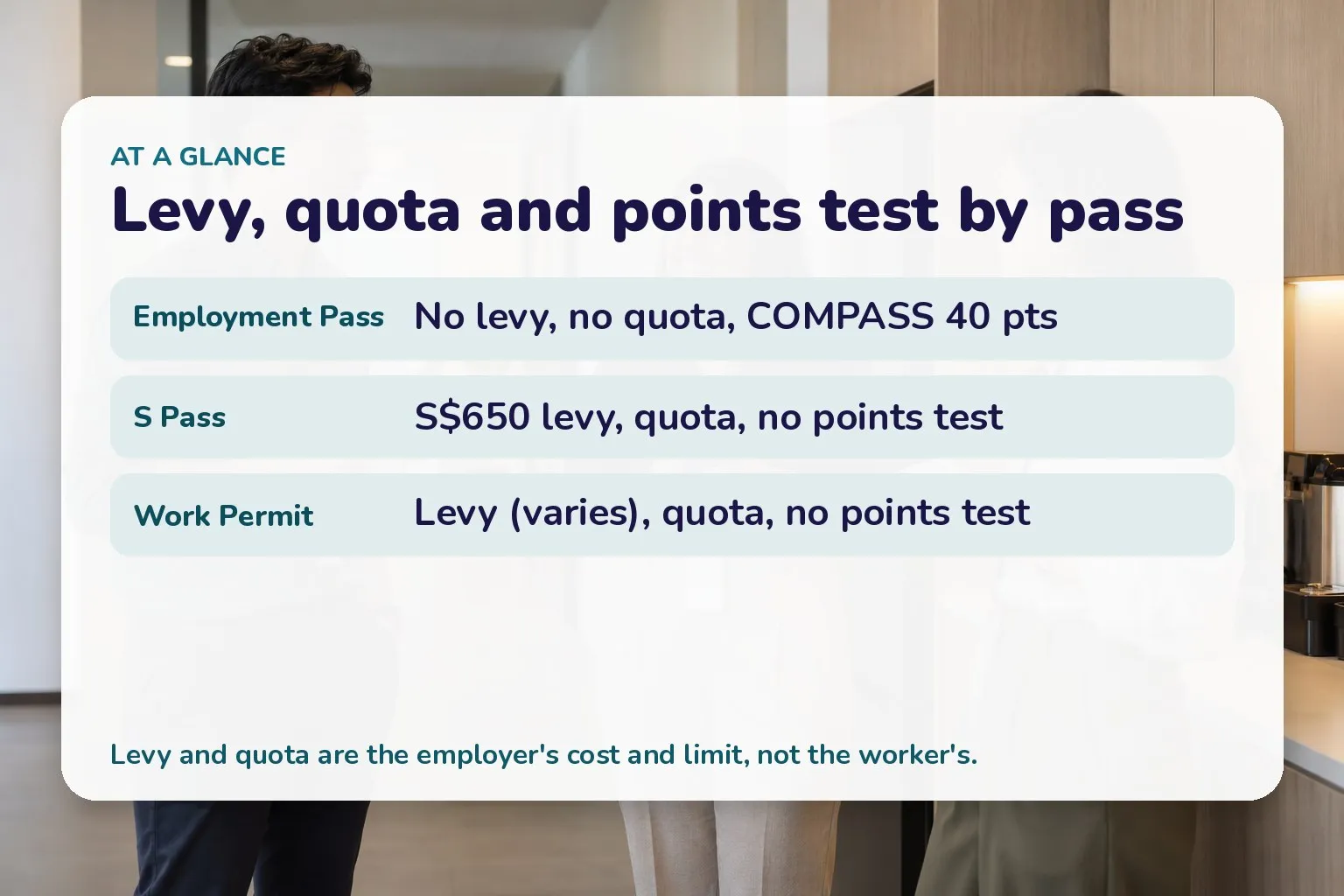
Employer-side obligations by pass.
The EP is assessed on COMPASS, a 40-point test covering your salary and qualifications and the firm’s workforce profile — but it carries no levy and no quota. For the employer that is the simplest arrangement: no per-head monthly cost and no cap on numbers.
The S Pass has no points test, but the firm pays a monthly levy of S$650 (harmonised across all sectors and tiers since 1 September 2025; S$21.37 a day for part-months) and is limited by a quota — the S Pass sub-quota is 10% of the firm’s workforce in services and 15% in construction, manufacturing, marine shipyard and process.
The Work Permit also carries a levy and quota, set within each sector’s Dependency Ratio Ceiling (DRC) — 35% in services, 60% in manufacturing, 75% in marine shipyard, and 83.3% in construction and process — and the levy itself varies by sector and the worker’s skill level.
Family, duration and renewal
- Family: the EP lets eligible holders sponsor family passes; the S Pass allows them too but only once your salary reaches the dependant threshold (higher than the S Pass entry pay); the Work Permit cannot sponsor any family passes.
- Duration: a first EP or S Pass runs up to 2 years and a renewal up to 3 years; some experienced tech professionals get a 5-year EP. A Work Permit runs up to 2 years and is renewable.
- Insurance: medical insurance is optional for EP holders (the employer chooses), but mandatory for S Pass and Work Permit holders, with extra requirements — security bond and, for some, a Primary Care Plan — on the Work Permit.
How you get each pass
For all three, you cannot apply for yourself — an employer or an appointed employment agent files the application. An overseas company without a Singapore-registered office must apply for an EP through a local sponsor. Each pass is also tied to one employer: if you change jobs, the current pass is cancelled and the new employer applies for a fresh pass under the rules in force at that time. You should not start a new role until the new pass is issued.
Who should not expect the EP
The EP is the pass most relocating professionals assume they will get, but it is the wrong target if:
- Your salary is below the floor for your age. No amount of COMPASS strength helps — the salary bar is a hard gate. A mid-skilled role under the EP floor points to the S Pass instead.
- You need the pass issued fast with no employer cost debate. The EP avoids levy and quota, but it adds COMPASS; a borderline COMPASS score can stall an application that an S Pass would not face.
- Your work is semi-skilled and sector-based. Construction, manufacturing, marine, process and many services roles sit on the Work Permit, which has no salary floor but restricts source countries and offers no family passes.
The runner-up to the EP for a mid-skilled hire is the S Pass: it accepts lower pay and skips COMPASS, at the cost of a levy and a quota the employer must carry. For semi-skilled sector work the Work Permit is the only route, so the real question there is sector eligibility and quota, not which pass.
FAQ
Can I choose which pass to apply for? No. Your salary and role decide which pass an employer can apply for, and the employer files it.
Can an S Pass or Work Permit be upgraded to an EP? Yes, with a fresh application if your salary and role meet the EP rules — MOM recognises prior pass experience in some levy calculations.
Which pass lets me bring my spouse and children? The EP (and the S Pass once your salary reaches the dependant threshold). The Work Permit does not allow family passes.
Do I pay the levy? No. The levy, quota and mandatory insurance are the employer’s responsibility and cannot be deducted from your salary.
To go deeper on each, read our Employment Pass eligibility guide, the COMPASS points breakdown and the S Pass criteria. If a job move is on the cards, see how EP renewal and cancellation work.
General information only, from MOM, with the date each figure was checked. We are not an immigration agent; the final decision on any pass rests with MOM. Confirm the current rules on the official MOM page for your own case.
Sources
- Key facts on Employment Pass — Ministry of Manpower (as of October 2026)
- Eligibility for Employment Pass — Ministry of Manpower (as of October 2026)
- Key facts on S Pass — Ministry of Manpower (as of October 2026)
- S Pass quota and levy requirements — Ministry of Manpower (as of October 2026)
- Key facts on Work Permit for migrant worker — Ministry of Manpower (as of October 2026)
- Sector-specific rules for Work Permit — Ministry of Manpower (as of October 2026)