COMPASS Points System for EP Applicants

COMPASS scores an EP application out of its six criteria; you need 40 points to pass. Four foundational criteria (salary, qualifications, firm diversity, local-employment support) each give 0, 10 or 20, and two bonus criteria add up to 20 and 10.
On this page9 sections · tap to jump
Once your salary clears the Employment Pass (EP) floor, the Ministry of Manpower (MOM) scores the application on COMPASS — the Complementarity Assessment Framework. It is a points test, and the pass mark is 40. What trips people up is that the points are not only about you: half of them depend on the firm doing the hiring. This guide breaks down exactly how each of the six criteria is scored, shows how the points combine in real cases, and explains what you can actually influence before applying.
What COMPASS is and when it applies
COMPASS is the second stage of a two-stage EP framework. Stage 1 is the qualifying salary (from S$5,600 a month, or S$6,200 in financial services, rising with age). Miss it and the application fails outright — the COMPASS score is never even counted. Stage 2 is COMPASS, which applies to new EP applications and to renewals unless the candidate is exempt.
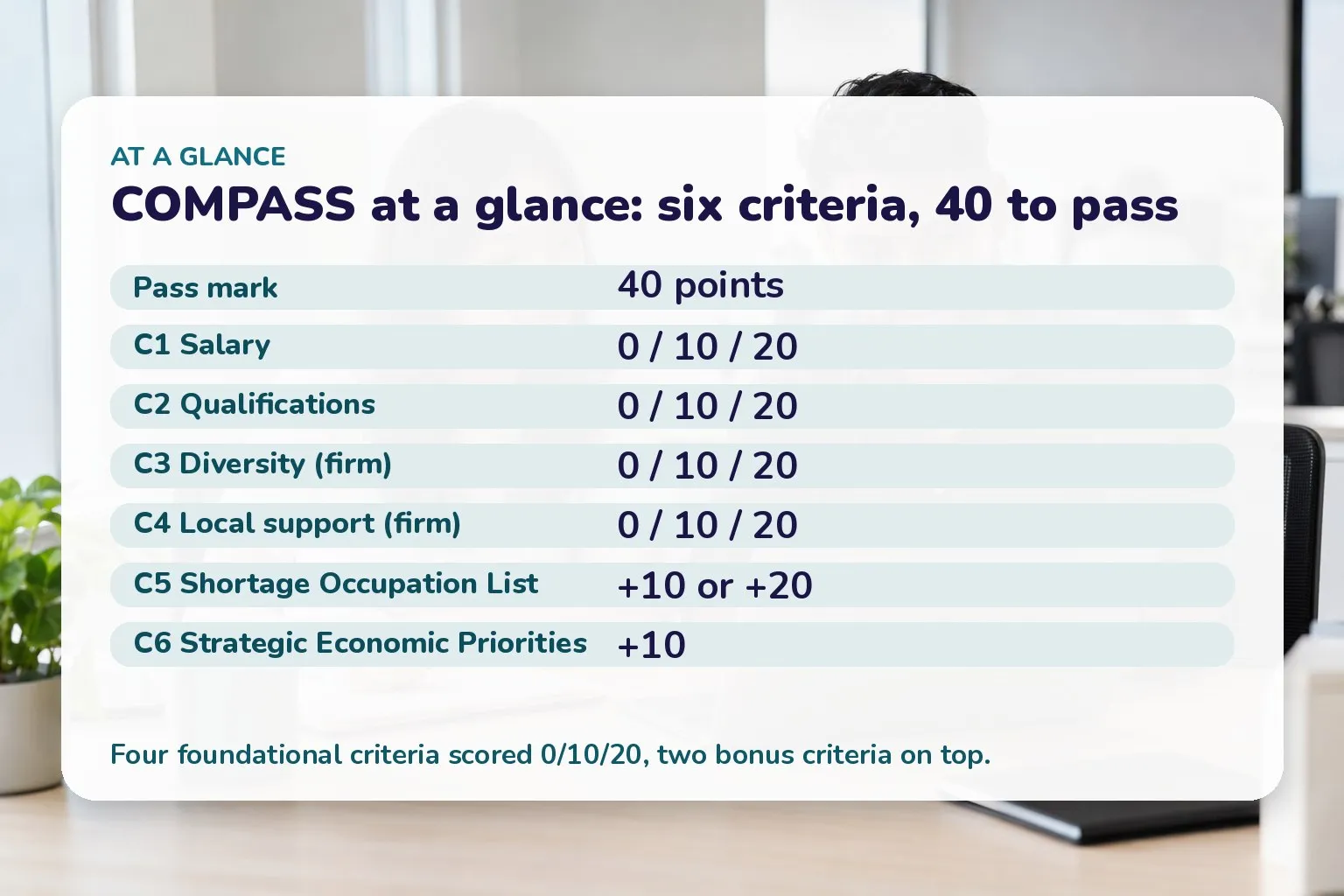
How COMPASS points are structured.
The test has four foundational criteria, each scoring 0, 10 or 20 points, and two bonus criteria worth up to 20 and 10. You need any combination adding up to 40 points to pass. Because the maximum from the four foundational criteria alone is 80, there is real room to make up a weak area — which is the whole point of the design.
C1 — Salary
This criterion compares your fixed monthly salary against local professional (PMET) salaries in your employer’s sector, by age. MOM derives the benchmarks from its annual Comprehensive Labour Force Survey and updates them once a year.
| Your fixed salary vs sector benchmark | Points |
|---|---|
| 90th percentile and above | 20 |
| 65th to below 90th percentile | 10 |
| Below 65th percentile | 0 |
The exact dollar figure for each band depends on your sector and age and sits in MOM’s downloadable benchmark tables, so the Self-Assessment Tool is the quickest way to see which band an offer lands in. Note the C1 benchmark is higher than the Stage 1 floor: meeting the minimum salary only gets you eligible, not necessarily any C1 points.
C2 — Qualifications
This rewards the candidate’s degree or professional qualifications.
| Qualification | Points |
|---|---|
| Degree from a top-tier institution (top 100 QS ranking, a highly-reputed Asian university, a Singapore Autonomous University, or an agency-endorsed institution) | 20 |
| Other degree-equivalent qualification (assessed comparable to a UK bachelor’s degree, or an industry-recognised professional qualification) | 10 |
| No degree-equivalent qualification | 0 |
A candidate without a degree is not blocked — they simply earn nothing here and must reach 40 from the other criteria. You only submit qualification proof if you are claiming these points; the institution lists are refreshed once a year.
C3 and C4 — your employer’s workforce
These two foundational criteria are about the hiring firm, not you, which is why two identical candidates can score differently at different companies.
C3 Diversity rewards applications where your nationality is a small share of the firm’s professional staff. C4 Support for local employment rewards firms with a healthy share of local PMETs relative to their sector.
| Criterion | Band | Points |
|---|---|---|
| C3 Diversity — share of your nationality among the firm’s PMETs | Less than 5% | 20 |
| 5% to below 25% | 10 | |
| 25% or more | 0 | |
| C4 Local support — firm’s local PMET share vs its sector | 50th percentile and above | 20 |
| 20th to below 50th percentile | 10 | |
| Below 20th percentile | 0 |
Two safeguards matter for smaller or local-heavy employers. First, a firm with fewer than 25 professionals scores 10 points by default on both C3 and C4 — so a lean start-up is not punished for its size. Second, any firm whose local PMET share is at least 70% scores at least 10 points on C4 regardless of where it sits in its sector.
The two bonus points: C5 and C6
On top of the four foundational criteria sit two bonuses.
C5 Skills bonus (Shortage Occupation List). If your job is on MOM’s Shortage Occupation List (SOL), the application earns bonus points: 20 if your nationality is less than one-third of the firm’s professionals, or 10 if it is one-third or more. The current SOL was released in November 2025 and applies to applications from 1 January 2026; it is refreshed once a year and comprehensively reviewed every three years. It spans agritech, financial services, the green economy, healthcare (registered nurses, physiotherapists, occupational therapists, clinical psychologists, diagnostic radiographers, podiatrists), infocomm (AI engineers, data scientists, cloud specialists, cybersecurity architects, software developers), maritime and semiconductor roles. Infocomm roles on the list can also open a 5-year EP for experienced tech professionals.
C6 Strategic Economic Priorities (SEP) bonus. This gives 10 points to firms taking part in at least one approved economic programme run by agencies such as EDB, Enterprise Singapore, IMDA, MPA, STB or NTUC. It is awarded at the agency’s discretion and lasts up to three years (or the length of the firm’s participation, whichever is shorter). It is firmly an employer-side bonus — a candidate cannot claim it directly.
How the scoring actually combines (case studies)
MOM publishes worked examples that show how 40 is reached different ways. These mirror the official case studies.
- All four at the middle band. Salary 10 + qualifications 10 + diversity 10 + local support 10 = 40. Pass. MOM says most applications look like this.
- Small firm. The same candidate at a firm with under 25 professionals scores the default 10 on both C3 and C4, so salary 10 + qualifications 10 + 10 + 10 = 40. Pass.
- Weak salary, rescued by diversity. Salary 0 (below the 65th percentile) + qualifications 10 + diversity 20 (nationality under 5% of staff) + local support 10 = 40. Pass.
- Weak firm, rescued by a shortage skill. Salary 20 (90th percentile) + qualifications 10 + diversity 0 + local support 0 + SOL bonus 10 = 40. Pass.
Who does not need to pass COMPASS
You are exempt from COMPASS — though you still must clear the Stage 1 salary — if any of these apply:
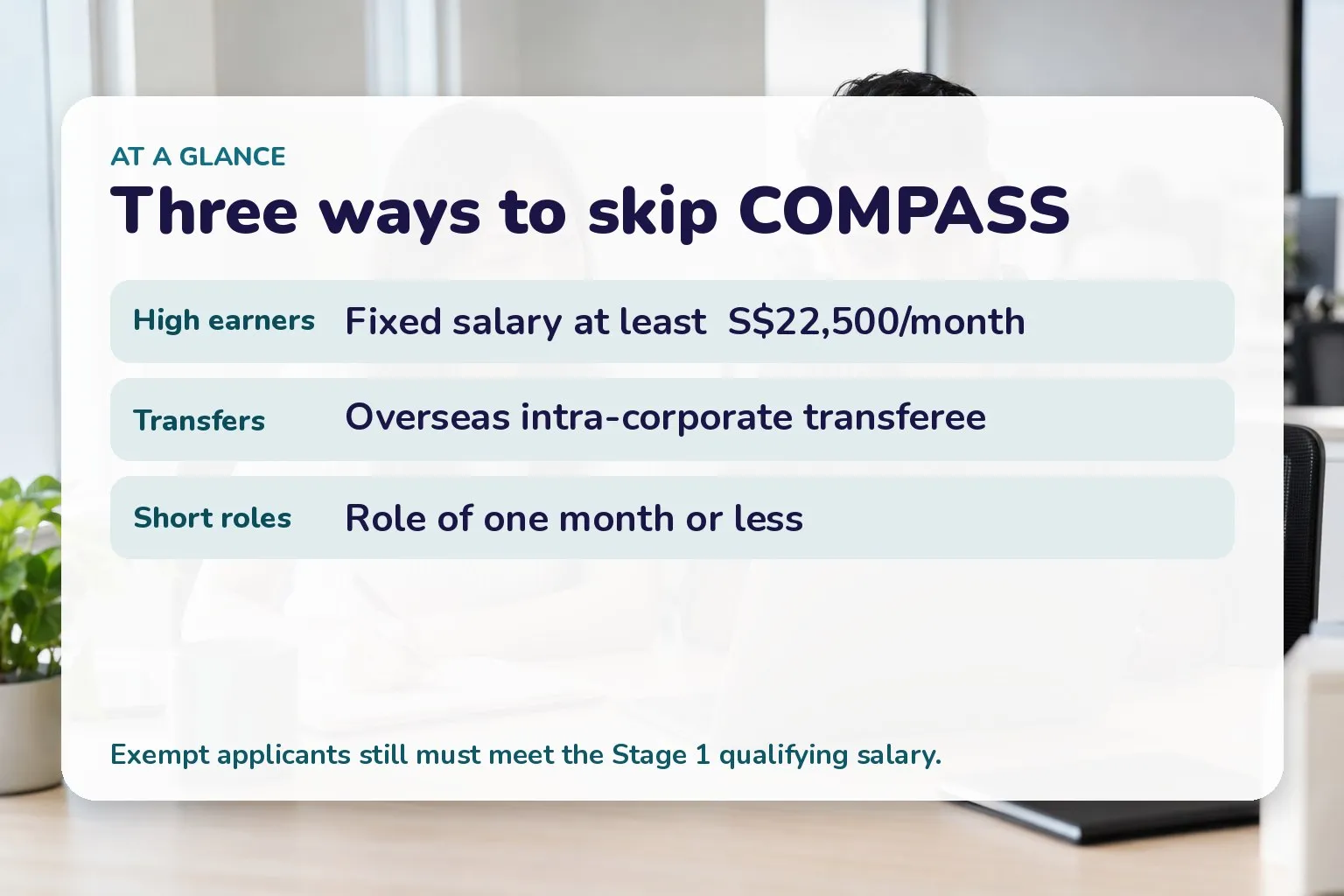
COMPASS exemptions.
- Your fixed monthly salary is at least S$22,500.
- You are an overseas intra-corporate transferee.
- The role is for one month or less.
These are not rare at the top end, and they explain why very senior hires rarely talk about points at all.
How to check and improve a score before applying
You cannot file your own EP — an employer or appointed agent does — but you can shape the odds:
- Run the Self-Assessment Tool (SAT). It checks both the salary floor and COMPASS and returns an eligible / not-eligible result. If it says “not eligible”, MOM advises not to apply; the enhanced version has been live since December 2025.
- Negotiate the salary band, not just the number. Moving from the 60th to the 65th percentile can turn a C1 of 0 into 10 — ask the employer where your offer falls.
- Claim qualification points by submitting verified proof if your degree reaches the top-tier or degree-equivalent lists.
- Ask the employer to check its own C3/C4 in the Workforce Insights tool, and whether the role is on the SOL or the firm is in a C6 programme.
FAQ
What score do I need? Exactly 40 points, from any mix of the six criteria.
What if I score below 40? The application will not pass COMPASS. Fix the gap (salary band, qualifications proof, SOL job fit, or the firm’s workforce profile) and reapply, or check whether an exemption applies.
Does COMPASS apply to EP renewals? Yes — renewals are assessed on COMPASS too, unless the holder is exempt.
Can I change the diversity or local-support points myself? No. Those move with the employer’s workforce; only the firm can influence them.
To see the salary floors and the full application flow, read our Employment Pass eligibility guide; if you are weighing options, compare EP, S Pass and Work Permit side by side or read the S Pass criteria for mid-skilled roles. For renewals, see how EP renewal and cancellation work.
General information only, from MOM, with the date each figure was checked. We are not an immigration agent; the final decision on any pass rests with MOM. Confirm the current rules on the official MOM page for your own case.
Sources
- Eligibility for Employment Pass (COMPASS) — Ministry of Manpower (as of October 2026)
- COMPASS C1. Salary benchmarks — Ministry of Manpower (as of October 2026)
- COMPASS C5. Skills bonus — Shortage Occupation List (SOL) — Ministry of Manpower (as of October 2026)
- COMPASS C6. Strategic Economic Priorities (SEP) bonus — eligible programmes — Ministry of Manpower (as of October 2026)
- Key facts on Employment Pass — Ministry of Manpower (as of October 2026)