PEP vs Employment Pass: Which Suits You

For most relocating professionals the Employment Pass wins: it starts at S$5,600 a month and is renewable. The Personalised Employment Pass suits only high earners (from S$22,500/month) who want job mobility, but it cannot be renewed.
Both the Employment Pass (EP) and the Personalised Employment Pass (PEP) let a foreign professional work in Singapore, and newcomers earning well often wonder which to chase. The honest answer for most people is the EP — it is the standard professional pass, starts far lower and can be renewed indefinitely. The PEP is a niche, premium option that trades those strengths for freedom from any single employer. Here is how they differ on the things that decide it — salary, who applies, job mobility, renewal and family — with the Ministry of Manpower’s (MOM) current figures.
The one big trade-off
Strip away the detail and the choice is about who the pass belongs to. An EP is tied to one employer, who applies for it and cancels it when you leave; a PEP belongs to you, so you can change jobs — or sit between them for a while — without a new application each time.
That freedom is the PEP’s only real advantage, and you pay for it twice: with a salary bar roughly four times the EP’s, and with a hard expiry. The EP asks less money and renews; the PEP asks a lot more and ends for good. Everything below flows from that trade-off.
Salary: the dividing line
Salary is where the two passes separate most sharply, and both use fixed monthly salary — basic pay plus fixed monthly allowances, not bonuses or variable pay.
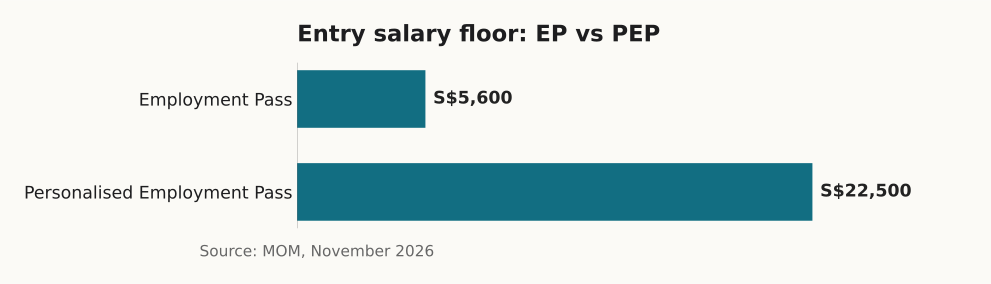
Entry-level fixed monthly salary floor, non-financial sector.
- EP: from S$5,600 a month (S$6,200 in financial services), rising with age to S$10,700 (S$11,800 in financial services) at 45 and above. On top of the salary bar, an EP must earn 40 points on the COMPASS points test (covering salary, qualifications and the firm’s workforce profile), unless exempted. See our Employment Pass eligibility guide and the COMPASS points breakdown.
- PEP: a fixed monthly salary of at least S$22,500 to qualify — MOM benchmarks this to the top 10% of EP holders — and no COMPASS test at all. Overseas applicants must have drawn that salary within the past six months.
The PEP also carries a second, ongoing test the EP does not: to keep it you must earn a fixed salary of at least S$270,000 per calendar year, regardless of how many months you actually work. Because that figure is not pro-rated, a gap between jobs can pull you under it.
Who applies, and how
This is the second practical fork.
- EP: you cannot apply for yourself. An employer or an appointed employment agent files it, and an overseas company without a Singapore-registered office must apply through a local sponsor. The application fee is S$105; online cases are usually processed within about 10 business days, and overseas-sponsorship cases within about six weeks.
- PEP: because it is not employer-sponsored, you (or an agent) apply directly. There is no job offer to attach and no COMPASS score to build.
Job mobility and gaps between jobs
- EP: the pass is cancelled when you leave an employer, and the new employer must apply for a fresh EP under the rules in force then. You should not start the new role until the new pass is issued.
- PEP: you keep the pass across job changes — just notify MOM — and you may stay in Singapore for a continuous period of up to six months without a job while you look for the next role. But that window is also a cliff: if you are unemployed for more than six months at any point, you must cancel the PEP.
Duration and renewal
| Employment Pass | Personalised Employment Pass | |
|---|---|---|
| Entry salary (fixed monthly) | From S$5,600 (S$6,200 financial services) | From S$22,500 |
| Points test (COMPASS) | Yes (40 points, unless exempt) | No |
| Who applies | Employer or employment agent | You, directly |
| Tied to an employer | Yes | No |
| First duration | Up to 2 years (up to 5 for some tech roles) | Up to 3 years |
| Renewable | Yes | No — issued only once |
| Levy or quota | None | None |
| Family passes | Yes | Yes |
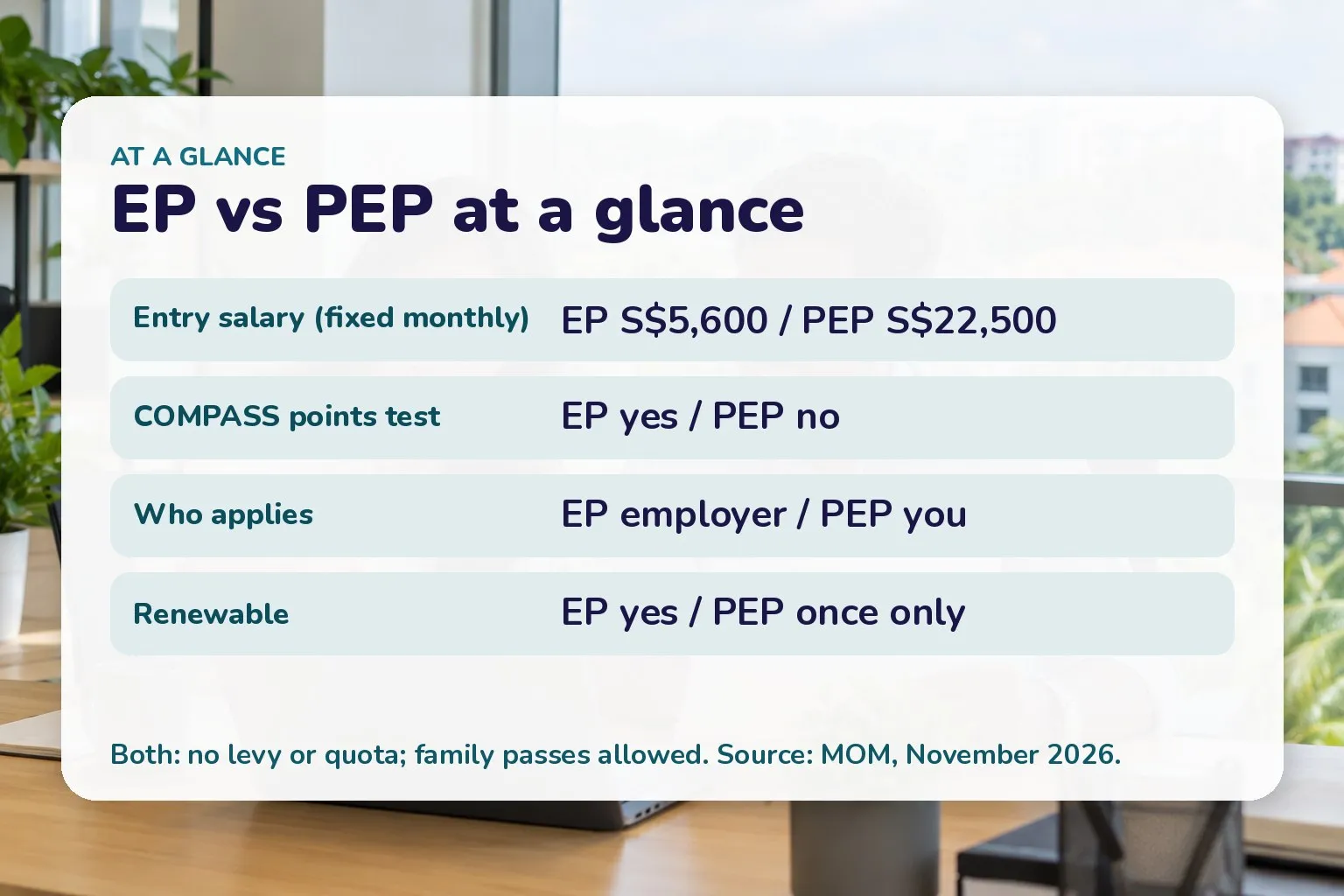
How the two professional passes differ at a glance.
The renewal line is the one that catches people out. An EP renews — first-timers get up to two years, renewals up to three (and some experienced tech professionals a five-year pass). A PEP is issued only once and cannot be renewed: when it nears expiry, you must move to an EP or S Pass to keep working (helpfully, you do not have to cancel the PEP first for an employer to apply for the new pass).
Family, levy and tax
On these three, the passes are the same. Both allow passes for eligible family members, and neither carries a foreign-worker levy or quota. Both may make you liable for Singapore income tax depending on your tax residency — a separate IRAS matter from your pass. PEP holders also have one extra admin duty: you must declare your annual income to MOM by 31 January each year.
What you cannot do on either
Neither pass is a route to entrepreneurship. The PEP explicitly bars starting a business or any entrepreneurial activity, freelancing, and restricted occupations such as media and religion; it is also closed to sole proprietors, partners, and directors who are also shareholders. The EP is likewise a pass for employment, not for running your own company. If founding or co-owning a business is the plan, the EntrePass or the ONE Pass — a renewable five-year personalised pass that does allow running companies — is the pass to study instead.
Which one fits you
- Choose the EP if you have a job offer and a standard professional salary, want to renew and stay long-term, or your pay sits below S$22,500 a month. This is the right pass for the large majority of newcomers.
- Choose the PEP only if your fixed monthly salary clears S$22,500, you can hold S$270,000 across the calendar year including any gaps, and you value employer-independence for a defined stretch more than the ability to renew.
- Choose neither — and look at the ONE Pass or EntrePass — if you intend to start or co-own a company.
The overall winner for most readers is the Employment Pass; the PEP is the runner-up and the better pick only for the narrow slice of high earners who prize mobility over renewal.
Frequently asked questions
Can I switch from an EP to a PEP? Yes, if your fixed monthly salary reaches S$22,500. You apply for the PEP yourself; you are not eligible while you remain an EP holder under the sponsorship scheme.
What happens when my PEP expires? You must obtain an EP or S Pass to keep working in Singapore. You do not need to cancel the PEP first for an employer to apply for the new pass.
Does the PEP really skip COMPASS? Yes. The PEP has no points test — its gate is purely the salary thresholds. Only the EP uses COMPASS.
Can either pass bring my family? Both can sponsor passes for eligible family members. Confirm the current salary conditions for family passes on MOM’s pages for your case.
General information only, from MOM, with the date each figure was checked. We are not an immigration agent; the final decision on any pass rests with MOM. Confirm the current rules on the official MOM page for your own case.
Sources
- Eligibility for Personalised Employment Pass — Ministry of Manpower (as of November 2026)
- Key facts on Personalised Employment Pass — Ministry of Manpower (as of November 2026)
- Eligibility for Employment Pass — Ministry of Manpower (as of November 2026)
- Key facts on Employment Pass — Ministry of Manpower (as of November 2026)
- Apply for an Employment Pass — Ministry of Manpower (as of November 2026)