What the Singapore Budget Means for Newcomers

Most Budget 2026 handouts — CDC vouchers, cost-of-living payments, CPF top-ups — go only to Singapore citizens. What touches foreigners and new PRs is the higher Employment Pass and S Pass salary floors from 2027, plus the GST and property duties newcomers already pay.
On this page7 sections · tap to jump
Every February the Singapore Budget makes headlines, and every year newcomers ask the same thing: is any of this for me? The honest answer is that most of the Budget’s direct help is built for Singapore citizens — the vouchers, the cash top-ups, the rebates on utilities. Budget 2026, delivered by Prime Minister and Finance Minister Lawrence Wong on 12 February 2026, follows that pattern. But a few measures land squarely on foreigners and new permanent residents (PRs), and they are worth understanding before they change your plans.
What Budget 2026 is — and who the money is for
Budget 2026 set out six areas of focus and a run of cost-of-living support. The headline sweeteners — CDC vouchers, the Cost-of-Living Special Payment, CPF top-ups and U-Save utility rebates — are aimed at Singaporeans and their households. The Budget 2026 CPF Top-Up, for instance, is open only to someone who is “a Singapore citizen, residing in Singapore” and aged 50 or above in 2026. The Cost-of-Living Special Payment is likewise described as support for “Singaporeans residing in Singapore”.
There is one place newcomers can benefit: if you run a company here. Budget 2026 raised the Corporate Income Tax rebate to 50% for Year of Assessment 2026, with a minimum benefit of S$2,000 for eligible companies, alongside SME cash grants and financing support. A foreign entrepreneur operating a Singapore-registered firm shares in those the same way a local-owned business does.
The real change for newcomers: work-pass salary floors
The Budget measure that matters most to a working foreigner is the increase in qualifying salaries for the Employment Pass (EP) and S Pass. These floors are reviewed against the top one-third of local professional wages, and Budget 2026 nudged them up again.
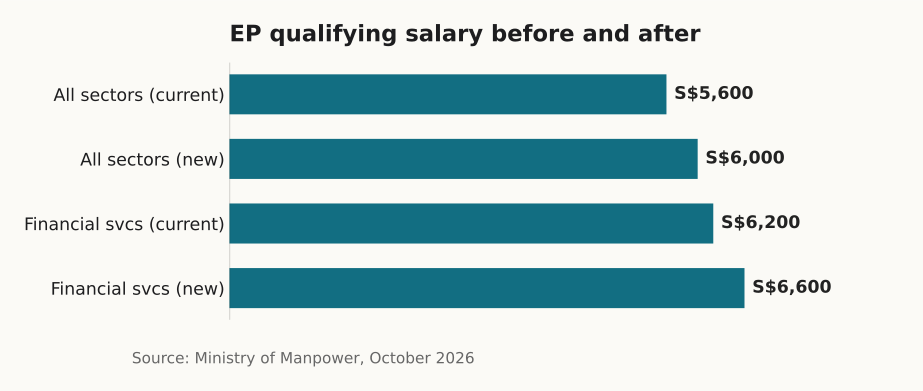
Minimum monthly EP qualifying salary at the youngest age band, current versus the new floor. Source: Ministry of Manpower, October 2026.
For the Employment Pass, the minimum qualifying salary rises from S$5,600 to S$6,000 for most sectors, and from S$6,200 to S$6,600 in financial services. Because the floor scales with age, an applicant in their mid-40s will need up to S$11,500 (or S$12,700 in financial services) to qualify.
For the S Pass, the minimum climbs from S$3,300 to S$3,600 in general sectors and from S$3,800 to S$4,000 in financial services, rising with age to as much as S$5,100 (S$5,650 in financial services).
What it means for families
Rising pass salaries do more than affect your own eligibility — they move the goalposts for bringing your family to Singapore. To sponsor a Dependant’s Pass (for a spouse or child) or a Long-Term Visit Pass (for parents or a common-law spouse), you must earn a fixed monthly salary of at least S$6,000. That S$6,000 family threshold sits above the entry-level EP floor, so a newcomer on the minimum EP salary cannot yet bring dependants until their pay rises.
As the EP floor itself moves toward and past S$6,000 for older applicants, the two numbers increasingly overlap — but the family threshold is assessed on your salary alone, not combined household income. If family reunification is part of your plan, treat S$6,000 as the real target, not the headline pass minimum.
Employer-side changes: levies and the local wage floor
Some Budget measures never touch your pass directly but change how willing employers are to sponsor you. The Local Qualifying Salary (LQS) — the minimum a firm must pay its local staff for them to count toward its foreign-worker quota — rose from S$1,600 to S$1,800 a month from 1 July 2026 (part-timers at least S$10.50 an hour). And Work Permit levies for basic-skilled (R2) workers in the marine shipyard and process sectors are set to rise from 2028, though higher-skilled (R1) rates are unchanged.
Taxes newcomers still pay
Here is the asymmetry that catches people out: newcomers are outside the relief but fully inside the taxes.
- GST stays at 9% on almost everything you buy, with no voucher offset for non-citizens. The citizen GST Voucher scheme that cushions the rate is not open to you.
- Property duties are steepest for newcomers. A foreigner pays 60% Additional Buyer’s Stamp Duty (ABSD) on any residential property; a PR pays 5% on a first home (then 30% on a second). Those rates have stood since 27 April 2023 and Budget 2026 did not change them.
For how income tax treats you, see our guide to income tax for newcomers.
New PRs: what you share in, what you don’t
Becoming a PR moves you partway in. You now contribute to and draw on CPF (at graduated rates for your first two years — see CPF for new PRs), you pay a lower 5% ABSD on a first home, and you can access some universal public services. But PRs remain outside the citizen-only Budget payouts — no CDC vouchers, no Cost-of-Living Special Payment, no CPF top-ups tied to citizenship. If you are weighing the step, read our overview of applying for PR and budget your household as though the annual Budget “goodies” will not reach you.
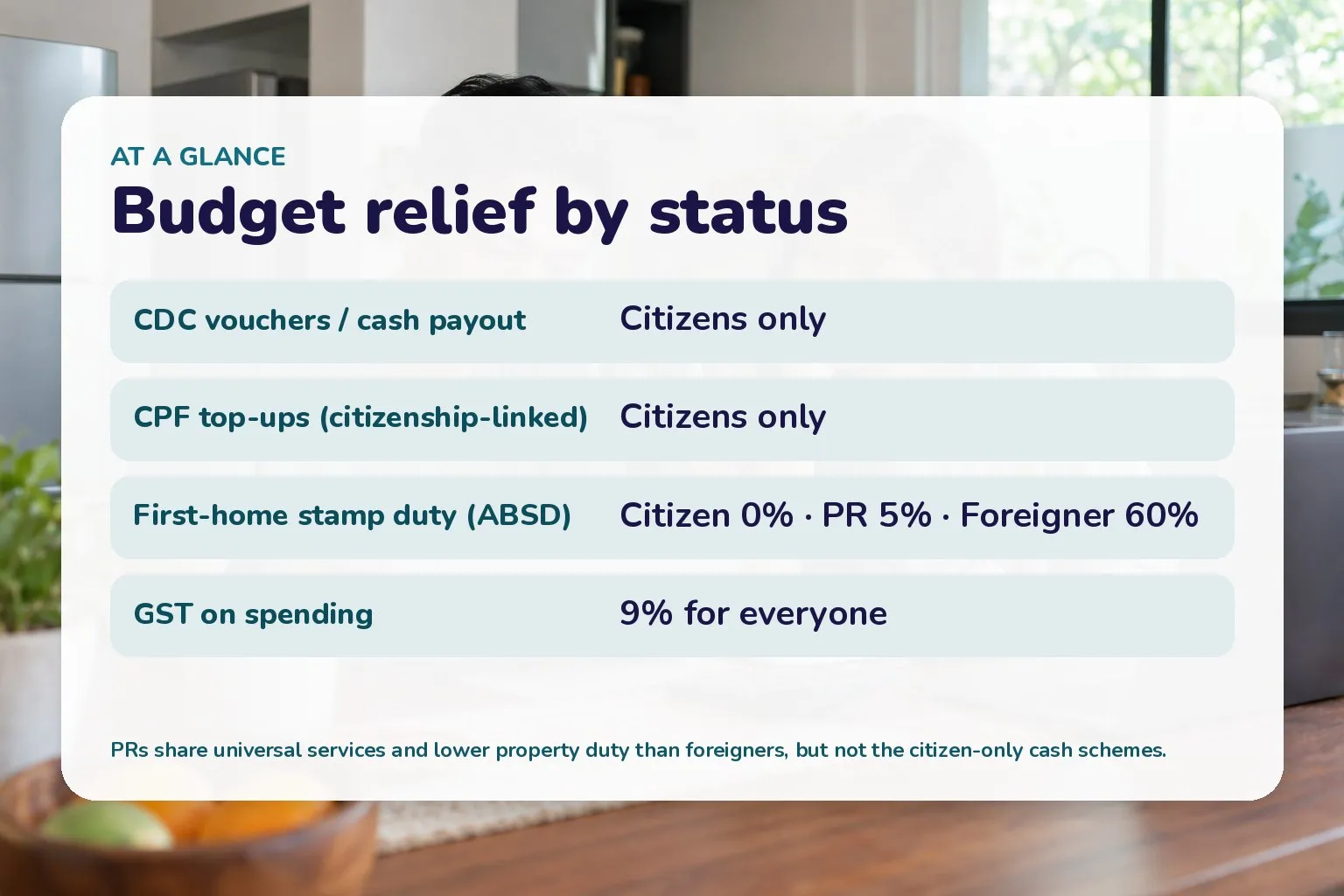
Who Budget 2026 support reaches, by resident status.
Frequently asked questions
Do EP or S Pass holders get CDC vouchers or the cash payout? No. Those are for Singapore citizens (and some for citizen households). Work-pass holders and their dependants are not eligible.
I’m renewing my EP in 2027 — do I need the new S$6,000 salary? Only if your pass expires on or after 1 January 2028. Renewals of passes expiring before then are assessed on the current floor; new applications from 1 January 2027 use the new one.
Does the Budget make it harder to bring my spouse over? Not directly, but the Dependant’s Pass threshold remains S$6,000 of monthly salary. As pass salaries drift upward over time, more newcomers will clear it — but it is still assessed on your pay alone.
As a PR, do I get any Budget relief? You share in universal services and pay lower property duty than a foreigner, but the signature Budget cash schemes are citizen-only.
Did GST or property stamp duty change in Budget 2026? No. GST remains 9% and the 60% foreigner / 5% PR first-home ABSD rates are unchanged. Confirm current figures on IRAS before transacting.
Related
If the pass rules themselves are your next question, start with Employment Pass eligibility and the S Pass explained, and if children are joining you, our guide to childcare and preschool for newcomers sets out what you will actually pay.
General information only, drawn from gov.sg, the Ministry of Manpower and IRAS, with the date each figure was checked. We are not an immigration or tax adviser. Rules and rates change — confirm the current position on the official pages for your own situation.
Sources
- Singapore Budget 2026 — Government of Singapore (gov.sg) (as of October 2026)
- Budget 2026 Measures (eligibility) — GovBenefits, Government of Singapore (as of October 2026)
- Eligibility for Employment Pass (qualifying salary) — Ministry of Manpower (as of October 2026)
- Eligibility for S Pass (qualifying salary) — Ministry of Manpower (as of October 2026)
- Eligibility for Dependant's Pass — Ministry of Manpower (as of October 2026)
- Goods and Services Tax (GST) rates — Inland Revenue Authority of Singapore (as of October 2026)
- Stamp Duty rates (ABSD) — Inland Revenue Authority of Singapore (as of October 2026)