Sending Money Overseas from Singapore

Send money overseas from Singapore only through a MAS-licensed provider — a bank or a licensed remittance company. Check its licence on the MAS Financial Institutions Directory before you pay, compare the fee and exchange rate, and keep the receipt.
On this page11 sections · tap to jump
- 01What remittance means here
- 02Who is allowed to send your money
- 03How to check a provider is licensed
- 04Why licensing protects you
- 05Banks, remittance companies and apps
- 06What it costs
- 07Limits and the destination’s rules
- 08The China lesson: use banks or card networks
- 09If something goes wrong
- 10Avoiding scams and unlicensed operators
- 11Frequently asked questions
Few things matter more to newcomers than getting money home — rent for a property abroad, support for family, or savings back to your own account. Singapore has a crowded market of banks, remittance companies and transfer apps, and most are perfectly safe. The job is to pick a licensed one, understand what you are really paying, and avoid the specific traps that have cost people their money. This guide stays neutral: no provider is recommended, and every rule comes from the Monetary Authority of Singapore (MAS) or the authorities.
What remittance means here
Sending money from Singapore to someone overseas is an outward remittance — formally a cross-border money transfer. The reverse, money coming in, is an inward remittance. You can do it through a bank’s telegraphic transfer, a dedicated remittance company with shop counters, or a digital app, and the mechanics are similar: you hand over Singapore dollars (plus a fee), and the recipient is paid in their currency at the other end.
What makes it safe or risky is not the format but whether the provider is licensed — and how the money actually travels to the destination.
Who is allowed to send your money
In Singapore, payment services are regulated by MAS, which licenses and supervises payment service providers — including remittance (cross-border money transfer) businesses. Under the Payment Services Act, a provider must be licensed by MAS to offer cross-border money transfers, and carrying on such a business without a licence is an offence. Licensees also have to follow anti-money-laundering rules and are required to issue you a receipt for the transaction.
That is why a licensed bank or remittance company is the baseline. An operator working without a licence is not just cheaper-looking — it is operating illegally and outside the consumer safeguards the law builds in.
How to check a provider is licensed
MAS publishes the Financial Institutions Directory precisely so you can check before you pay. MAS’s own guidance is to verify the institution and deal only through official channels before transferring money, and, if in doubt, check its official contact details on its website or the MAS Financial Institutions Directory.
To confirm a remittance provider, search its name in the directory and look for a payment-institution licence covering cross-border money transfer. Do this once for any new provider, and always reach it through its official app or website rather than a link someone sends you.
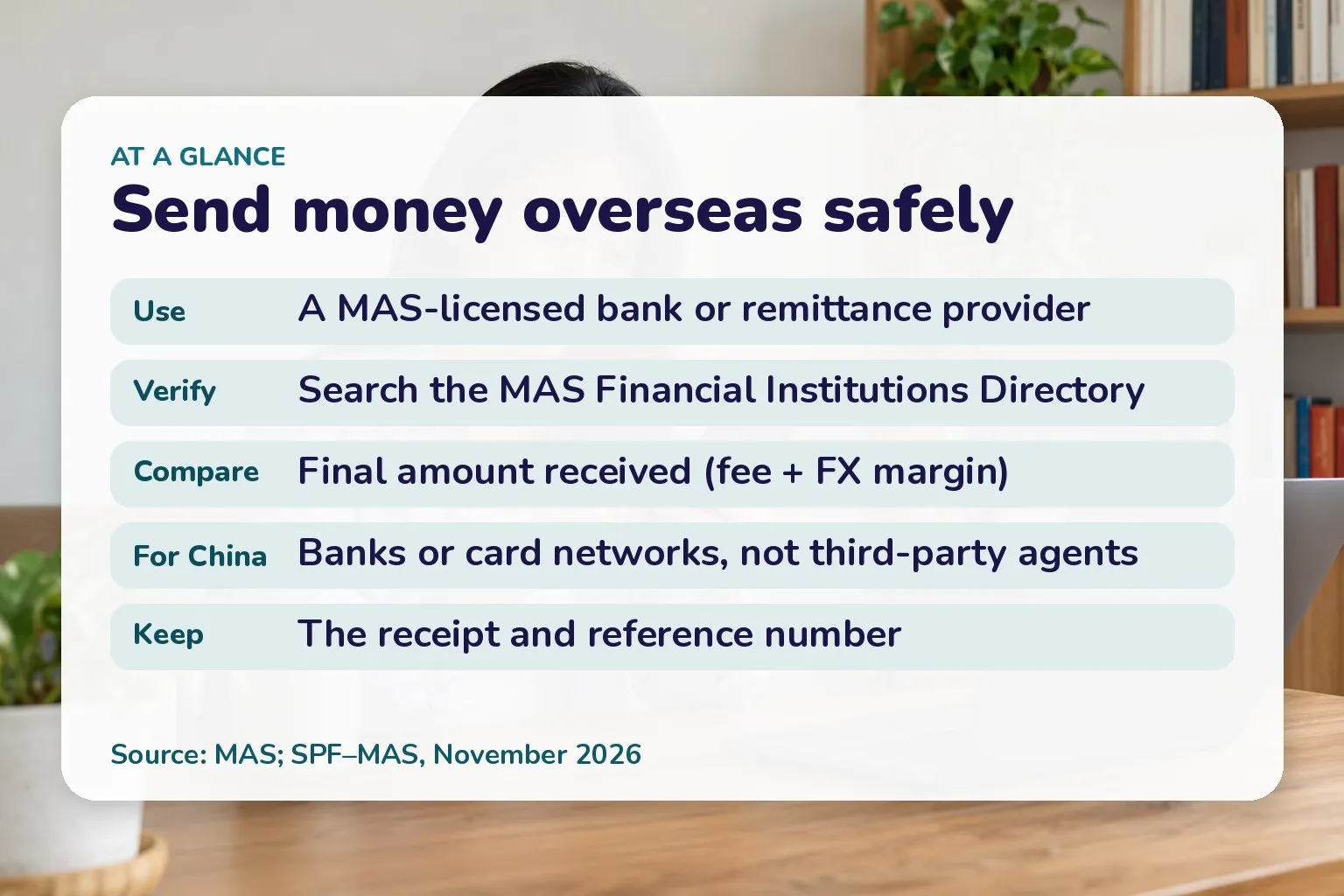
A quick safety check before any transfer.
Why licensing protects you
Licensing is not red tape for its own sake. A licensed provider is supervised by MAS, must keep anti-money-laundering controls, and must give you documentary proof of the transfer. If a licensed provider fails you, there is a regulator to complain to and a paper trail to rely on. With an unlicensed operator, you typically have neither — and recovering money is far harder.
Banks, remittance companies and apps
All three can be licensed; they differ in experience, not in whether they are regulated.
- Banks (through telegraphic transfers or their apps) are convenient if you already bank here — see opening a bank account — but often carry higher per-transfer fees and wider exchange-rate margins.
- Remittance companies keep physical counters, which helps if you prefer cash or in-person service, and frequently offer sharper rates on popular corridors.
- Transfer apps are app-only, usually show the fee and rate upfront, and suit regular, smaller transfers.
Choose on total cost, speed and the corridor you actually use — not on brand familiarity.
What it costs
Your real cost has two parts: the upfront fee and the exchange-rate margin (the gap between the rate you get and the mid-market rate). A provider can advertise “no fees” while taking its cut in the rate, so compare the final amount your recipient receives for the same Singapore-dollar send, on the same day, across two or three providers. Speed varies too — some corridors settle within hours, others take a few business days. Because these figures are set by each provider and change constantly, check them in the provider’s own app at the moment you send rather than relying on any quoted “typical” number.
Limits and the destination’s rules
There is no single MAS cap you need to memorise for personal transfers, but two practical limits apply. Your bank or app sets its own transfer limits, which you may be able to raise in-app. And the receiving country may impose its own controls or limits on incoming transfers — some set daily or per-transaction ceilings, or restrict certain channels. Check the destination country’s rules (and ask your recipient’s bank) before sending a large or time-sensitive amount.
The China lesson: use banks or card networks
The clearest real-world warning came in December 2023. The Singapore Police Force and MAS reported that, as of 15 December 2023, there were more than 670 reports of remittances being frozen, totalling around $13 million, after money sent to beneficiaries in China was frozen by PRC law enforcement. The affected transfers had been routed through overseas third-party agents rather than a direct bank transfer, to keep costs low.
The authorities’ advice was blunt: remittances into China should be made through channels such as banks and card networks to prevent inadvertent freezing. MAS directed remittance companies to use only banking and card channels for remittances to China from 1 January 2024 — initially for three months and reviewed after that — allowing only a bank, a card-network operator such as UnionPay International, or a licensed financial institution acting through them.
If something goes wrong
Keep your transaction receipt and reference number for every transfer; a licensed provider must give you one. If the recipient does not receive the money, contact the provider first — in the China cases, MAS had providers issue a confirmation letter on request to prove the funds were sent, which helped unfreeze accounts. If you suspect a scam or cannot resolve it, make a police report.
Avoiding scams and unlicensed operators
Treat remittance like any other money decision: verify first, pay second. Use only providers you have confirmed on the MAS directory, reach them through official channels, be wary of “agents” messaging you with special rates, and never route money through someone’s personal account on a stranger’s instruction. Settling other first-week money tasks? See opening a bank account and, if you earn here, income tax for expats.
Frequently asked questions
How do I know a provider is licensed? Search its name in the MAS Financial Institutions Directory and look for a payment-institution licence covering cross-border money transfer; reach the provider through its official site or app.
Is a bank or a remittance app cheaper? It depends on the corridor. Compare the amount the recipient receives for the same send on the same day — that captures both the fee and the exchange-rate margin.
Can I send unlimited amounts? There is no single MAS personal cap, but your provider sets limits and the receiving country may restrict incoming transfers — check both first.
Is sending to China still restricted? The 2023 direction to use only bank and card channels was a temporary measure; regardless, the standing advice is to send to China through banks or card networks rather than third-party agents.
General information only, from MAS and the Singapore Police Force, with the date each point was checked. We recommend no provider and give no financial advice; confirm a provider’s licence on the MAS Financial Institutions Directory and check current fees on the provider’s own channels.
Sources
- MAS Financial Institutions Directory — Monetary Authority of Singapore (as of November 2026)
- Singapore Government working with PRC Government and remittance companies (frozen remittances to China) — Singapore Police Force and Monetary Authority of Singapore (as of November 2026)
- Payment Service Providers — Monetary Authority of Singapore (as of November 2026)
- Payment Services Act — Monetary Authority of Singapore (as of November 2026)
- Guide to the Payment Services Act 2019 — Monetary Authority of Singapore (as of November 2026)