Getting Married in Singapore as a Foreigner

To marry in Singapore as a foreigner, at least one party must spend 31 continuous days here before applying to the Registry of Marriages, give 21 days' notice, and pay S$42 if one partner is a citizen or PR, or S$380 if both are foreign.
On this page9 sections · tap to jump
- 01Who can marry in Singapore
- 02The 31-day residency rule for foreigners
- 03The timeline: notice period and validity
- 04Fees
- 05Documents, witnesses and declarations
- 06If a work-pass holder marries a citizen or PR
- 07Staying after the wedding: PMLA and the LTVP
- 08The Muslim marriage track (ROMM)
- 09Frequently asked questions
Plenty of couples who move to Singapore end up marrying here — sometimes two foreigners, sometimes a foreigner and a local. The process is efficient and largely online, but there is one rule newcomers trip over (a month-long residency step) and some stale advice floating around the web. This guide sets out the current position for a civil marriage at the Registry of Marriages (ROM), the Muslim track at the Registry of Muslim Marriages (ROMM), and what it takes for a foreign spouse to stay afterwards.
Who can marry in Singapore
The baseline conditions are straightforward. Both parties must be at least 21 years of age, and neither party may be presently married — a previous marriage must be legally dissolved first. A party who is 18 to 20 needs parental or guardian consent and must attend a marriage preparation programme; anyone below 18 also needs a Special Marriage Licence.
Which registry you use depends on religion, not nationality. The Ministry of Social and Family Development explains that the ROM administers civil marriages under the Women’s Charter where at least one party is non-Muslim, while the ROMM administers Muslim marriages where both parties are Muslims under the Administration of Muslim Law Act. Most expat couples use the ROM; we cover the ROMM separately below.
The 31-day residency rule for foreigners
This is the step that catches people out. Where either party is not a Singapore citizen or PR, the current ROM rule requires at least one of them to be physically present in Singapore for at least 31 continuous days before a marriage application can be submitted. Usefully, those 31 days need not fall immediately before you apply — they can be a single past trip to Singapore, as long as the stay was continuous.
Beware older guidance. A legacy government solemnisation article still states a “15 days” presence rule; the up-to-date ROM guide (updated October 2026) sets it at 31 continuous days. Use the 31-day figure and confirm it on ROM’s own page before you plan travel around it.
The timeline: notice period and validity
Marriage in Singapore runs on a notice system. You submit a marriage application (the notice), and there is a minimum 21-day notice period before you can solemnise — so if you file in early October, the earliest ceremony date is about three weeks later. You can plan ahead, too: the earliest you can submit is 6 months before the solemnisation, and the application carries a 6-month validity period, after which it lapses.
Fees
The civil application fee depends on nationality, and the gap is large. ROM charges S$42 where at least one party is a Singapore citizen or PR, and S$380 where both parties are foreigners. Payment is by card or eNETS online, or NETS at an ROM counter. If you later need to change solemnisation details, a S$25 fee applies.
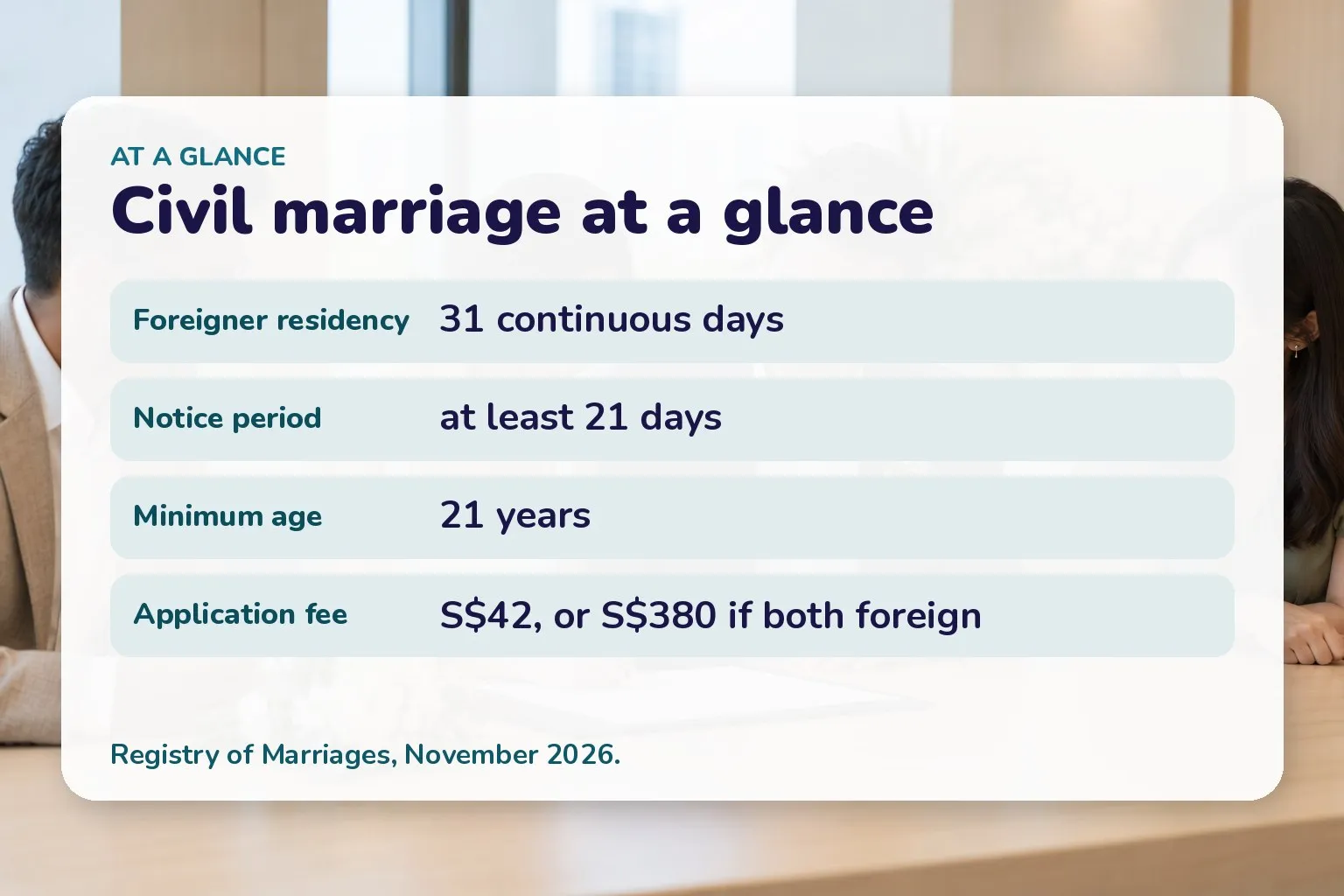
Key civil-marriage rules for foreign couples.
Documents, witnesses and declarations
For a civil marriage you need the NRIC (for citizens or PRs) or passport (for foreigners) of the groom, the bride and two witnesses above 21. The ceremony can take place at ROM with an in-house solemniser, or at a venue of your choice with a licensed solemniser whose consent you arrange first.
How you make your statutory declaration depends on your paperwork. Couples can declare online only if both are 21 or older, it is a first marriage for both, the solemnisation is at least 21 days after the application, and the application was submitted jointly using Singpass. In practice, that excludes many expat couples: ROM states that where foreign documents are involved, or one party has no Singpass, you must make the declaration in person at ROM. After the solemniser registers the marriage, your digital certificate of marriage — the official legal record — is emailed to you. If you are still setting up your government login, see our guide to setting up Singpass.
If a work-pass holder marries a citizen or PR
One approval step applies only to the lowest work-pass tier. A Work Permit holder — current or former — needs the Controller of Work Passes’ approval before marrying a Singapore citizen or PR, regardless of the type of marriage (civil, religious or customary); skipping it can cost their work privileges and entry to Singapore. By contrast, MOM states you do not need to seek approval if you now hold an Employment Pass or S Pass. Where approval is needed, MOM emails the outcome within 4 weeks of receiving all the documents.
Staying after the wedding: PMLA and the LTVP
A wedding is not an immigration pass. ICA is explicit that marriage to a Singapore citizen does not automatically guarantee a foreign spouse entry or long-term stay. The intended route for most foreign spouses is a Long-Term Visit Pass (LTVP), applied for after marriage.
Before you marry, do the free Pre-Marriage LTVP Assessment (PMLA). It checks the intended spouse’s chances and, crucially, speeds the later LTVP to about 6 weeks instead of 6 months. A positive assessment comes with a Letter of Eligibility valid to apply for the LTVP within 1 year, and the PMLA itself is processed within 1 month. For how the pass then works — including the stronger LTVP+ for spouses of citizens and the right to work on a Letter of Consent — see our Long-Term Visit Pass guide. Many couples who settle later consider applying for permanent residence.
The Muslim marriage track (ROMM)
If both parties are Muslim, you marry through the ROMM, not the civil ROM. The ceremony is solemnised by a Kadi or Naib Kadi, and the marriage needs the consent of the bride’s wali (guardian), who must be present. As with civil marriages, both parties must be at least 21, the earliest solemnisation is 21 days after submitting the application, and couples receive a digital certificate of marriage. The ROMM process also involves a face-to-face session with your Kadi and customary elements such as the maskahwin and hantaran, which are agreed between the families. Confirm the current steps on the ROMM pages, as some details are case-specific.
Frequently asked questions
Can two foreigners marry in Singapore? Yes. Two foreigners can marry at ROM, but at least one of them must have been physically present in Singapore for 31 continuous days before applying, and the fee is S$380.
One of us was divorced — can we still marry? Yes, provided the earlier marriage is legally dissolved. You bring the divorce certificate (or the late spouse’s death certificate) and declare any maintenance orders.
Do we both need to be in Singapore the whole time? No. Only one party needs the 31 continuous days, and they can be a past single trip. But both of you (and two witnesses) must attend the solemnisation.
Is a Certificate of No Impediment required? Some countries’ own laws ask their nationals to produce one before marrying abroad; ROM itself does not issue it. Check with your embassy whether your home country expects it.
How soon can we actually get married? At the earliest, about 21 days after you file the application — the minimum notice period — subject to meeting the residency and document rules.
General information only, from ROM, MSF, ICA and MOM, with the date each rule was checked. We are not a marriage agent or immigration agent; confirm the current rules on the official ROM, ROMM and ICA pages for your own case.
Sources
- Overview of Marriage Process (Civil) — Registry of Marriages (Our Marriage Journey) (as of November 2026)
- Registering & Solemnising Your Marriage — Ministry of Social and Family Development (as of November 2026)
- Pre-Marriage Long-Term Visit Pass Assessment (PMLA) — Immigration & Checkpoints Authority (as of November 2026)
- Marriage and pregnancy regulations for Work Permit holders — Ministry of Manpower (as of November 2026)
- Muslim marriage process (ROMM) — Registry of Muslim Marriages (Our Marriage Journey) (as of November 2026)